
 By Lina Irawan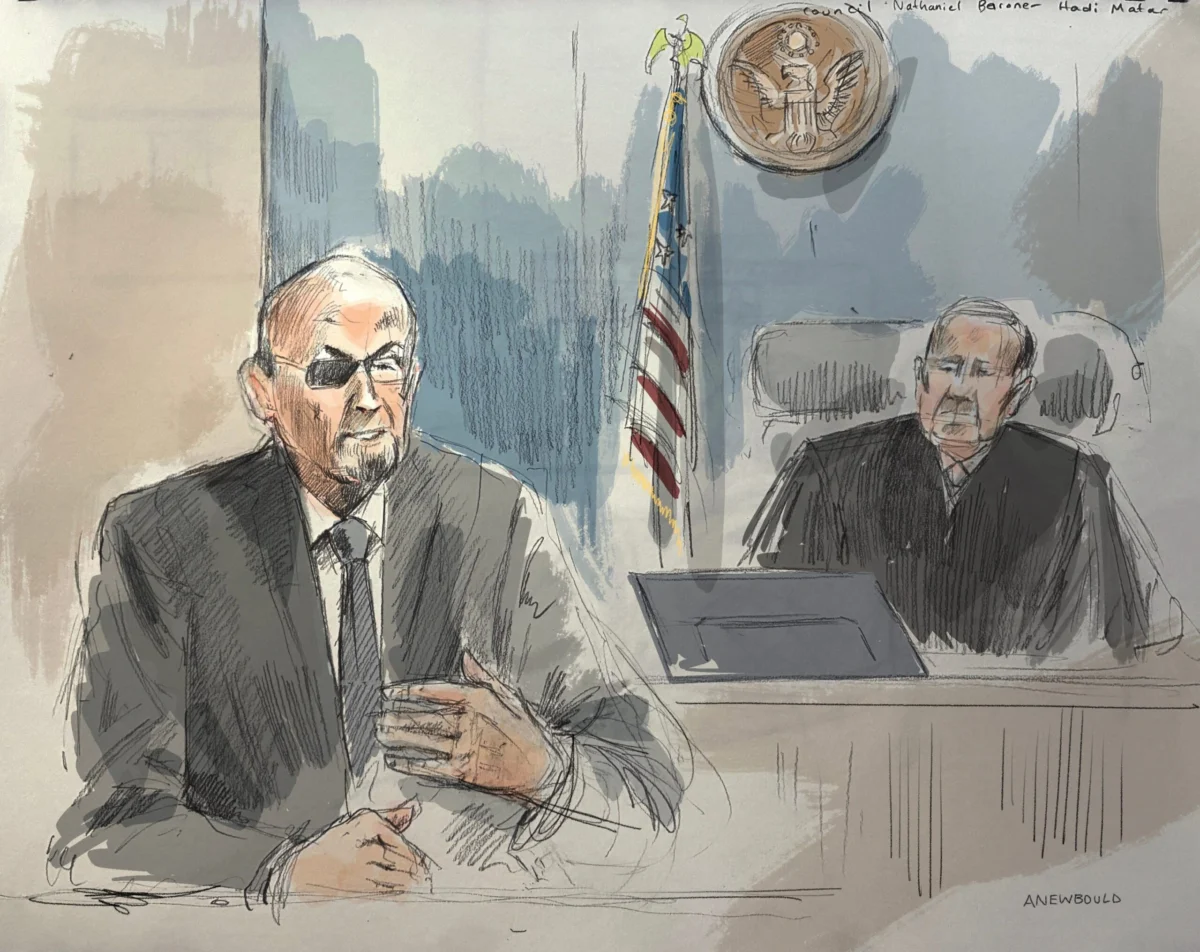
Four years after the horrific ambush that nearly claimed his life, literary icon Salman Rushdie returned to a courtroom, confronting his convicted attacker, Hadi Matar, in a Buffalo federal court on Thursday. In a deeply poignant and chilling testimony, the prize-winning writer recounted for a second time the brutal assault on an amphitheater stage that left him profoundly wounded and permanently scarred. The hearing marked a critical juncture in Matar’s federal terrorism trial, underscoring the enduring shadow of a decades-old religious edict and the unwavering resilience of a voice that refused to be silenced.
Rushdie, now 79, described the initial moments of the attack with a vivid clarity that belied the passage of time. He recalled feeling what he initially mistook for a "punch" beneath his chin, a sensation quickly followed by the harrowing realization of blood gushing from his neck. The scene rapidly escalated into a nightmare: "Soon I was on the stage, lying down, with an enormous pool of blood all around me," Rushdie testified, his voice composed but firm. He emphasized the sheer volume of his life force spilling out, describing it as "an enormous and expansive lake of blood." The Buffalo federal court jury watched, transfixed, as Rushdie delivered his hour-long testimony, at one point removing his glasses to reveal his now sightless right eye – a stark, physical manifestation of the violence he endured.
The attack, which unfolded in August 2022 at the venerable Chautauqua Institution in western New York, sent shockwaves across the globe. Rushdie had been poised to deliver a speech on the vital topic of threats to writers and artists, a cruel irony given the events that immediately followed. Matar, then 24, had rushed the stage, approaching the author from behind, and proceeded to stab him 15 times before spectators and another speaker, Henry Reese, could intervene and restrain him. Law enforcement officers assigned to the event swiftly arrested Matar. The attack left Rushdie with devastating injuries: permanent blindness in his right eye, severe damage to his liver, temporary paralysis of his left hand, and a period on a ventilator. He famously stated during his testimony, "The knife was a millimeter from my brain," illustrating the terrifying proximity to a fatal wound.
This federal trial for terrorism comes after Matar was already convicted of a state-level attempted murder charge in the same incident, for which he is currently serving a 25-year state prison sentence. Federal prosecutors are now seeking to prove that Matar’s actions were an act of transnational terrorism, directly motivated by an allegiance to Iran’s government and the Iranian-backed Hezbollah militant group. They contend that Matar was acting on the infamous 1989 fatwa, or religious edict, issued by Iran’s late Ayatollah Ruhollah Khomeini, which called for Rushdie’s death over his novel "The Satanic Verses." Rushdie himself, when questioned by the defense about Matar’s potential ties to terrorism, responded, "I had no knowledge, but I had my suspicions."
The controversy surrounding "The Satanic Verses" has cast a long and perilous shadow over Rushdie’s life for more than three decades. Published in 1988, the novel includes a dream sequence involving Islam’s Prophet Muhammad that some Muslims deemed blasphemous. The backlash was immediate and fierce, leading to book burnings, violent protests across several countries, and attacks on translators and publishers of the book. Khomeini’s fatwa, issued in February 1989, transformed the literary dispute into a global death sentence, forcing Rushdie into nearly a decade of hiding under constant police protection, living under pseudonyms and enduring an existence largely cut off from public life. Though the Iranian government later distanced itself from the fatwa in 1998, the edict was never officially repealed, and a bounty on Rushdie’s head remained. Despite this enduring threat, Rushdie had gradually re-emerged into public life, believing the immediate danger had subsided. "For two decades or more, I led a public life without a hint of trouble," he testified Thursday, a statement that tragically underscores the sudden and brutal re-ignition of the threat he had lived under for so long.
During the federal trial, Matar, 28, maintained a largely impassive demeanor, often looking down at the defense table, conversing with his lawyer, or resting his hand on his chin. He only glanced toward Rushdie as the author exited the courtroom, a gaze Rushdie reportedly did not return, if at all. Matar’s defense lawyer, Nathaniel Barone, focused his cross-examination on Rushdie’s awareness of potential "blowback" from "The Satanic Verses." Rushdie’s sharp retort — "Probably, but I don’t believe the book to be on trial here. I believe someone else is on trial" — was, at Barone’s request, struck from the court transcript by the judge, highlighting the defense’s strategy to divert focus from Matar’s direct culpability to the historical context of the controversy.
Prosecutors have meticulously built their case around Matar’s alleged motivations. Assistant U.S. Attorney Timothy Lynch stated in his opening remarks that Matar was animated partly by comments made in 2006 by the late Hassan Nasrallah, a former leader of Hezbollah, regarding Rushdie and the enduring fatwa. Matar, who holds dual citizenship in the U.S. and Lebanon – where Hezbollah is based – reportedly underwent a significant personality shift after a 2018 trip to Lebanon, becoming moody and withdrawn, according to his mother. Lynch presented compelling evidence, including Matar’s personal notes from 2020 where he explicitly wrote, "We need to kill him ASAP," casting the intended killing as part of a "jihad," or holy war. Further evidence from Matar’s New Jersey bedroom and electronic devices revealed photos and other material demonstrating his admiration for Hezbollah, which the U.S. government designates as a terrorist organization. He even carried a fake driver’s license bearing a name similar to that of a Hezbollah figure.
The defense, however, argues that the prosecution is asking jurors "to connect the dots" without concrete evidence of Matar’s precise intent or mindset at the moment of the attack. They have questioned witnesses about the security arrangements at the Chautauqua Institution, implying that the relatively light security—a state trooper and a sheriff’s deputy assigned to the event—suggests that the immediate threat was not widely perceived, even by those responsible for Rushdie’s safety. This line of questioning attempts to undermine the prosecution’s claim that Matar was directly and consciously executing a decades-old terrorist directive. While Matar declined to testify at his state court trial, his lawyer, Barone, indicated outside court on Thursday that he might choose to do so in the federal proceedings, a decision that could dramatically alter the trial’s trajectory. If convicted of federal charges, which include engaging in an act of transnational terrorism, Matar faces a potential life sentence, a stark contrast to his current 25-year state prison term.
The attack on Salman Rushdie transcended a personal assault; it became a chilling symbol of the ongoing struggle for free speech and artistic expression in the face of religious extremism and political violence. The Chautauqua Institution, a revered sanctuary for open dialogue and cultural exchange, was violated in a manner that underscored the fragility of such freedoms. For many, Rushdie’s survival and his continued commitment to writing, even after such trauma, represent a profound act of defiance against those who seek to silence dissent through terror. His memoir detailing the attack and recovery, and his continued literary output, including his recent collection "The Eleventh Hour," serve as testament to his indomitable spirit.
Rushdie, born in India and raised in Britain before becoming a U.S. citizen, is a literary titan, having won the Booker Prize in 1981 for his acclaimed novel "Midnight’s Children." His work has consistently explored themes of migration, identity, and the clash of cultures, often with a magical realist sensibility. The attack on him not only reignited the debate around the fatwa’s lasting power but also sparked renewed discussions about the responsibilities of authors, the limits of free speech, and the global interconnectedness of extremist ideologies. Although Iran’s government denied involvement in the 2022 stabbing, its Foreign Ministry’s then-spokesperson disturbingly suggested Rushdie had invited the trouble by insulting Islam, echoing the original justification for the fatwa. Hezbollah’s Nasrallah notably remained silent on the attack, leaving his alleged influence on Matar to be inferred from circumstantial evidence.
As the federal trial unfolds, the world watches, not just for the verdict on Hadi Matar, but for the broader implications it holds for the defense of free expression, the long arm of historical grievances, and the enduring courage required to speak truth to power. Rushdie’s testimony is not merely a recounting of a personal tragedy; it is a powerful affirmation of the values he has championed throughout his extraordinary and often perilous life.
