
 By Lina Irawan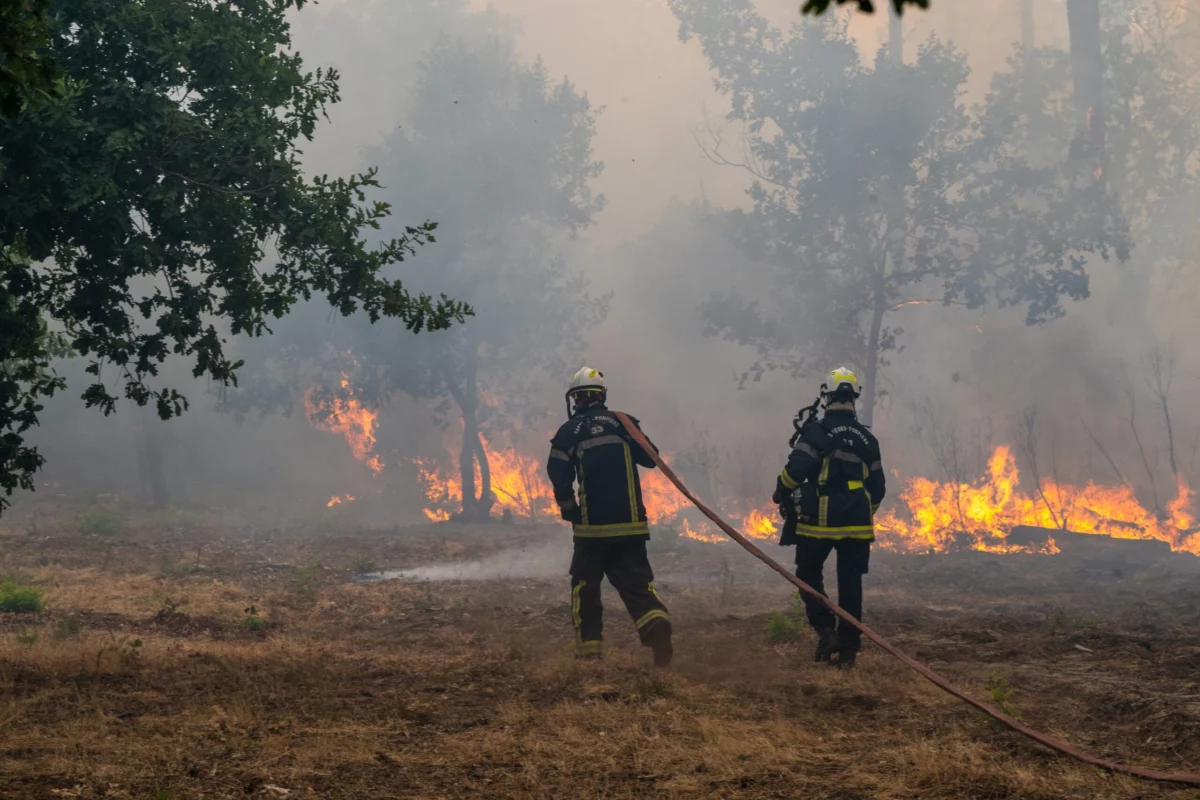
The latest wildfires sweeping across Southern Europe this week have collectively displaced more than 250,000 people, painting a grim picture of communities uprooted and livelihoods threatened. Among those affected, a staggering 70,000 individuals were evacuated in central Spain alone, highlighting the widespread nature of the crisis. Tragically, the human cost began to mount, with one man reported dead in Manises, a municipality in Spain’s Valencia region, marking the first confirmed fatality linked directly to these devastating blazes. This loss served as a stark reminder of the mortal danger posed by these rapidly advancing infernos, which often move with a speed and ferocity that defy conventional firefighting tactics.
In France, the colossal A400M military transporter, typically used for cargo and troop deployment, swooped low over the parched landscapes of the southwest. From its belly, a long, distinctive plume of ochre-colored retardant streamed out, blanketing drought-hit woodlands in a desperate attempt to slow the flames. On the ground, exhausted fire crews fought relentlessly against the encroaching inferno, which authorities gravely feared could spread towards the historic and economically vital wine region city of Bordeaux. The deployment of the A400M, a heavy-lift aircraft adapted for aerial firefighting, signaled the gravity of the situation, as it represented a significant escalation in the resources being thrown at the fires, supplementing the smaller, more agile water-bombing planes.
The pervasive nature of the crisis was further emphasized by the announcement from Tour de France organizers and the Paris police department regarding a truncated 21st and final stage for the prestigious three-week cycling event. France’s most famous annual sporting spectacle, a cultural touchstone watched by millions globally, was forced to adapt in a manner reflecting the immense pressure that two massive fires in the southwest were exerting on the nation’s emergency services. The decision to shorten the final stage was not merely a logistical adjustment but a powerful symbol of the nation’s collective focus shifting from celebration to crisis management.
Instead of the originally planned 133-kilometer (82.5-mile) route starting from Thoiry, west of the capital, Tour riders would race a significantly shortened circuit of 89 kilometers (55 miles) entirely within Paris on Sunday. This reduction by a third was a direct consequence of the need to reallocate critical personnel. A substantial portion of the race’s extensive security detail, comprising police, gendarmerie, and other emergency responders, would instead be redirected to "reinforce the response efforts in the areas affected by the wildfires," according to the official statement. These "exceptional measures made necessary by the situation" underscored the unprecedented nature of the challenge, where even a world-renowned event had to yield to the urgent demands of a national emergency.
Shifting Winds Raise Concerns for Bordeaux and the Gironde Region
The battle against the flames intensified with predictions of shifting winds. French Interior Minister Laurent Nunez articulated profound concerns that a west-to-east wind shift on Saturday afternoon could potentially drive the ravenous flames closer to Bordeaux. In response, fire crews and authorities worked tirelessly, digging trenches, deploying retardants, and implementing other blaze-blocking measures in a desperate race against time. Nunez grimly predicted a "long and very difficult" battle ahead, acknowledging the formidable challenge posed by the conflagration. While the fire had lost some intensity overnight and was approximately 30 kilometers (20 miles) west of Bordeaux, the prefect of the Gironde region, Sophie Brocas, cautioned that the blaze, which had grown into a "firestorm" on Friday after igniting earlier in the week, "remains dangerous" despite firefighters making some progress.
The sheer scale and ferocity of the fires in Gironde prompted the government to mobilize soldiers, deploying them alongside exhausted fire crews. Furthermore, a massive logistical effort was underway to rush 1.5 million face masks to the affected regions, an essential measure to protect residents and responders from the choking, noxious smoke that blanketed the skies. Authorities issued urgent evacuation orders for people situated between the advancing fire front and Bordeaux, extending to parts of the city’s western suburbs and numerous other towns and villages. These orders were disseminated via special alerts to mobile phones, ensuring direct and immediate communication to residents, instructing them to leave their homes for safety. Prefect Brocas confirmed the devastating toll, reporting that the fire had already consumed approximately 140 homes in the region, turning them into ashes and rubble.
Prime Minister Sébastien Lecornu characterized the fires as "unprecedented," emphasizing that the Gironde blaze had become so powerful on Friday that it had begun generating its own localized winds, a phenomenon known as pyrocumulus, which can further fuel and spread the fire in unpredictable ways. He reiterated the reinforcement of firefighting teams with hundreds of soldiers and the urgent provision of breathing masks, designed to filter out potentially noxious smoke particles for those exposed to the acrid air.
In Bordeaux, the regional capital, authorities sprang into action, setting up emergency shelters. Thousands of evacuees were taken in, offered food, and provided shelter in a large exhibition center. The city’s mayor indicated that the facility could be equipped to welcome as many as 10,000 people if the situation deteriorated further, underscoring the preparedness for a worst-case scenario. While the city’s airport remained operational, its vital bus and tram services were suspended, reflecting the disruption to daily life and the focus on emergency logistics.
The Magnitude of the Wildfires Caught Authorities Off Guard: A "New Normal"
The French military A400M transport plane, specially converted for firefighting duties, represented a heavyweight new tool in the ongoing battle. Its deployment joined at least 18 other water- and retardant-dropping aircraft and helicopters that Interior Minister Nunez confirmed were deployed in the Gironde region, working in continuous rotation in the smoke-filled skies. This concerted aerial assault, combined with thousands of ground personnel, highlighted the monumental effort required to combat these modern blazes.
The virulence and rapid spread of both the French and Spanish wildfires, fueled by scorching high temperatures, prolonged drought, and the long-term, undeniable effects of climate change, collectively caught fire crews and authorities off guard. Experts now increasingly refer to these events as a "new normal," as traditional firefighting strategies struggle to cope with the sheer intensity and unpredictability of these "mega-fires." Firefighters in Spain openly admitted that the blazes spread so fast and violently that they could not be tackled head-on, forcing them into defensive positions to protect communities rather than directly engaging the overwhelming fire fronts. In France, the ferocity of the flames on the Atlantic coast was such that some residents and tourists were forced to flee by boat, abandoning their homes and possessions to the advancing inferno.
The human element of the crisis was poignantly captured by Javier Organista, a resident of El Tiemblo, west of Madrid, where a revered chestnut grove was charred beyond recognition. "We’ve never seen anything like this," Organista lamented. "When we saw the flames coming into our town, surrounding us, leaving us with practically no way out, all the neighbors joined together to try to stop its advance." His words echoed the desperation and communal spirit often found in the face of such overwhelming natural disasters. "It’s just really sad," he concluded, a sentiment shared by countless others whose lives had been irrevocably altered.
Climate Change Supercharges Fires Across Europe
The scientific consensus is unequivocal: climate change is profoundly altering weather patterns, leading to more frequent, longer, and hotter heatwaves, as well as prolonged periods of drought, particularly in the Mediterranean basin. These conditions transform vast stretches of forests and scrublands into highly combustible tinderboxes, priming them for ignition and rapid, uncontrollable spread. The "successive heat waves that hit unusually early and hard this year, baking Europe with record-shattering high temperatures," are not isolated incidents but a direct manifestation of a warming planet. The Intergovernmental Panel on Climate Change (IPCC) reports have consistently warned that the Mediterranean region is a climate change hotspot, highly vulnerable to increased aridity and extreme weather events, including wildfires.
In Spain, the response was robust, with 2,600 firefighters, police, and other emergency personnel deployed to two major blazes west of Madrid, supported by 19 water-dumping aircraft and helicopters. The scale of destruction in Spain this year is alarming; Prime Minister Pedro Sánchez, during a visit to a command post west of Madrid, stated that fires had already consumed 130,000 hectares of forest. This figure is significantly higher than the annual average of 100,000 hectares recorded over the past decade, indicating an accelerated trend of land destruction. Sánchez noted that more favorable weather conditions on Saturday, including a slight drop in temperatures and winds, offered "a window of opportunity" for fire crews to gain some control over the blazes. Indeed, Madrid’s regional government later confirmed that the fires had decreased in intensity as winds subsided and temperatures moderated, offering a glimmer of hope amidst the devastation.
France mirrored Spain’s intensive efforts, deploying 1,400 firefighters to the colossal Gironde fire and hundreds more to another significant wildfire further south in the Landes region. The dangerous nature of their work was evident, with dozens of firefighters reportedly suffering injuries as they confronted the infernos. Panic scenes unfolded as townsfolk fled by car, often under police escort, with officers going door-to-door to ensure everyone evacuated safely. The sheer size and speed of these blazes, often creating their own weather systems and throwing embers miles ahead, overwhelm conventional firefighting strategies, forcing authorities to prioritize the protection of human life and critical infrastructure.
The fatality reported on Saturday in Manises, part of the wildfire-affected region of Valencia, underscored the very real and immediate danger to human life. Beyond direct burns, smoke inhalation poses significant health risks, particularly for vulnerable populations, and the long-term environmental and economic consequences are vast, including soil erosion, loss of biodiversity, and disruption to agricultural and tourism sectors.
In a powerful demonstration of European solidarity and cooperation, other nations across the continent stepped forward to offer assistance. Italy, Greece, the Netherlands, Portugal, Croatia, the Czech Republic, Sweden, Slovakia, Germany, and Switzerland were either already providing or expected to deploy crucial water-dumping planes and helicopters to bolster the Spanish and French fire fronts. This international aid, often coordinated through the European Union Civil Protection Mechanism, is vital in tackling fires of this magnitude, which often transcend national borders and require a pooled response of specialized resources. The current crisis serves as a stark reminder that as climate change continues to intensify, such collaborative efforts will become an increasingly critical component of Europe’s strategy to adapt and respond to the escalating threat of wildfires.
