
 By admin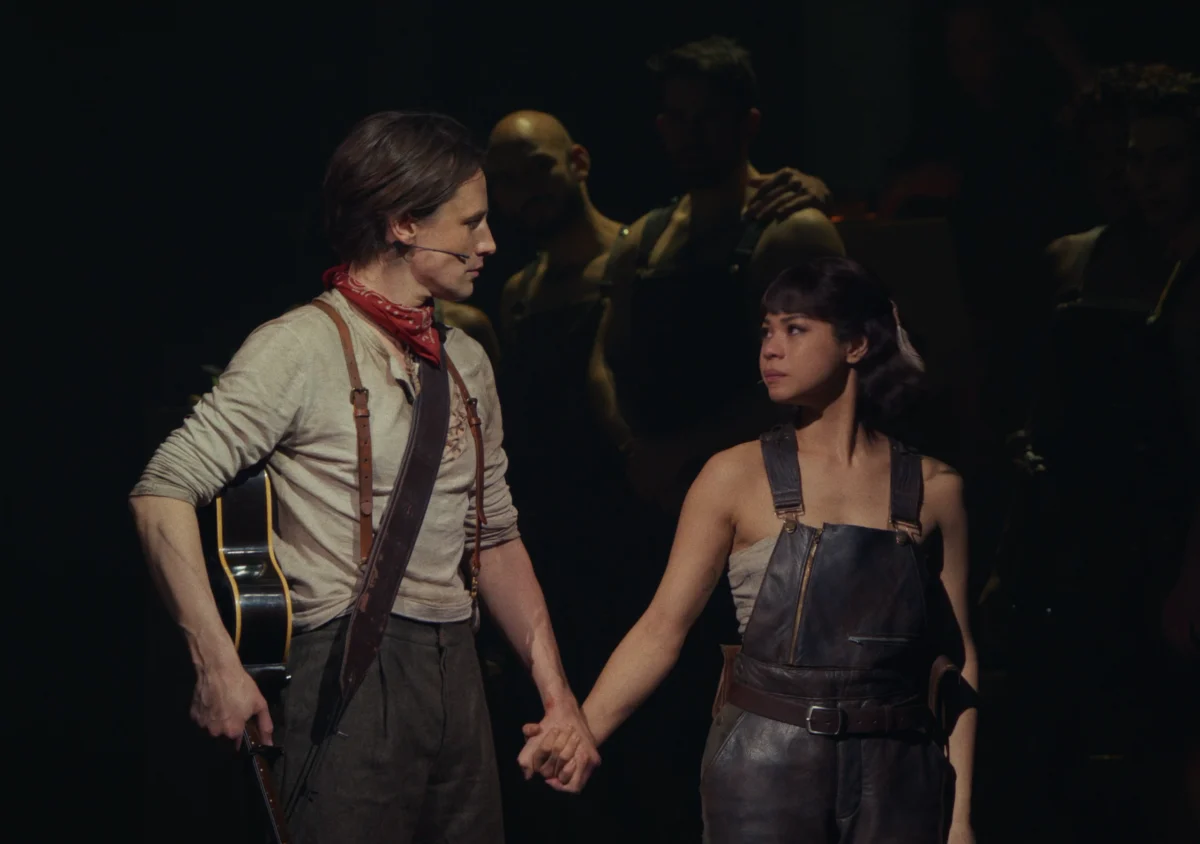
While the epic journey of Odysseus in "The Odyssey" often relegates the gods to mere background players, a current cinematic offering allows mortals and immortals to engage in profound interactions. "Hadestown: The Musical," a filmed rendition of one of the decade’s most celebrated and commercially successful Broadway productions, is making waves in theaters. Projections suggest the film will gross approximately $9 million at the U.S. box office this weekend, positioning it as the second-highest-grossing direct capture of a stage production, trailing only the theatrical release of the "Hamilton" film. This success underscores the enduring appeal of musical tragedy as a compelling counterprogramming choice, especially when the divine characters are allowed to take center stage.
"Hadestown" defies conventional Broadway expectations. Tony Award-winning actor André De Shields, who portrays the god Hermes, aptly describes it as a "folk opera." Even a basic plot synopsis, which reimagines the ancient myth of Orpheus and Eurydice, can sound esoteric by modern musical theater standards, further intensified by Anaïs Mitchell’s distinctive, sung-through score, infused with Americana influences. Despite its unconventional nature, the show boasts a fervent, almost cult-like following, particularly among younger audiences, whose adoration rivals that of "Hamilton." The cinematic adaptation, masterfully directed by Brett Sullivan, is poised to introduce this underworld narrative to a vast new audience, likely drawing devoted fans back for multiple viewings before its limited theatrical run concludes.
In anticipation of the film’s release, Variety spoke with Anaïs Mitchell, Brett Sullivan, and five original Broadway cast members who reprised their roles for the cinematic version: Reeve Carney (Orpheus), Eva Noblezada (Eurydice), Patrick Page (Hades), André De Shields (Hermes), and Amber Gray (Persephone). They discussed the enduring resonance of "Hadestown" in American culture and the meticulous creative process behind its surprisingly impactful cinematic translation.

Mitchell highlighted the seamless collaboration between stage director Rachel Chavkin and film director Brett Sullivan of Steam Motion. "There was a really beautiful collaboration… between Rachel and Brett… and they did a lot of close work on the edits and figuring out how to present the story," Mitchell explained. The film’s strength lies in its ability to provide unparalleled emotional access to the characters through intimate close-ups, revealing subtle expressions like a tear or a lip twitch that might be lost in a live theater setting. Crucially, the adaptation never loses sight of its theatrical roots, incorporating shots that showcase the stage within the context of the audience and the grandeur of the Lyric Theatre in London’s West End. Sullivan’s direction, while incorporating occasional long shots of the engaged audience and reaction shots, primarily focuses on the stage, lending the film the feel of a true movie musical rather than a mere "capture."
The five original Broadway principals, along with Amber Gray, reunited for the film, which was shot over five weeks within the West End production. Performances were meticulously captured during three live shows: a Friday night, a Saturday afternoon, and a Saturday evening. Additional close-up filming was conducted without an audience to achieve perspectives that would have been impossible during a regular performance, thereby enhancing the cinematic experience without compromising the integrity of the live show.
Reeve Carney, who embodies the hopeful Orpheus, described the filming as a "Herculean task" driven by the crew’s deep affection for the material. "Every shot you see in the film, we only had one take at it," Carney revealed. He detailed the complex logistical undertaking, involving four to six cameras simultaneously capturing each performance, with camera positions rotated for each show. "So the end result is that it looks so cinematic because (added up) it was like a 30-camera shoot."
The path to realizing this cinematic version was not without its delays. Carney shared, "There was a desire and an attempt to do this in the winter of 2022… because Amber Gray… was about to leave the show." The initial plan was thwarted, leading to doubts about its feasibility. "So when we got the call saying ‘Hey, we have another chance to do this, but the only way this is gonna work is if we bring you guys over to London during this cast changeover that’s happening,’ we were really grateful." He ultimately found value in the delay, noting, "There’s something really magical about the Lyric Theatre in London that allowed for this capture to be something that I don’t think it would’ve been, exactly, at the Walter Kerr (in New York). The stage is three-quarters the size in London, which really lent itself beautifully to a cinematic experience."

For audiences familiar only with the cast album, witnessing Patrick Page’s resonant baritone voice brought to life visually will be a revelation. Even those who saw him perform live will discover new depths through the camera’s intense focus on his subtle internal struggles as he grapples with the fate of the mortal characters. Page elaborated on the film’s ability to reveal the unspoken: "The wonderful thing about the film is that it allows the audience member to participate in things that were always part of those performances, but which even sitting in the fourth or fifth row of the audience you might not catch… A close-up comes right in and reads the actor’s thoughts." He emphasized the layers of subtext and intricate relationship-building that the original cast members brought to their roles, elements that were deeply felt and understood among themselves, even if not always explicitly visible to the audience.
André De Shields maintained that the actors did not consciously alter their performances for the cameras. "It’s only in film that you have to be cautioned not to play to the camera, because in the theater the audience is the camera," he stated. "So when the cameras were actually there, we didn’t adjust any attitudes or any focus. We just had to do what we knew and what we had been feeling… for two, three, four, five years." Patrick Page, however, offered a slightly different perspective, suggesting that the cinematic medium necessitated a heightened level of commitment. "Now that I’m thinking, Andre, maybe the only difference is that when you’re doing it eight times a week, you know exactly what you do at every moment. But perhaps there are times where you don’t actually do it; you sort of pretend to do it. Whereas on film, you know, it’s ‘I’ve gotta actually do this now or that damn camera’s gonna catch me. I can’t cheat.’” The playful exchange concluded with De Shields’ mock protest and Page’s retort, highlighting the camaraderie among the cast.
The on-stage chemistry between Reeve Carney and Eva Noblezada, who are now married, developed into a celebrated real-life romance, affectionately dubbed "Reeva" by fans. Noblezada, wearing a "Reeva" T-shirt, acknowledged the fan support, stating, "We’re very grateful that people love the show and are big supporters of Reeva, individually and also together, because without that support we couldn’t really do what we do."
Carney offered a nuanced view of the show’s tragic elements, stating, "I don’t view ‘Hadestown’ as a tragedy. I view it as a piece designed to empower and embolden people to make a different decision and to choose a different ending. I see it as very optimistic and it’s a very hopeful piece, even though it is based upon a Greek tragedy." He believes this hopeful undertone is a key reason for its enduring appeal, particularly to young people, whom he feels are "bound to know that they can change the world." He added, "I think it resonates with all age groups, but in terms of it resonating with young people in particular, I think it’s because it’s important to not forget who you were as a child, in order to make the changes in the world that our world so desperately needs."

Carney admitted to initial hesitation about reprising the role after a significant hiatus. "Yes, there was a bit of that hesitation," he said. "I was the last one to leave the show, and even for me it had been a year and a half… But I had a lot of amazing communication with Rachel Chavkin and Anaïs Mitchell about what exactly they wanted for this version of ‘Hadestown,’ because we had all performed such different versions of the character over the years." He emphasized the importance of unifying their artistic vision for the limited filming window. His sole non-negotiable was a change in his hairstyle from his 2019 look, recognizing the significant role costume and hair play in characterization.
Noblezada, who delivers some of the show’s most emotionally charged performances, felt confident in her ability to access Eurydice’s pain. "The good thing is, we don’t have to start from scratch. We have so much to pull from because the inner world of ‘Hadestown’ that we live in is so rich and so real," she explained. She described the experience as akin to riding a rollercoaster, where the narrative and emotional arc inherently guide the performers. Noblezada, identifying as a "quintuple Pisces" with a "rising Gemini," embraced her emotional nature as integral to her portrayal of Eurydice. "It’s not easy to feel those every night, but it’s easy to get into it," she stated, underscoring the character’s profound journey of love, loss, and difficult choices.
Director Brett Sullivan, a seasoned veteran of live stage captures for cinematic release, has directed over a dozen such productions, including notable versions of "Miss Saigon," "Waitress," and "Kinky Boots." His recent work includes the "Stranger Things" musical for Netflix. Sullivan noted the evolving industry perception of these cinematic translations, recalling early skepticism. "We tried it out with ‘Newsies’ with Disney quite a while ago… and Tom Schumacher… was like, ‘Let’s try this and see what happens.’ As it turns out, when the film did its event cinema thing, they got another couple of tours booked off the back of it just because the interest just got so wide again." This experience, he believes, demonstrated that these cinematic events can coexist with and even boost the popularity of live stage productions.
Sullivan acknowledged the inherent challenge of guiding a viewer’s focus in a cinematic capture, contrasting it with the freedom of a live theater audience. "I mean, when you go to the theater, you’re basically watching a wide shot all night, and your eyes can go wherever they want to. And we’re making choices for you for the screen, including who to look at, at what particular point in time, through the editing or the close-ups." He described the process as a delicate balance between honoring the live performance and incorporating cinematic conventions. His artistic inspiration for this approach stems from Jonathan Demme’s "Stop Making Sense," which masterfully combined intimate close-ups with grand spectacle, a benchmark he strives to emulate.

The unique single set design of "Hadestown" proved advantageous for filming. "The band is taking the space of traditional wings in a theater, which is great. It means we can shoot across, which gave us a sense of, like, the camera’s not always at the front," Sullivan explained. He focused on employing "deep two-shots," where foreground and background action are visible, allowing for dynamic focus pulls and reduced cutting. "So a lot of it was trying to search for these deep twos when we were designing the shots."
An unexpected adaptation for the film involved Patrick Page’s foot injury, which required him to perform with a boot and cane. Despite this, his tender dance sequence with Persephone remained intact. Mitchell commented on Page’s resilience, stating, "You might have heard that he was injured during the rehearsal process, and that’s why he ended up in the live capture with this big boot on one of his legs." She noted that while all returning actors had to reacquaint themselves with their roles, Page’s situation necessitated significant adjustments to his blocking and choreography. Mitchell felt that the actors authentically embodied their characters, enriched by six years of life experience since the show’s Broadway premiere.
The enduring appeal of "Hadestown," leading to repeat viewings, is attributed by Sullivan to Anaïs Mitchell’s exceptional music. "I would have to say that Anais’ music is just so good that that’s people’s entry point into it; the staying power of those songs is so effective," he stated. He finds the penultimate song, "We’ll Sing It Again," profoundly moving, even knowing the tragic conclusion. The show’s universal truths and timely themes, such as the prophetic "The Wall," written before real-world political discourse mirrored its narrative, resonate deeply with contemporary audiences searching for meaning.
Patrick Page identified a specific line from Orpheus’s toast – "the world we dream about and the one we live in now" – as encapsulating the show’s central tension and its profound attraction. He believes this paradox between aspiration and reality is what draws people in. André De Shields offered a simpler, yet equally powerful, interpretation: "To speak in the current vernacular, I think the audience feels, ‘I’m finally being seen.’ Simply that.”

Mitchell found herself rediscovering her own work through the meticulously filmed version. "I’ve seen it so many times that it’s hard to get a response sometimes because I know it so well," she admitted. However, she was particularly struck by Eva Noblezada’s raw and intimate rendition of "Flowers," describing it as something new. She also appreciated the film’s ability to immerse the viewer not only in the story but also in the shared experience of the audience. Mitchell noted the subtle visual elements that became more apparent on film, such as the play of shadows, the choreography of the background workers, and the Fates’ subtle movements that amplify the emotional core of the songs. These visual layers, she explained, added a "visual, image-based, impressionistic" dimension that she, as a lyric-focused writer, had previously overlooked. She concluded by expressing a sense of wonder at the show’s independent life and its profound connection with audiences worldwide.
Mitchell reflected on her evolving identification with the characters over the years. While initially identifying with the idealism of Orpheus and Eurydice in her early twenties, she now relates more to the complex relationship of Hades and Persephone and the role of Hermes as the storyteller. This evolution, she believes, has allowed her to remain deeply engaged with the piece.
The show’s journey is marked by significant anniversaries: its 2019 Broadway opening, its 2016 off-Broadway debut, and its origins in 2006 with Mitchell’s early folk club performances. Mitchell expressed astonishment at having lived with the piece for two decades, emphasizing its continued vitality and its reach through Broadway, the West End, and now film. She also highlighted the profound impact of licensing the show for high school productions, where young people creatively interpret the characters and narratives, often with innovative casting choices.
Reeve Carney posited that empathy is a core element that resonates across demographics. "As actors, one of our jobs is to constantly be expanding our capacity for empathy," he stated. He believes that the show encourages this capacity, countering any notion that empathy is a weakness. This sentiment, he suggested, would likely find agreement even within the formidable world of Hadestown.
