
 By Rifan Muazin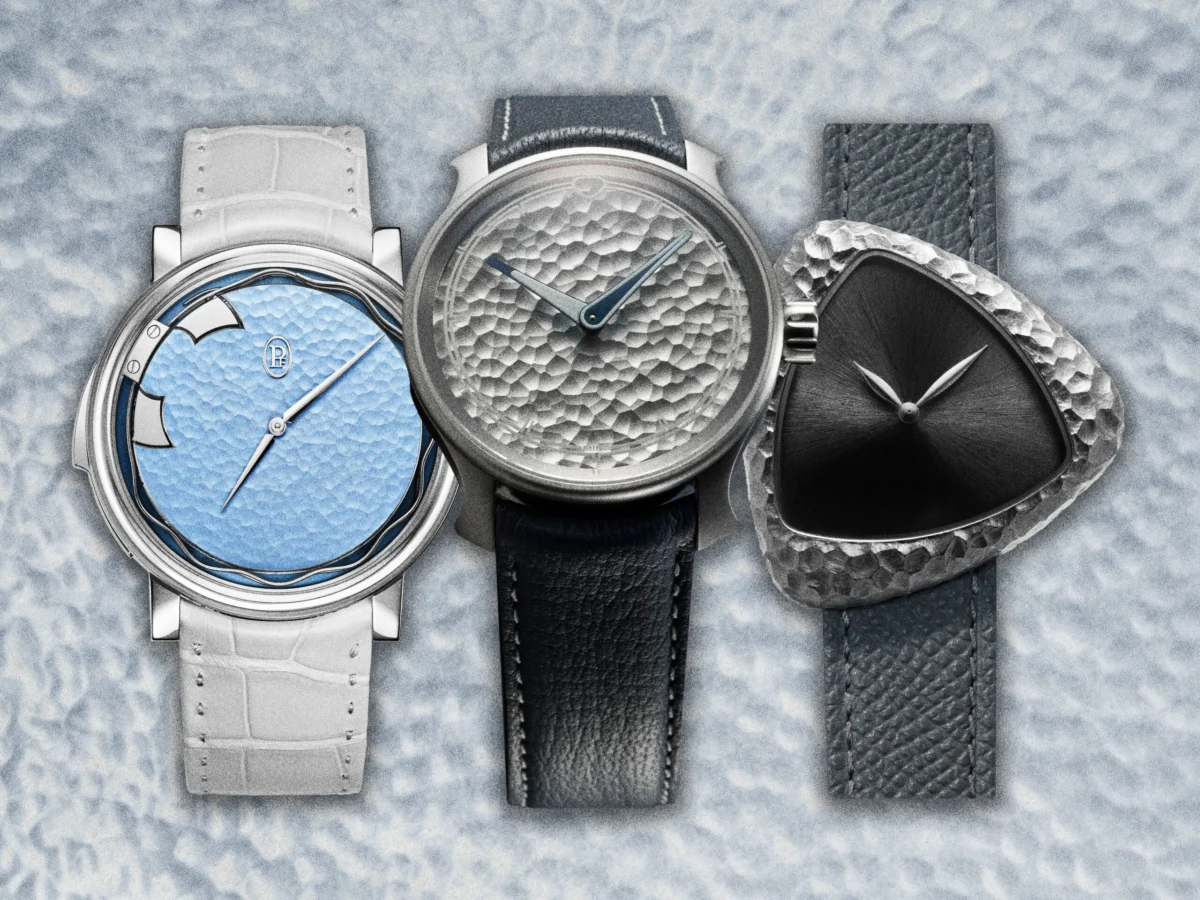
The landscape of contemporary watch collecting has undergone a seismic shift over the last decade, transitioning from a rigid obsession with internal mechanical specifications toward an exuberant celebration of external design and artistic expression. This evolution has birthed an "arms race" of aesthetics, where the traditional boundaries of horology are being pushed by "strange" shapes—typified by the meteoric rise of the distorted Cartier Crash—and a newfound bravado in color palettes, seen in everything from Rolex’s vibrant "Celebration" dials to the playful, pigment-heavy releases from Nomos Glashütte. As collectors increasingly view their timepieces as wearable sculpture rather than mere instruments of utility, brands are digging deep into the annals of history to find techniques that distinguish their work in an overcrowded market. The latest frontier in this quest for distinction is the revival of hammered and chiseled surfaces, a category of finishing that prioritizes the human touch over the cold precision of a CNC machine.
Historically, the technique known as martelage—or hand-hammering—was a secret language spoken only by the most elite houses of haute horlogerie. It is an ancient, grueling process that involves an artisan striking a metal surface hundreds, if not thousands, of times with a small hammer or a polished steel punch to create a textured, multi-faceted finish. Because every blow is delivered with varying force and at slightly different angles, no two hammered watches can ever be truly identical. Recently, this "wabi-sabi" appreciation for beautiful imperfection has begun to migrate from the stratospheric price brackets of six-figure masterpieces into the more accessible realm of independent boutique brands. This democratization of high-end finishing is fundamentally changing how enthusiasts at all levels engage with the hobby.

One of the most compelling leaders of this movement is Ming, an independent watchmaker headquartered in Kuala Lumpur that has consistently punched above its weight since its inception. Founded by the polymath Ming Thein, the brand has built a reputation for "trailblazing" by merging photography-inspired light play with cutting-edge manufacturing, such as 3D-printed mesh bracelets and dials that shift from vibrant hues to deep blacks depending on the angle of the light. Their latest endeavor, the Ming 37.06 Royal Selangor, represents a profound intersection of horology and heritage. By collaborating with Royal Selangor—a Malaysian pewter institution established in 1885 and perhaps the world’s most famous name in the alloy—Ming has introduced a texture rarely seen in watchmaking.
Pewter, while a staple of fine tableware and trophies for over a century, is an unconventional choice for a watch dial due to its relative softness compared to brass or gold. However, Ming Thein recognized that this very softness makes it an ideal canvas for martelage. In this 88-piece limited edition, artisans at Royal Selangor hand-hammer each pewter dial, creating a surface of undulating "valleys" and "craters" that evoke the lunar landscape. When encased in a sleek, modern titanium housing, the organic, prehistoric look of the hammered pewter creates a startling contrast. The result is a watch that offers the soul of a hand-finished masterpiece for a price point well under $10,000, proving that artisanal soul is no longer the exclusive province of the ultra-wealthy.
As the industry’s aperture widens, it becomes clear that Ming is not alone in this rhythmic pursuit of texture. Anoma, another darling of the boutique watch scene, has taken a slightly different but equally labor-intensive approach with its A1 Prehistoric model. While the Ming utilizes a hammer, the Anoma A1 Prehistoric features a stainless-steel case that is hand-chiseled. This distinction is subtle but significant; where hammering compresses the metal to create dimples, chiseling carves material away to create sharp, organic ridges.

The creation of an Anoma A1 Prehistoric is a masterclass in patience, requiring at least five hours of focused manual labor per case. The artisan must carefully navigate the watch’s unique, asymmetrical triangular silhouette—a design already famous for its "optical" weirdness—to ensure the chiseled texture feels intentional rather than random. The market response to this tactile experimentation has been overwhelming. Despite a price tag of approximately $3,900, all 100 pieces of the limited run sold out almost instantly, signaling a desperate hunger among collectors for watches that look and feel like they were touched by human hands.
While Ming and Anoma represent the "new guard" bringing these techniques to the masses, the pinnacle of the craft remains anchored in the world of high-end independents like Parmigiani Fleurier. To celebrate the firm’s 30th anniversary, Parmigiani unveiled the Carillon Tourbillon, a horological tour de force that sits at the opposite end of the financial spectrum. This piece is not just a watch; it is a historical dialogue, inspired by an early 19th-century pocket watch by Perrin Frères. It features a one-minute tourbillon and a minute repeater with four gongs—a "carillon" complication that chimes the time with the complexity of a cathedral bell.
However, even amidst such mechanical complexity, the hand-hammered dial is what often captures the imagination first. Finished in a serene "Morning Blue," the dial’s martelage surface provides a soft, shimmering backdrop for the serpentine gongs of the movement. The texture of the dial complements the "vertical gadroons"—the signature ridges on the Parmigiani case—creating a cohesive aesthetic that feels both ancient and avant-garde. With only five pieces in existence, the Carillon Tourbillon serves as a reminder of why hammering was traditionally reserved for the elite: it is an expression of time that transcends the movement itself, turning the watch into a canvas for light.

The technical allure of hand-hammering lies in its transformative power. Depending on the size of the tool and the force of the strike, an artisan can make gold, steel, or pewter take on the visual characteristics of stone, tree bark, frozen snow, or the rippling surface of a lake. This versatility allows brands to tell a story through texture. In an era where high-end watches are often criticized for being "over-engineered" or "sterile" due to the perfection of robotic manufacturing, the hammered dial offers a return to the visceral. There is a psychological comfort in seeing the slight variations in a hammered surface; it is a reminder that a person sat at a bench, breathed life into the metal, and left a permanent mark of their existence on the object.
Furthermore, the rise of the hammered watch reflects a broader trend in luxury goods toward "quiet uniqueness." In previous decades, luxury was often defined by brand logos or the flash of diamonds. Today’s sophisticated collector seeks "stealth wealth"—items that look understated from a distance but reveal incredible complexity upon close inspection. A hammered dial doesn’t scream for attention from across the room, but under a loupe or in the right sunlight, it reveals a universe of micro-shadows and highlights that a flat, painted dial simply cannot replicate.
This shift toward artisanal textures also highlights the growing importance of the "independent" sector of the market. While the "Big Three" (Patek Philippe, Audemars Piguet, and Vacheron Constantin) have certainly utilized these techniques, it is the smaller, more agile brands like Ming and Anoma that are using martelage to build their brand identities. For these companies, hand-finishing isn’t just a high-end option; it is a way to compete with the marketing budgets of giants by offering something the giants cannot easily mass-produce.

As we look toward the future of horology, the "hammered" trend shows no signs of slowing down. It represents a perfect storm of consumer desires: the craving for handmade authenticity, the appreciation for historical craft, and the demand for visual novelty. Whether it is the lunar-like pewter of a Ming, the rugged, chiseled steel of an Anoma, or the ethereal blue gold of a Parmigiani, these watches offer a tactile connection to time that a smooth surface never could. For the modern collector, the message is clear: in a world of digital perfection, there is nothing quite as beautiful as the marks left by a hammer. Truly, there has never been a more exciting—or more accessible—time to appreciate the art of getting "hammered" in the world of fine watchmaking.
