
 By Rifan Muazin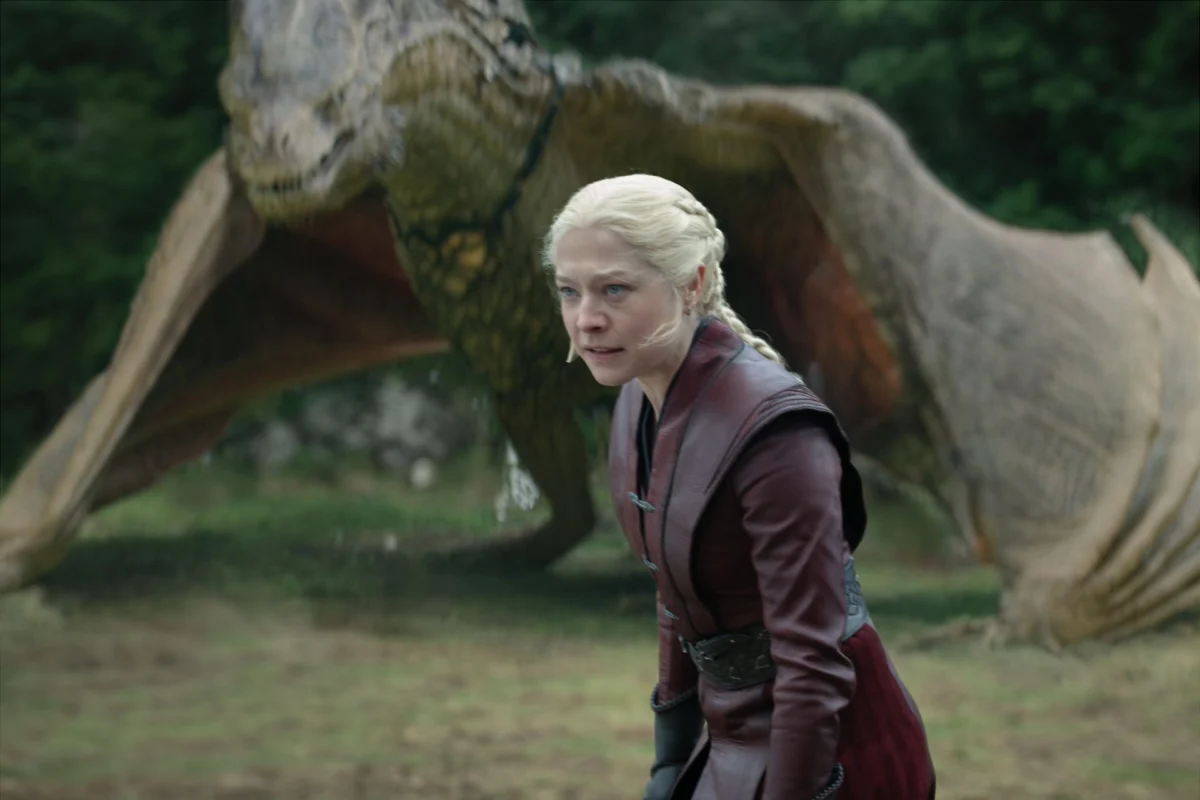
For a minute there, it really looked like Aegon Targaryen was about to meet his maker. The petulant boy-king of Westeros has spent most of this third season of House of the Dragon on the road, evading those who wish him dead, transitioning from a pampered prince to a scarred fugitive of a crumbling dynasty. In this week’s episode, “The Dragon in Winter,” he finally decides to stop running. He stands atop a windswept hill, arms outstretched in a gesture that is equal parts messianic and suicidal, as a rival army encroaches from all sides. As he begins to recount his legacy—filling in his “damn titles,” as it were—his dragon Sunfyre, long assumed dead after the catastrophic events at Rook’s Rest, emerges from the darkness behind him. This resurrection ends poorly for the assembled troops, who quickly become human kabobs as Aegon and his golden pet roar in a terrifying display of pyrotechnic victory.
The moment is a well-earned story beat for Aegon, played with a searing, desperate intensity by Tom Glynn-Carney, but it’s also a nice thematic echo of the broader state of the Game of Thrones universe in 2026. Seven years after the Thrones finale took the wind out of an entire fandom’s sails, the franchise is officially "back," thanks to the truly wonderful debut of the prequel series A Knight of the Seven Kingdoms and a stellar, high-octane third season of House of the Dragon. The skepticism that once defined the discourse surrounding George R.R. Martin’s televised world has been replaced by a fervor that mirrors the show’s early-2010s peak.
It’s taken a while to land here. Who can forget the wilderness period that followed the flagship show’s much-maligned finale in 2019? For years, the brand seemed tarnished by the narrative collapse of its final season. The proposed Jon Snow spin-off, which Kit Harington championed for years, reportedly felt too dark and directionless for HBO’s executive suites and was eventually shelved. Even more notorious was the never-to-see-the-light-of-day prequel Bloodmoon, starring Naomi Watts. Its pilot reportedly incinerated $30 million of HBO’s budget—much like Aegon and Sunfyre did to that opposing army—before being buried in the archives. There were countless other series that languished in various stages of "development hell," from 10,000 Ships to The Sea Snake, leaving fans wondering if the magic of Westeros was a lightning-in-a-bottle moment that could never be recaptured.
The franchise didn’t find its footing again until House of the Dragon revved up—largely by grounding itself in writer George R.R. Martin’s original texts rather than attempting to forge a path into the unknown. Turns out, having a concrete roadmap versus going off-book is a useful and helpful foundation to build upon. Fire & Blood, the book on which House of the Dragon is based, is written as a scholarly history book from within the world of Westeros, documenting the civil war known as the "Dance of the Dragons." Considering history is written by the victors (and often contradicted by different "primary" sources like Mushroom the Jester or Septon Eustace), the book provides the best of both worlds for television. It offers enough of a skeleton to build a concrete narrative around, but contains enough grey area to allow showrunner Ryan Condal and his team to take creative liberties that feel like "revealing the truth" behind the legends.
From the beginning, Condal has sketched the arc of House of the Dragon as a tragic, generational misunderstanding between two women. Rhaenyra Targaryen (played by Milly Alcock and later Emma D’Arcy) and Alicent Hightower (Emily Carey and Olivia Cooke) become adversaries not through inherent malice, but through the systemic pressures of a patriarchal society and the failings of King Viserys I. Viserys, played with heartbreaking vulnerability by Paddy Considine in season one, inadvertently sowed the seeds of war by marrying and fathering heirs with Alicent after promising Rhaenyra the throne.
This setup has yielded consistently strong performances. Milly Alcock’s breakout work as the young Rhaenyra set the stage, while Matt Smith’s coiled arrogance as Daemon Targaryen has made him a fan favorite. Ewan Mitchell’s resentful, one-eyed Aemond Targaryen has become a chilling personification of "second-son syndrome." However, across the first two seasons, critics often noted that the series felt more focused on shuffling its expansive familial cast around like pieces on a chessboard than it was on pushing its story forward. The pacing was deliberate, sometimes to a fault, as the show moved through decades of history to set the stage for the inevitable clash.
That treading-water feeling disappeared, fittingly, with the massive aquatic battle that led off season three—the long-awaited Battle of the Gullet. The sequence resulted in fire, blood, and the kind of high-stakes death that Game of Thrones was always famous for. It heralded House of the Dragon’s MO for the rest of the season: an unflinching commitment to showing the brutal, unglamorous reality of this civil war. The overwhelming nihilism makes a narratively dark show even bleaker as it knocks down various plot dominoes to emotionally effective results, while addressing some of its biggest previous critiques in the process.
The show finally feels like it has a handle on its sprawling cast, fleshing out Rhaenyra and Daemon’s children (Jacaerys, Baela, and Rhaena) as much as it has Alicent’s family. Even the introduction of long-awaited Hightower allies Ormund Hightower (James Norton) and Daeron Targaryen (Benjamin Evan Ainsworth) has met and exceeded expectations. Ormund, in particular, has quickly established himself as one of the best villains in Thrones history—a calculating, sophisticated commander who brings a different kind of threat to the battlefield than the impulsive dragon-riders.
As good as House of the Dragon has become in its third season, it may not end up closing out 2026 as the year’s most popular Thrones-universe spinoff. That honor may go to A Knight of the Seven Kingdoms, which recently racked up a staggering nine Emmy nominations. Made on what industry insiders call a “shoestring budget” compared to the dragon-heavy flagship shows, Knight proved the franchise still feels big even when it’s working in a different register. Based on Martin’s "Dunk and Egg" novellas, the show follows Ser Duncan the Tall (Peter Claffey) and his diminutive squire, Egg (Dexter Sol Ansell).
There’s still enough of the Thrones DNA in the mix—on full display in the massive season-concluding battle that captured the grit of the Blackfyre legacy—but Knight lives on the dynamic of its perfectly-cast leads. The Odd Couple-like friendship at its core provides a warmth and humor that is often absent from the main series. If House of the Dragon is the closest thing to a direct Thrones successor, with its political squabbling, incestuous royal drama, and massive setpieces, Knight focuses exclusively on the commonfolk and the "hedge knights" who live on the fringes of power.
Critics have frequently drawn comparisons to Andor in the Star Wars universe. In the same way that Andor detailed the lives of those living under the Empire’s boot rather than focusing on Jedi and Sith, Knight is equally engaged with the ordinary denizens of Westeros. The show is set in the relatively uneventful years between major canon events—decades after the Dance of the Dragons and decades before the Mad King’s fall. This allows tournament organizers, innkeepers, sex workers, and theater performers to take center stage. The focus on regular people makes this the most humanistic Westeros show to date, especially when combined with Tom McCullagh’s sterling production design, which makes the inns and roads of the Seven Kingdoms feel muddy, lived-in, and tactile.
Industry analysts suggest that HBO’s strategy has shifted from "more is better" to "better is more." By allowing House of the Dragon the time to find its voice and A Knight of the Seven Kingdoms the space to be something entirely different, the network has avoided the "franchise fatigue" that has plagued other major intellectual properties. The fact that two shows this distinct from one another can share a fictional universe is impressive on its own. The fact that there’s now equal fan fervor around both shows is another achievement entirely.
While the media landscape is far more fragmented today than it was in 2011, making it unlikely we will ever see a show achieve the timeline-dominating ubiquity of the original Thrones at its peak, this 2026 resurgence is the closest we’ve come in a decade. The return of Aegon Targaryen and Sunfyre in "The Dragon in Winter" served as a literal and metaphorical rising from the ashes. It’s a testament to the depth and breadth of George R.R. Martin’s world-building, but also to the creative teams who learned from the mistakes of the past. It took a few fits and starts, and several millions of dollars in scrapped pilots, but the wide world of Westeros is making its presence felt onscreen in a bold, exciting, and terrifyingly fiery way for the first time in years. As the credits rolled on this week’s episode, one thing became clear: the dragons haven’t just returned to the screen; they’ve reclaimed the cultural conversation.
