
 By admin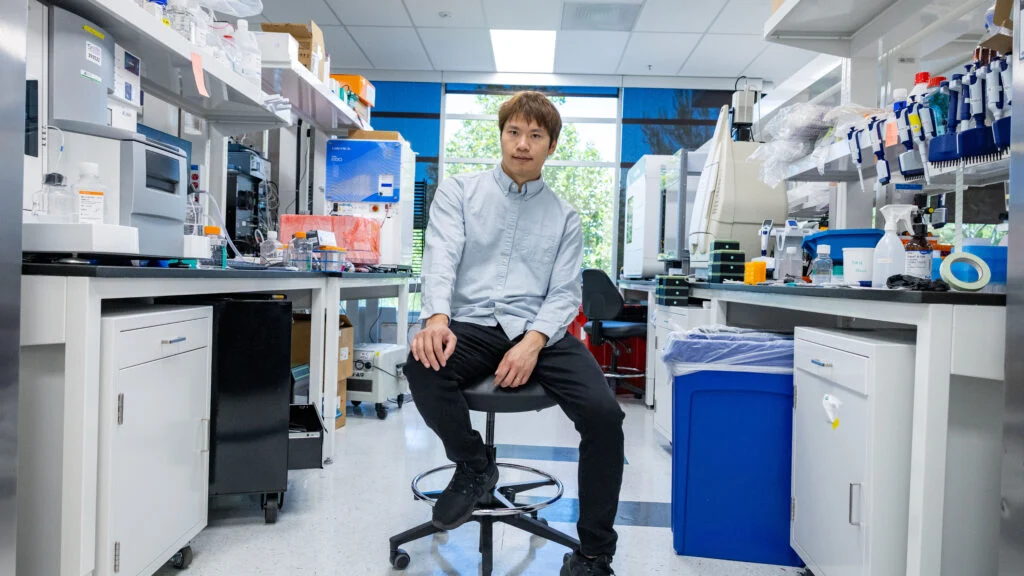
By all rights, Felix Wong and his company should be in Massachusetts. Wong, 33, is the quintessential product of the Commonwealth’s elite academic and cultural pipeline, a trajectory that usually culminates in a laboratory in Kendall Square or a glass-walled office in the Seaport District. Born in Quincy and a graduate of Braintree High School, Wong spent a formative decade immersed in the intellectual ecosystem of Cambridge. He earned two degrees from Harvard University and completed a prestigious post-doctoral fellowship at the Massachusetts Institute of Technology, working under the guidance of industry titans. His parents still reside in Massachusetts, and his professional focus—biotechnology—is the very industry that Boston has claimed as its own for nearly two decades. Yet, on a recent Wednesday, Wong found himself thousands of miles away from the Atlantic coast, walking through the sun-drenched streets of Redwood City, California. Beneath the shade of jacaranda trees near a hiking trail adjacent to his office, Wong reflected on a choice that is becoming increasingly common among the next generation of scientific entrepreneurs: the decision to leave the "Genetown" of the East for the "Tech-Bio" frontier of the West.
Wong is the co-founder of Integrated Biosciences, a startup at the bleeding edge of longevity science and artificial intelligence. His company represents a new breed of biotechnology firms that prioritize computational power and rapid iteration over the slower, more traditional methods of drug discovery that defined the previous generation of Boston-based giants. While Massachusetts remains the undisputed world leader in total lab space and National Institutes of Health (NIH) funding, a subtle but significant shift is occurring. The gravitational pull of Silicon Valley, once reserved for software engineers and social media disruptors, is now tugging at the heart of the life sciences. For Wong, the move to California wasn’t merely about weather or proximity to venture capital; it was about an intangible "creative spirit"—a willingness to merge the high-risk, high-reward ethos of Big Tech with the rigorous demands of biology.
The narrative of Boston’s dominance in biotech has long been anchored by the "Golden Triangle" of Harvard, MIT, and the massive hospital systems of the Longwood Medical Area. Since the early 2000s, this concentration of talent has turned Cambridge into a localized powerhouse where billion-dollar companies are born in the square mileage of a single neighborhood. However, by 2026, the landscape has begun to fragment. The rising cost of living in the Greater Boston area, combined with a perceived institutional rigidity, has created an opening for California to reclaim its status as a primary hub for biological innovation. Redwood City, Palo Alto, and South San Francisco are no longer just the homes of Genentech; they are the epicenters of a "Tech-Bio" revolution that treats DNA like code and drug discovery like a machine-learning problem.
Integrated Biosciences, Wong’s venture, is a prime example of this evolution. The company utilizes sophisticated AI models to identify compounds that can target senescent cells—often referred to as "zombie cells"—which stop dividing but refuse to die, contributing to inflammation and the various diseases of aging. In a landmark study published in Nature Aging, Wong and his team demonstrated how AI could screen millions of molecules with unprecedented speed, identifying candidates for age-related therapies that would have taken years to find through traditional screening methods. This fusion of deep learning and synthetic biology is the hallmark of the Redwood City startup scene. In California, Wong found a community of founders who speak the language of both the lab bench and the server farm, a hybrid identity that he felt was less established in the more siloed environment of Massachusetts.
The data supporting this migration is increasingly stark. While Massachusetts saw a record-breaking surge in biotech investment during the early 2020s, the post-pandemic correction hit the region’s mid-cap firms hard. Meanwhile, the specialized "Longevity" and "AI-Drug Discovery" sectors have seen a disproportionate amount of capital flowing toward West Coast firms. According to recent venture capital reports, while Boston still leads in total deals, the "average deal size" for AI-centric biotech startups in 2025 and 2026 was nearly 30% higher in Northern California than in New England. This is largely driven by the presence of tech-native investors—firms like Andreessen Horowitz and Founders Fund—who are more comfortable with the "moonshot" timelines associated with anti-aging research.

Furthermore, the physical infrastructure of the two hubs offers a study in contrasts. Boston’s biotech scene is vertical and dense, characterized by high-rise lab buildings where space is at a premium. In Redwood City, the landscape is more expansive, allowing for a different kind of collaborative environment. Wong’s reflection on the jacaranda trees and hiking trails isn’t just a comment on the scenery; it’s a commentary on the "campus culture" that Silicon Valley perfected. This environment encourages cross-pollination between disciplines. On any given day in Redwood City, a biotech founder might find themselves sharing a coffee with a generative AI researcher from OpenAI or a hardware engineer from Tesla. This proximity to the broader tech world is a competitive advantage that Boston, despite its academic brilliance, struggles to replicate.
The "brain drain" from Massachusetts to California also highlights a growing tension in how the two regions approach regulation and risk. Massachusetts has built a highly successful, albeit more conservative, framework for biotech growth, heavily influenced by the pharmaceutical giants (Big Pharma) that have set up their headquarters in the state. This has created a robust "exit" pipeline for startups, but it has also fostered a culture focused on incremental improvements and traditional clinical trial pathways. California, conversely, has leaned into the "disruptive" model. In the realm of longevity science—a field that often borders on the speculative—the West Coast’s appetite for high-uncertainty ventures provides a more fertile soil for companies like Integrated Biosciences.
Despite his relocation, Wong’s ties to Massachusetts remain a vital part of his narrative. His journey from Braintree High to the top tiers of Harvard and MIT provided him with the technical foundation necessary to lead a high-stakes startup. His story is a testament to the Massachusetts educational system’s ability to produce world-class innovators. However, his departure serves as a warning sign for state policymakers. The Massachusetts Life Sciences Center, a quasi-public agency, has spent billions to keep the state competitive, but the challenge in 2026 is no longer just about providing tax incentives or building lab space. It is about retaining the "creative spirit" that Wong found in the West.
Experts in the field suggest that for Massachusetts to maintain its lead, it must find a way to bridge the gap between its traditional biotech roots and the burgeoning tech-centric future. "Boston is the best place in the world for biology, but Silicon Valley is the best place in the world for the future of everything else," says one industry analyst. "If you are a founder who sees biology as a subset of information technology, you are going to be tempted by the West Coast." This sentiment echoes through Wong’s experience. While his parents in Quincy and the familiar streets of Cambridge represent his past, the sprawling, sun-lit possibilities of Redwood City represent his company’s future.
As Wong walks back toward his office from the hiking trail, the stakes of his work are clear. The diseases of aging—Alzheimer’s, Parkinson’s, cardiovascular decline—are the greatest challenges facing the global healthcare system in the 21st century. The tools he is developing at Integrated Biosciences, powered by the AI expertise concentrated in California, have the potential to extend the human "healthspan" by decades. Whether the next breakthrough in this field happens in a lab overlooking the Charles River or one nestled in the Silicon Valley foothills may seem like a matter of geography, but for the founders making the move, it is a matter of culture. For Felix Wong, the "creative spirit" of California provided something that even the hallowed halls of MIT could not: a sense of limitless, tech-driven optimism that is currently redefining the boundaries of what is possible in medicine. Massachusetts may have raised him, but California is where he is building the future.
