
 By admin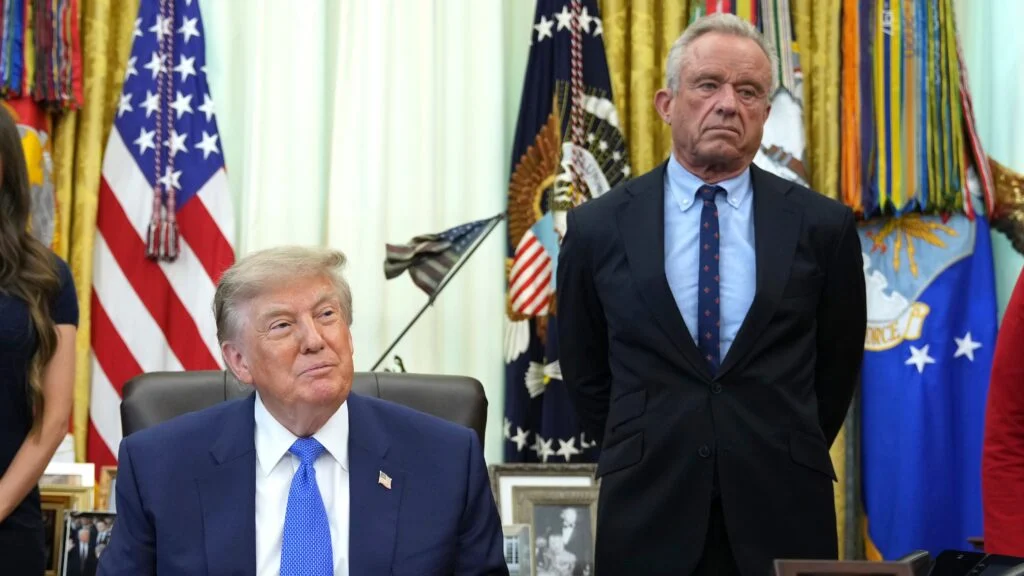
In a move that signals a seismic shift in the federal government’s relationship with the pharmaceutical industry and public health establishment, President Donald J. Trump signed a sweeping executive order on Monday that fundamentally redefines the United States’ approach to childhood immunizations. Speaking from the Oval Office, flanked by top health officials and advisers, the President unveiled the "Gold Standard Childhood Vaccine Recommendations," a new federal framework that significantly reduces the number of recommended vaccines for children and calls for a drastic restructuring of the immunization schedule. The move marks a definitive end to the administration’s recent period of public silence on vaccine policy, a strategic pause that had been maintained due to concerns over political repercussions in the lead-up to recent policy battles.
The executive order represents an unprecedented departure from the decades-long, scientist-led process of determining federal immunization guidelines. Historically, vaccine schedules in the United States have been the purview of the Centers for Disease Control and Prevention (CDC) and its Advisory Committee on Immunization Practices (ACIP), a panel of independent medical and public health experts who spend months, and often years, reviewing clinical trial data, epidemiological trends, and peer-reviewed research before making recommendations. Under the new order, this process has been largely bypassed in favor of a mandate developed in consultation with the President’s personal advisers and members of the "Make America Healthy Again" (MAHA) movement. The administration has justified this shift by claiming the new recommendations are based on a comparative analysis of the U.S. system against those of other developed nations, though the White House has yet to provide specific data or the names of the international experts who supposedly guided this comparison.
At the heart of the executive order is a reduction in the number of vaccines recommended for all children. The new federal guidelines list 11 essential vaccines, down from the 18 previously recommended by the CDC. Furthermore, the President announced that these doses would be spread out over a significantly longer period than the current schedule allows. This "alternative schedule" approach has been a cornerstone of vaccine-skeptical circles for years, under the theory that "overloading" the immune system of infants can lead to adverse health outcomes. However, the American Academy of Pediatrics (AAP) and the broader immunological community have consistently maintained that there is no scientific evidence to support the "overload" theory. Experts warn that spreading out vaccines leaves children vulnerable to preventable diseases for longer periods during their most formative and vulnerable years. The administration did not provide new immunological evidence to justify the changed schedule during Monday’s announcement.
One of the most contentious aspects of the order involves the Measles, Mumps, and Rubella (MMR) vaccine. President Trump directed federal health agencies to move toward breaking the combined MMR shot into three separate injections. During the signing, the President made the extraordinary claim that the combined vaccine could be "quite lethal," a statement he later tempered by saying he had "heard" such claims from others and that there was no definitive evidence of lethality. Despite this backtracking, the directive to split the vaccine remains in the order. Medical experts and vaccine manufacturers have pointed out that monovalent (separate) versions of the measles, mumps, and rubella vaccines are not currently produced for the U.S. market and haven’t been for years. Reintroducing them would require massive investment in new manufacturing lines and years of clinical trials to meet FDA safety and efficacy standards—a process that the administration’s order does not address in terms of funding or regulatory logistics.
Heidi Overton, a key health policy adviser at the White House, framed the executive order as a necessary response to judicial interference. The administration had previously attempted to alter vaccine guidelines through administrative channels, only to have those efforts stalled by court orders. Overton and other White House officials contend that the President possesses the legal authority to issue these recommendations as his "best view of the science," arguing that the executive branch has the right to set the "gold standard" for what the federal government promotes as healthy practice. A White House official, speaking on a background call with reporters, expressed confidence that this new policy would survive future legal challenges because it is framed as a series of recommendations rather than a direct mandate that overrides state laws.
The political subtext of the announcement was clear as the President repeatedly referenced the "Make America Healthy Again" movement. This coalition, led in large part by Health and Human Services (HHS) Secretary Robert F. Kennedy Jr., has long pushed for a radical re-evaluation of the nation’s health priorities, specifically targeting what they describe as "captured" federal agencies like the CDC and the FDA. Kennedy, who has spent decades promoting theories linking vaccines to various chronic conditions—theories that have been repeatedly debunked by large-scale global studies—hailed the executive order as a victory for parental rights and scientific transparency. He noted that the HHS has already launched "unprecedented" research efforts into vaccine safety, though critics fear these studies are being designed to confirm pre-existing biases rather than to test hypotheses objectively.
The reaction from Capitol Hill was swift and, in some quarters, sharply critical. Senator Bill Cassidy (R-La.), a physician who chairs the Senate Health, Education, Labor, and Pensions (HELP) Committee, took to social media to denounce the move. Cassidy argued that the President lacks the medical expertise to override the scientific consensus on immunizations. His opposition is particularly notable given his role in the confirmation of several of the administration’s top health officials. Cassidy’s stance suggests a growing rift within the Republican party between traditional pro-science conservatives and the more populist, skeptical wing of the party represented by the MAHA movement.
The implications of this policy shift extend far beyond the walls of the Oval Office. While the federal government issues recommendations, the actual implementation of vaccine mandates for school entry is handled at the state level. However, federal recommendations carry immense weight in determining insurance coverage and the standards of care followed by private physicians. While the President assured the public that insurance companies would continue to cover the shots and that parents could still choose the old schedule if they wished, the logistical reality is more complex. If the federal "Gold Standard" changes, insurance providers may eventually use those recommendations to limit what they are willing to reimburse, and doctors may face increased liability for following a schedule that the executive branch has labeled as potentially "lethal" or sub-optimal.
Furthermore, the order places the incoming CDC Director, Erica Schwartz, in a precarious position. During her recent Senate confirmation hearings, Schwartz pledged to "follow the science" and uphold the integrity of the agency’s research. With the White House now issuing top-down directives that contradict the agency’s own historical data and expert consensus, Schwartz faces an immediate test of her independence. The executive order also creates a new "Task Force on Safer Childhood Vaccines," which is directed to issue a report on the President’s assertions. This task force is expected to be populated with individuals who share the administration’s skeptical view, potentially creating a shadow scientific body that rivals the established committees within the CDC.
The shift in tone from the White House is perhaps the most striking development. Only months ago, Trump’s political team was reportedly advising him to avoid the vaccine issue entirely, citing internal polling that showed vaccine skepticism was a "political loser" with moderate and suburban voters. The administration had pivoted to focusing on healthcare costs and affordability. However, the influence of RFK Jr. and the MAHA base appears to have won out. Calley Means, a senior adviser at HHS, summarized the new aggressive stance in a succinct text message: "Gloves are off."
As the administration moves forward with this agenda, public health advocates warn of the potential for a resurgence of diseases that were once considered eradicated in the United States. Measles, in particular, requires a high level of community immunity (herd immunity) to prevent outbreaks. By spreading out the MMR schedule or creating confusion around the safety of the combined shot, experts fear that vaccination rates will drop below the critical threshold, leading to preventable hospitalizations and deaths. The administration’s focus on the rising rates of autism—a condition that the President again linked to vaccines despite the lack of evidence—suggests that the federal government will continue to prioritize these theories in its public messaging, further complicating the efforts of healthcare providers to maintain public trust in immunization programs.
Ultimately, the executive order is a landmark moment in the "medical freedom" movement. It represents the first time a sitting U.S. President has used the power of the office to formally validate vaccine skepticism and to bypass the scientific institutions designed to protect public health. Whether this order results in a tangible change in vaccination rates or remains a symbolic victory for the President’s base, it has undeniably altered the landscape of American public health for the foreseeable future. The "Gold Standard" has been set by the White House, but the scientific community remains firmly on the other side of the divide, setting the stage for a prolonged battle over the health and safety of the nation’s children.
