
 By admin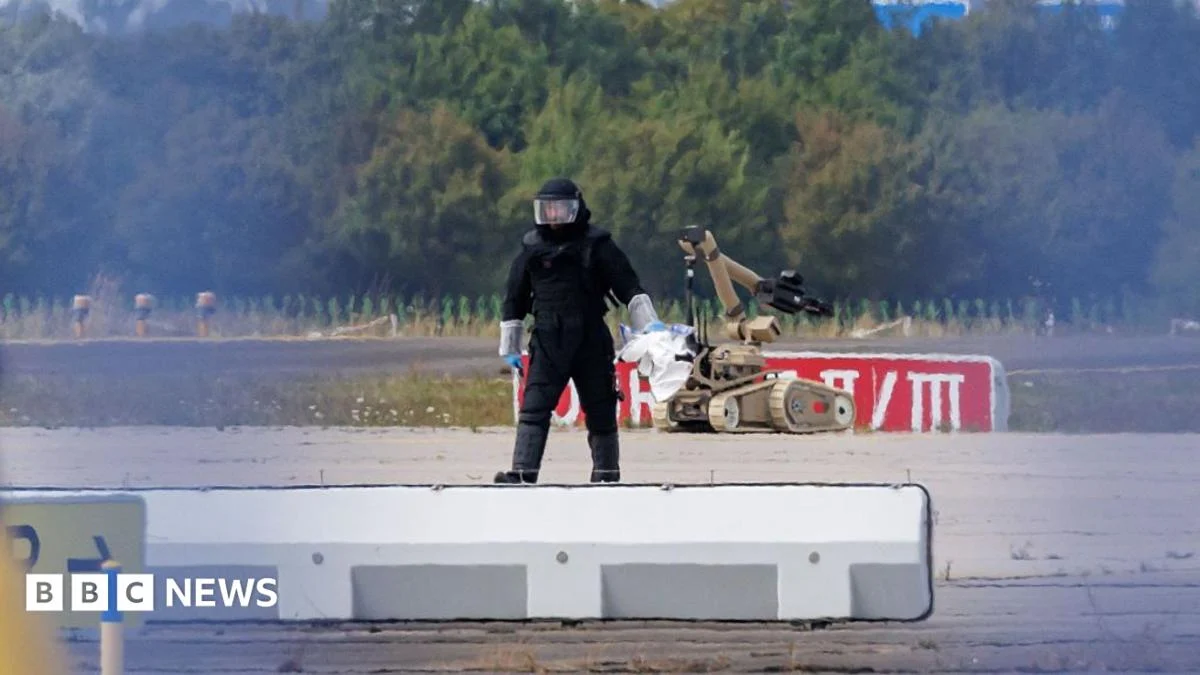
Berlin has officially attributed the audacious drone attack on Leipzig/Halle Airport last month to Russia, escalating tensions between the two nations and prompting a swift, multi-pronged retaliatory response from the German government. The August 4th incident, which saw a drone armed with an explosive device discovered perilously close to Ukrainian cargo planes, has been characterized by German officials as a clear manifestation of Russia’s "well-established pattern of Russian hybrid operations in Europe." The failed detonation, attributed to a faulty detonator, was followed by reports of a second drone colliding with a cargo aircraft and a third discovered near the airport ten days later, painting a picture of a coordinated, albeit partially unsuccessful, attempt to disrupt vital logistical operations.
The gravity of the situation was underscored by Interior Minister Alexander Dobrindt’s firm assertion at a press conference in Berlin that intelligence findings and the examination of the recovered equipment unequivocally pointed to Russian involvement. This accusation carries significant weight, given Germany’s prominent role within NATO and its unwavering support for Ukraine since Russia’s full-scale invasion in February 2022. The Leipzig/Halle Airport, a crucial hub for the German military and NATO allies for the transport of military goods, also serves as a vital base for Ukraine’s Antonov Airlines, which handles a substantial portion of the country’s aerial cargo. The targeting of such a facility is seen as a direct attempt to undermine Ukraine’s ability to receive essential supplies and military aid.
In direct response to the Leipzig attack, German Foreign Minister Johann Wadephul announced a series of stringent measures designed to curtail Russian influence and deter future aggression. Most notably, he declared the closure of the Russian consulate in Bonn and the termination of the contract for the Russian House in Berlin. The Russian House, a cultural and information center, has long been a subject of scrutiny, with numerous observers and intelligence agencies alleging its use for espionage activities and the dissemination of Russian propaganda. The termination of its operations signals a clear intent by Germany to sever channels that could be exploited for hostile purposes.
Furthermore, Wadephul announced the implementation of tighter entry controls for Russian nationals, a move aimed at restricting movement and potentially identifying individuals involved in or sympathetic to hostile operations. In a significant economic maneuver, he vowed to increase pressure on Russia’s "shadow fleet" – a collection of aging tankers utilized by Moscow to circumvent Western sanctions imposed following the 2022 invasion of Ukraine. This action targets a key revenue stream for Russia and attempts to cripple its ability to fund its war effort. The Foreign Minister also confirmed he had summoned Russia’s ambassador to Germany, Sergei Nechayev, who was subsequently seen arriving at the Foreign Ministry, signaling the seriousness of the diplomatic exchange.
The Russian response was predictably swift and defiant. Maria Zakharova, spokesperson for Russia’s foreign ministry, declared that Moscow would retaliate in a "mirror-image" fashion to Germany’s measures, implying a reciprocal imposition of sanctions and restrictions. In a particularly provocative statement, she accused Berlin of "sponsoring terrorism," a thinly veiled reference to Germany’s substantial military and economic support for Ukraine. This rhetoric highlights the deep ideological chasm that has emerged between Russia and Western nations, with Moscow increasingly framing any support for Ukraine as an act of aggression against itself.
The potential implications of Germany’s actions extend beyond immediate diplomatic and economic measures. There have been prior suggestions that the Goethe-Institut in Moscow, a prominent German cultural institution, might be forced to cease its operations if Germany proceeded with closing the Russian House. This raises the specter of a tit-for-tat cultural and educational shutdown, further isolating Russia from international engagement.
While security experts had previously speculated about Russian involvement in such incidents, Russia has consistently denied all claims of responsibility. However, the German government’s definitive pronouncement, backed by intelligence and forensic evidence, marks a significant shift in its public stance. Germany is not alone in experiencing such incidents; several NATO member states have reported drone sightings at airports, military installations, and industrial sites over the past year, underscoring a broader pattern of alleged Russian disruptive activities across Europe.
The North Atlantic Treaty Organization (NATO) has expressed its full solidarity with Germany. The head of NATO, Mark Rutte, stated on X (formerly Twitter) that "The evidence is clear. And I welcome the measures announced by Germany in response." This unified stance from the military alliance reinforces the perception of a coordinated Western response to Russian aggression. The issue was slated for discussion at a meeting of EU foreign ministers in Ireland later that Tuesday, indicating a broader European effort to address the escalating threat.
European Commission President Ursula von der Leyen also took to X, emphasizing the bloc’s united resolve. "We are united in our resolve to stand against Russian aggression. We will deter anyone who seeks to undermine our freedom and security," she declared, adding that the EU was preparing additional sanctions against Russia. This indicates that Germany’s actions may be a precursor to a more comprehensive and coordinated European response. British Prime Minister Andy Burnham echoed this sentiment, stating, "Russian attempts to undermine our united resolve and our willingness to support Ukraine are futile and doomed to fail."
Until this announcement, Berlin had been relatively circumspect regarding the Leipzig attack, only indicating that "foreign powers" might be involved. US media had already reported that American officials had linked the incident to Russia, suggesting a degree of intelligence sharing and corroboration among allies. Chancellor Friedrich Merz had previously warned that Germany was the "daily target" of hybrid warfare and that those carrying out hostile acts would "pay a price." This latest announcement solidifies that warning and demonstrates a willingness to act decisively.
The German government is actively considering measures to bolster the capabilities of its intelligence services, which have faced criticism for being relatively ineffectual in countering modern hybrid threats. The perceived weakness of these agencies has been a long-standing concern, and the Leipzig drone attack may serve as a catalyst for significant reform and investment. Germany, as a key supporter of Ukraine, with Chancellor Merz being particularly forthright in his commitment to Kyiv, has a vested interest in countering any actions that could impede its ability to provide aid. The strategic location of Leipzig/Halle Airport, serving as a critical logistics hub for Ukrainian cargo, makes it a logical target for Moscow seeking to disrupt Western support.
However, this decisive action by the German government occurs at a particularly delicate political juncture. A crucial state election in Saxony-Anhalt, an eastern German state bordering Poland and the Czech Republic, could see the far-right Alternative für Deutschland (AfD) party ascend to power at a state level for the very first time. The AfD, currently the largest opposition party in Germany, advocates for an end to support for Ukraine and the normalization of relations with Russia. This political backdrop adds another layer of complexity to the government’s response, as it seeks to project strength and resolve on the international stage while navigating domestic political challenges.
In a separate but potentially related development, German police are investigating the discovery of improvised explosive and incendiary devices at a power substation in the eastern state of Brandenburg on Tuesday. The incident resulted in damage to a power line and a temporary outage. While the perpetrators remain unknown, the timing of this event, occurring shortly after the Leipzig drone attack accusation and amidst heightened security concerns, raises questions about a potential coordinated campaign of disruptive activities within Germany. The investigation into this incident is ongoing and will be closely watched for any links to the broader geopolitical tensions.
