
 By admin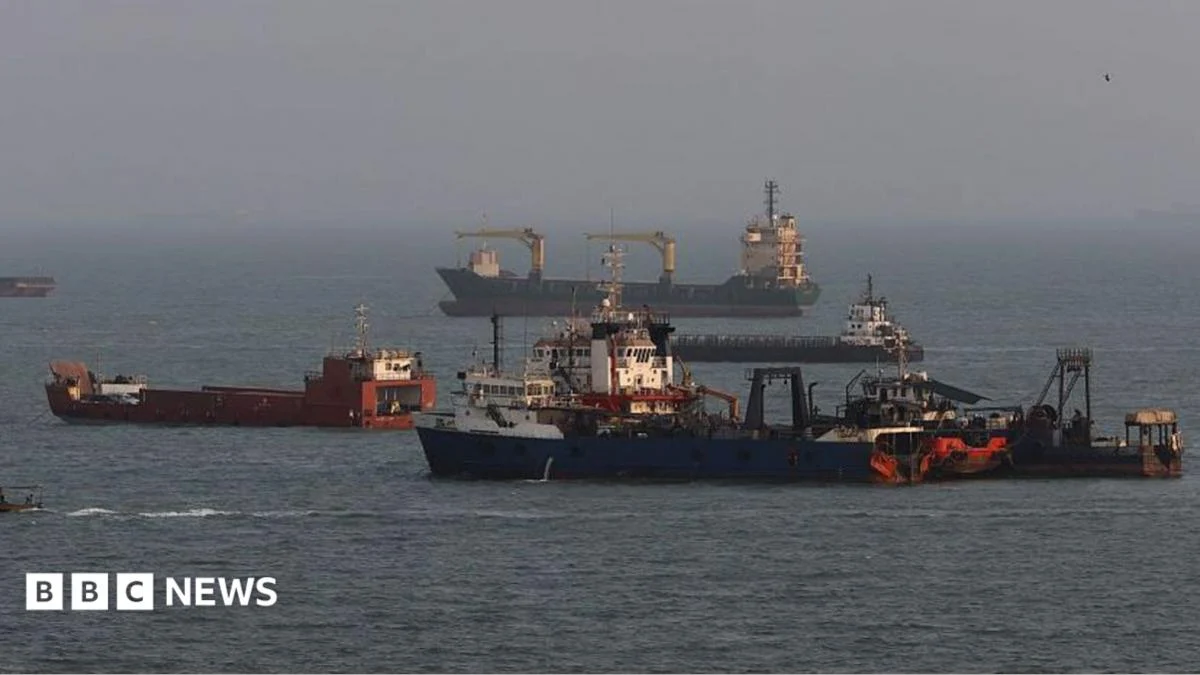
Saudi Arabia has vehemently condemned what it asserts was an Iranian attack on a Saudi-owned supertanker on Monday night, an incident that tragically resulted in the deaths of two Filipino sailors. The Saudi national shipping company, Bahri, officially confirmed on Wednesday that its vessel, the Sidr, was "involved in a security incident while transiting the Strait of Hormuz." Maritime security firms, citing data from their sophisticated monitoring systems, reported that the Sidr was struck by projectiles north of Oman’s Musandam Peninsula. Disturbingly, a South Korean-owned supertanker, the Senegal Prosperity, was reportedly targeted and struck by similar projectiles east of Musandam around the same time, indicating a coordinated or at least temporally linked series of aggressive actions.
Iran, meanwhile, has not directly responded to Saudi Arabia’s specific allegation of an attack. However, Iranian state media had earlier reported that two tankers had caught fire after striking mines while navigating what they described as an "unauthorised route" through the strategic strait. This discrepancy in narratives highlights the escalating tensions and the difficulty in establishing an irrefutable chain of events in such a volatile region. The tragic news of the sailors’ deaths emerged in the wake of a significant escalation in hostilities between the United States and Iran. The US military had carried out a wave of air strikes targeting Iranian positions, prompting retaliatory missile and drone attacks by Iranian forces on US bases in neighbouring Arab states. This exchange marked the most intense military confrontation between the two adversaries since July, underscoring a dangerous pattern of escalating aggression.
Adding to the grim toll, Iran’s health minister reported on Wednesday that 18 people had been killed and 108 injured in the US attacks. Iran has publicly accused the United States of committing a "war crime" over a strike that, according to Iranian reports, killed four people, including two children, at a wedding party in the southern city of Sirik. The US military stated that it was investigating these reports, a response that has done little to assuage Iranian anger.
Bahri’s statement, released on Wednesday, provided further details regarding the "security incident" that befell the Sidr. The company specified that the incident occurred in the Strait of Hormuz at approximately 23:40 local time on Monday, which corresponds to 19:40 GMT. "It is with profound sadness that Bahri confirms the loss of two of its Filipino seafarers as a result of the incident," the statement read, expressing the company’s "deepest condolences and heartfelt sympathies to their families, loved ones, and colleagues during this difficult time." The acknowledgement of the Filipino sailors’ deaths brings a human face to the geopolitical conflict, highlighting the devastating impact on innocent civilians caught in the crossfire.
Following Bahri’s confirmation, the Saudi foreign ministry issued a strong statement expressing the Kingdom’s unequivocal condemnation of "Iran’s targeting of the Saudi tanker (Sidr) while it was transiting the Strait of Hormuz." The ministry’s statement extended beyond the immediate incident, also condemning recent Iranian attacks on Jordan, Bahrain, and Kuwait. This broad condemnation suggests a wider pattern of Iranian aggression that Saudi Arabia views as a threat to regional stability. The foreign ministry stressed the "need to halt escalation and respect the security and safety of international navigation," emphasizing the critical importance of maintaining unimpeded maritime routes for global trade and energy supplies. Furthermore, the statement underscored the necessity of respecting "national sovereignty, and international law," framing the incidents as violations of fundamental principles of international relations.
These official pronouncements were issued a day after maritime risk management and intelligence firms, Marisks and Kpler, had reported the initial findings of their investigations. Their reports detailed that two tankers, each laden with two million barrels of Saudi crude oil, were struck by unknown projectiles within minutes of each other as they were transiting outbound through the Strait of Hormuz late on Monday. Marisks specifically reported that the Sidr was struck by "unknown projectiles" at 19:52 GMT, approximately 16 nautical miles (30km) north-east of Khasab, Oman. The Senegal Prosperity, according to Marisks, was struck by "three unknown projectiles" about 17 nautical miles east of Khasab. The UK Maritime Trade Operations agency corroborated these findings, reporting two separate incidents in the same geographical locations, further strengthening the evidence of coordinated attacks.
In contrast to the Saudi and Bahri statements, Iran’s Islamic Revolution Guard Corps (IRGC) issued its own statement on Wednesday, asserting that two oil tankers had sought to transit "via an illegal route" in the Strait of Hormuz "at the urging of the US military." The IRGC claimed that these vessels subsequently "struck mines and exploded," and that the vessels were "currently on fire." This narrative attempts to shift blame and portray the incident as a consequence of the tankers’ own actions or US instigation, rather than a direct Iranian attack. While the US military has not officially commented on the IRGC’s specific claims, it has previously stated that the recent strikes on Iran followed "recent attempted attacks by the IRGC against commercial shipping in the Strait of Hormuz and against American service members," providing a context of ongoing hostile actions.
The Strait of Hormuz is a critical chokepoint for global energy supplies, with approximately one-fifth of the world’s oil and gas shipments typically passing through its narrow waters. The region has been a flashpoint for geopolitical tensions for decades, and its strategic importance cannot be overstated. The strait has been effectively closed to normal traffic since the commencement of what Iran perceives as the US and Israel’s war against it in February. This closure has been attributed to a series of Iranian missile and drone attacks targeting commercial vessels, coupled with a US blockade of Iranian ports, aimed at disrupting Iran’s oil exports and pressuring its economy.
The situation had reached a precarious diplomatic stage earlier in the year, with the US and Iran reportedly reaching a preliminary agreement in June to end the hostilities and reopen the strait. However, this agreement collapsed within weeks. The resumption of Iranian attacks on shipping and the US’s reinstatement of its blockade signaled a significant setback for diplomatic efforts and a return to a more confrontational posture. Iran has consistently maintained its position that it will not relinquish a measure of control over the waterway, a position that has led to continued friction. This has resulted in Iran targeting vessels that attempt to use a southern route through Omani waters, a route that bypasses Iran’s preferred and more heavily controlled passage through its own territorial waters.
Despite the escalating tensions and the reported attacks on shipping, US President Donald Trump has publicly declared that the strait remains "open." The US military has been actively involved in assisting ships in navigating the southern route, ostensibly to ensure the free flow of global commerce. In a statement that appears to contradict the narrative of a severely disrupted trade flow, US Energy Secretary Chris Wright reported on Wednesday that 17 million barrels of oil had flowed through the Strait of Hormuz by ship on Monday alone, a figure he described as a "record daily total since the start of the war." This assertion suggests that while incidents are occurring, the overall volume of oil transit has not been completely choked off, though the risks associated with such transit have undoubtedly increased.
The underlying causes of this renewed escalation are complex and deeply rooted in regional rivalries and international power dynamics. The ongoing conflict between Iran and the US, often played out through proxy forces and maritime incidents, has created a volatile environment where any miscalculation can have severe consequences. Saudi Arabia, as a major oil producer and a key regional rival to Iran, finds itself directly impacted by disruptions to maritime security and the global energy market. The targeting of its supertanker, with the tragic loss of life, represents a direct challenge to Saudi Arabia’s economic interests and its regional standing.
Expert analysis suggests that the attacks are likely intended to disrupt global oil markets, exert political pressure on the US and its allies, and demonstrate Iran’s capacity to control or at least significantly impact a vital global trade route. The use of projectiles and the reported mine strikes point towards a deliberate act of aggression, regardless of Iran’s official narrative. The involvement of multiple vessels in close proximity and temporal proximity further suggests a planned operation rather than isolated accidents.
The international community faces a significant challenge in de-escalating this dangerous situation. The condemnation from Saudi Arabia, coupled with the reports from maritime security firms, provides strong evidence of Iranian involvement. However, without direct admission or irrefutable proof presented in a universally accepted forum, Iran’s denial and counter-narrative continue to complicate diplomatic efforts. The potential for a wider regional conflict remains a grave concern, with significant implications for global energy security, economic stability, and international peace. The tragic deaths of the two Filipino sailors serve as a stark reminder of the human cost of these geopolitical power struggles. The focus now shifts to diplomatic channels and the potential for international intervention to prevent further bloodshed and restore stability to this critical maritime artery.
