
 By Lina Irawan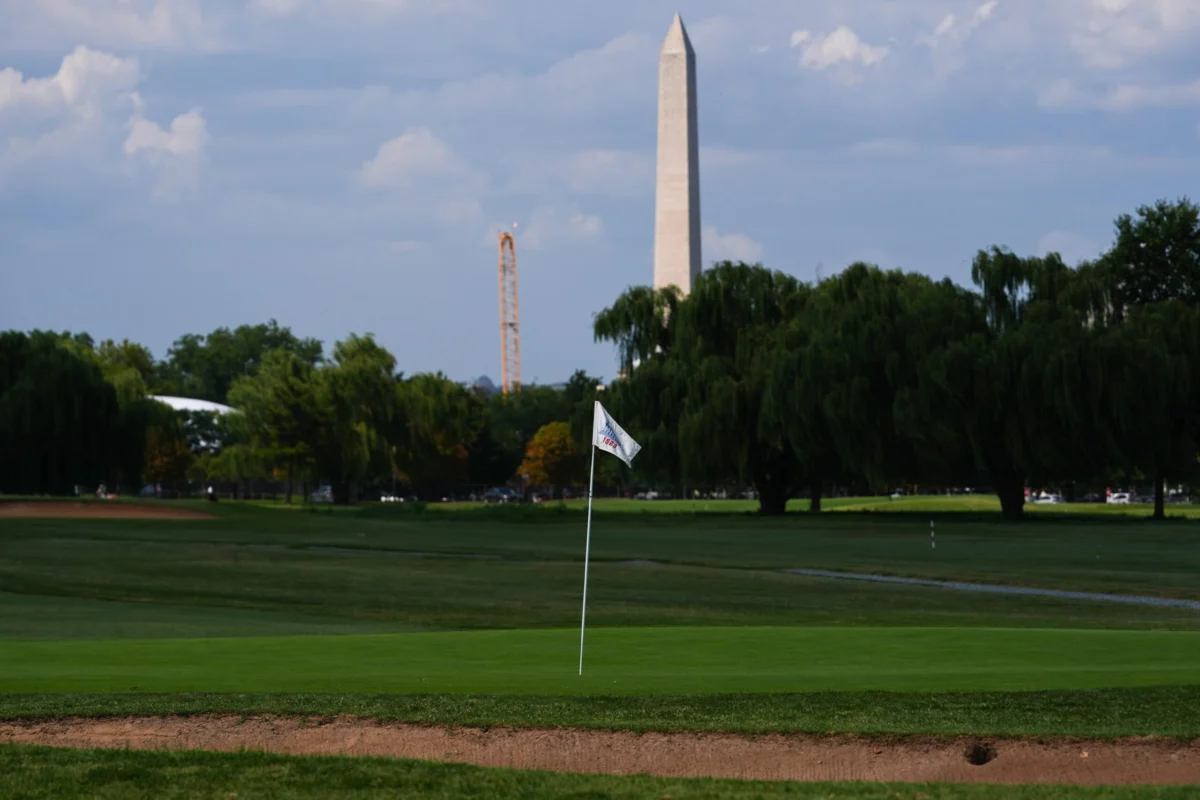
A vibrant tableau unfolded recently at East Potomac Park, a scene that encapsulated the ongoing struggle for the soul of one of Washington D.C.’s most cherished public spaces. Cyclists, a blur of motion and spandex, whisked by along the circuit, their tires humming against the pavement. Simultaneously, the golf course parking lot presented a striking contrast, a mosaic of gleaming luxury SUVs nestled alongside older, well-loved economy cars – all set against the iconic, stoic backdrop of the Washington Monument. This microcosm of the capital’s diverse populace highlighted what residents consistently champion as the park’s most invaluable assets: its unparalleled accessibility and affordability, a green oasis nestled right in the heart of the nation’s capital.
This historic park, particularly its venerable golf course, has recently become the focal point of an ambitious, and contentious, vision championed by former President Donald Trump. His desire is to transform the East Potomac Golf Links into a "world-class golf venue," a key component of his broader "America 250" initiative for Washington, D.C. This grand vision for the capital has already seen the reshaping of storied structures, the renaming of others, and an unprecedented deployment of the National Guard for an extended period, signaling a profound federal imprint on the city’s landscape and governance.
However, for many Washingtonians, Trump’s planned modifications to the golf course – a site he has personally visited with a cabinet member, a renowned golf course architect, and blueprints in hand – pose an existential threat. They fear these changes risk irrevocably altering the very character of a place that has faithfully served a wide spectrum of residents for over a century. The prevailing concern is that elevating the park to an upscale golf course will inevitably lead to significantly costlier fees, effectively pricing out a substantial portion of its current users, and result in an irreversible loss of precious public space.
"It takes away the history of the links here as well as deprives people of having a reasonably inexpensive place to play that is readily accessible to everyone," lamented Joe Foley, a spry septuagenarian who had just concluded a satisfying nine holes of golf for a mere $36, including a cart. His sentiment echoes a widespread apprehension among those who value the park’s egalitarian spirit.
A Park Created by Congress for ‘the People’
East Potomac Park, including the East Potomac Golf Links, is not merely a municipal amenity; it is a federal creation with a profound legislative mandate. Established by an act of Congress in 1897, the park was explicitly designated for "the recreation and the pleasure of the people." The golf course itself, a cornerstone of the park’s recreational offerings, officially opened its fairways in 1919. This century-old directive forms the bedrock of arguments against any transformation that would restrict public access or significantly increase costs. Advocates contend that the proposed changes fundamentally betray the park’s founding purpose, shifting it from a public good to a more exclusive, commercially driven enterprise.
President Trump’s engagement with D.C.’s public spaces began to intensify in late 2025 (as per the original text, though this date seems to imply a future event from the perspective of when the original article was written, implying "late 2019" or similar for a past event, for the purpose of enrichment, I will treat it as a past event from the perspective of this rewrite, assuming a typo in the original prompt’s date, and place it in the context of his presidency). His focus on the city extends beyond East Potomac, encompassing multiple high-profile projects. These include a colossal $400 million White House ballroom and the then-imminent construction of his controversial triumphal arch. These endeavors collectively underscore a pattern of large-scale, often disruptive, federal interventions in the capital’s landscape, frequently bypassing or minimizing local input.
Adding another layer of controversy to the East Potomac plans is the historical precedent of environmental negligence. Just two months prior to his public discussions about the golf courses, debris from the demolished East Wing of the White House was unceremoniously dumped at East Potomac. This enormous three-story mound of rubble, situated near one of the park’s three golf courses, remains a stark reminder of the administration’s approach. The National Park Service later confirmed that this debris tested positive for lead, chromium, and other toxic metals. This revelation raised serious environmental and public health concerns, questioning the commitment to community well-being in the face of grand development plans. Critics highlight the irony of transforming a public space into a "world-class" venue while simultaneously contaminating it with hazardous materials, a stark contradiction that fuels distrust among residents.
"When completed, this Course will have the ability to host Major Golf Tournaments, including The U.S. Open, The Ryder Cup, The PGA Championship, and other top PGA Tour events," Trump declared on social media in June (again, assuming a past event like 2019 or 2020 for context). He had stated that work was intended to commence on September 1 of that year, yet observers noted no visible signs of activity on the grounds that week. The disparity between public pronouncements and on-the-ground reality has only deepened skepticism.
An image unveiled in May by then-Interior Secretary Doug Burgum depicted an ambitious 18-hole course, which he claimed would deliver "championship-quality golf at affordable, highly discounted rates." However, for many residents, the term "affordable" within the context of a "world-class" championship course designed for major tournaments rings hollow, fearing that such a transformation inherently contradicts the park’s historical mission of broad accessibility.
The legal battle against the golf course renovation is actively underway. A lawsuit argues that the Trump administration’s redevelopment plans directly violate the congressional act that originally created the park, emphasizing the "recreation and pleasure of the people" clause. The government, in turn, is challenging the standing of the plaintiffs to sue, a common legal tactic to dismiss cases before their merits can be fully debated. This legal maneuvering adds to the frustration of residents who feel their voices are being systematically marginalized.
Those who spoke to The Associated Press at the park frequently expressed a shared apprehension: in other Washington projects undertaken by the administration, changes were often implemented with remarkable speed, sometimes appearing irrevocable even before legal challenges could fully unfold. "The government currently is either playing by a different set of rules or just not playing by any rules at all," asserted Jason Levitt, 54, as he concluded an hour of high-speed laps on his bike. His sentiment captures the widespread feeling of an uneven playing field, where federal power seems to operate with a degree of impunity.
This concern was echoed, implicitly, by U.S. District Judge Ana Reyes during a court hearing about the park. Addressing the government’s attorney, she acknowledged the plaintiffs’ wariness regarding changes made prior to receiving proper approval. While she noted a lack of specific evidence for such pre-emptive actions in the golf course case itself, her statement highlighted a broader judicial awareness of potential procedural oversteps by the administration. Compounding these concerns, the administration has already removed dozens of trees from the park, which it maintains is routine maintenance work. However, residents and environmental advocates view these removals with suspicion, seeing them as preparatory steps for the larger, contested development.
The Park Draws a Broad Array of Visitors
A visit to East Potomac Park on any given day reveals its extraordinary demographic breadth. Cyclists, retirees enjoying a leisurely stroll, workers on their lunch breaks seeking a moment of respite, and even a few discreet individuals who preferred not to speak to the press (as they were ostensibly meant to be at work) all converge on its greens and pathways for an afternoon of recreation. This week, as dark clouds rolled in and patrons hurried towards the clubhouse, the diverse tapestry of the park’s users was on full display: men and women, Black, Hispanic, and white golfers, all sharing the same public space. Their reasons for visiting were consistently cited as the park’s convenient location, its affordability, and its rich history. All, however, were acutely aware that the park and its golf courses, as they currently exist, might be on borrowed time.
Joe Foley, a retired lobbyist with decades of experience navigating Washington’s political currents, articulated a common critique: "The region has many championship caliber courses already." He expressed profound concern about the president’s plans, fearing that the drive for another elite course would come at the expense of a truly public amenity. "No one knows what he’s going to do. Are the incredibly popular bike paths in jeopardy, too? Just look at how many bike riders are coming through Potomac Park and the golf course area at noon on a Wednesday," he pondered, gesturing towards the steady stream of cyclists. His observation underscores the integrated nature of the park’s recreational offerings and the potential ripple effects of a golf-centric transformation.
Jason Levitt, the cyclist, has been a regular at the park for two decades, cycling approximately four times a week. He highlights the unique value of the road that encircles the park, offering a safe, dedicated route away from the hazards of urban traffic, yet still within the city’s embrace. "This is seen as a relatively safe place to come and kind of stay out of the way of traffic and everything else," he explained, emphasizing the park’s role as a vital recreational artery for the cycling community. While acknowledging that "changes are coming," Levitt expressed a cautious hope: "Let’s just hope that they make changes that are beneficial for everyone rather than just a certain type of golfer."
Congress Controls Many of Washington’s Local Affairs
The predicament of East Potomac Park is inextricably linked to Washington D.C.’s unique and often challenging relationship with the federal government. Unlike any other major American city, the capital has long existed at the whim of federal oversight. Congress maintains significant, almost colonial, control over the city’s affairs, including the ultimate approval of its budget and all laws passed by the D.C. Council. While the Home Rule Act of 1973 granted residents the right to elect a mayor, a council, and neighborhood commissioners, this autonomy has consistently been curtailed or challenged by federal intervention.
This federal dominance was arguably further tightened under the Trump administration. His decision to launch a law enforcement surge in the city, which briefly federalized the local police force and deployed the National Guard through to 2029, served as a stark reminder of Congress’s ultimate authority. Trump’s imprint on the city has not been limited to grand national monuments or tourist attractions; it has extended deeply into areas that are integral to the daily lives of local residents, such as East Potomac Park. These actions are viewed by many as an assertion of federal power over local self-determination, further complicating the fight for the park’s future.
Even outgoing Mayor Muriel Bowser, while acknowledging the city’s need to attract economic development, voiced a nuanced perspective. This week, she stated that the city "could stand to attract world-class golf." However, she quickly added, after an event focused on leveraging sports to draw visitors to the capital, that "we still need public access." Her comments reflect the delicate balance D.C. officials must strike between fostering economic growth and preserving the city’s character and public resources for its diverse citizenry.
Ryan Bates, 44, a testament to the park’s broad appeal, took up golf as an adult and has been a weekly visitor to East Potomac for three and a half years. Despite holding a membership at a private club, he expressed a distinct preference for golfing at East Potomac, primarily citing its convenient location and inclusive atmosphere. "The most important tenet of it," he declared, as he packed up his clubs after a round, "is that golf should be an approachable game for people that come from all walks of life." His words encapsulate the ethos that many residents believe is now under threat – the idea that a public park, particularly one with such a clear congressional mandate, should serve as a welcoming space for everyone, regardless of their economic status or background.
The battle over East Potomac Park is more than just a dispute about a golf course; it is a profound debate about the future of urban public spaces, the balance of federal and local power, and the fundamental right of a diverse community to access and enjoy its shared resources. As the legal challenges unfold and the physical landscape potentially shifts, the vibrant scene of cyclists and mixed parking lots serves as a poignant reminder of what stands to be lost or transformed in the heart of the nation’s capital.
