
 By admin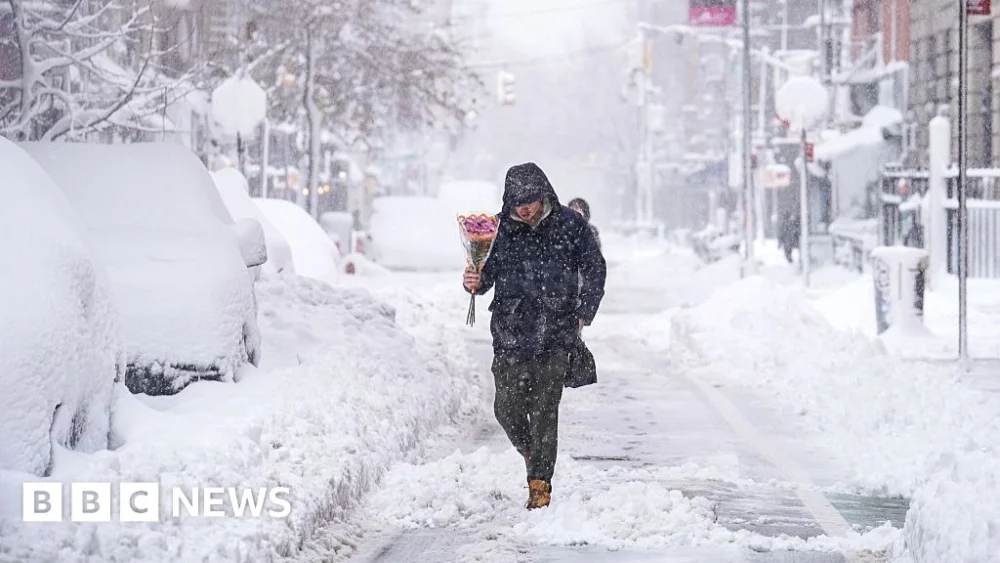
A ferocious winter storm, dubbed a "nor’easter," unleashed a historic deluge of snow across the U.S. East Coast on Monday, paralyzing millions and forcing widespread cancellations and power outages. The storm, which stretched its icy grip from North Carolina all the way to northern Maine, and even extended into parts of eastern Canada, shattered snowfall records in several locations, painting a stark picture of winter’s formidable power.
In the hardest-hit areas of Rhode Island and Massachusetts, snowfall totals soared, with some communities reporting nearly 37 inches (94 cm) of accumulated snow. New York City’s iconic Central Park, a barometer for the city’s weather, recorded over 19 inches (48 cm), a significant amount that brought the bustling metropolis to a near standstill. The National Weather Service (NWS) meticulously tracked the storm’s progression, issuing continuous updates and warnings that underscored the severity of the unfolding meteorological event.
The impact of this colossal storm was felt far beyond just inches of snow. More than 600,000 properties across the Eastern Seaboard were plunged into darkness, grappling with power outages that disrupted daily life and strained emergency services. The severity of the blizzard was so profound that the Boston Globe, a venerable institution with a 153-year history of continuous publication, announced it would not go to print for the first time in its existence. This unprecedented decision highlighted the sheer immensity of the storm’s disruptive capabilities, forcing a pause in the dissemination of news for a city that relies on it.
Travel across the region became a perilous undertaking, with many states and cities implementing strict travel bans to prevent further accidents and to allow emergency crews to navigate the treacherous conditions. The "nor’easter," a term that describes a storm originating in the eastern United States and moving northeastward, was forecast to begin its retreat on Tuesday, moving off the U.S. coast and towards the maritime provinces of Canada. However, even as the storm moved, the NWS cautioned that strong winds would likely persist, adding another layer of challenge to the post-storm recovery efforts. Along the northeastern coastline, forecasters anticipated further snow accumulations of 1 to 2 feet (30-61 cm), even as the primary intensity of the storm began to wane.
Rhode Island, the nation’s smallest state, found itself bearing the brunt of the storm’s fury, receiving an unprecedented amount of snowfall that local media outlets declared the worst snowstorm in the state’s history. Providence, the state capital, was buried under an astonishing 36 inches (91 cm) of snow, shattering the previous single-storm record of 28.6 inches (72.6 cm) set in February 1978. Candice Hrencecin, an NWS meteorologist stationed in Boston, expressed her astonishment to The New York Times, stating, "It completely smashed it. We were just as shocked as everyone else." This level of snowfall was not just a record; it was a profound statistical anomaly that underscored the storm’s exceptional nature.
In response to the overwhelming conditions, Rhode Island and its neighbor, Connecticut, implemented bans on non-essential travel. Later in the day, Massachusetts Governor Maura Healey followed suit, imposing her own travel ban across the Bay State. "White-out conditions are making travel extremely dangerous," Healey declared in an online post, emphasizing the severe reduction in visibility caused by the swirling snow. "If you get stuck, help will have a hard time reaching you… I strongly urge everyone to stay off the roads no matter where you live." The term "white-out" itself signifies a condition where snow significantly obscures visibility, rendering travel virtually impossible and extremely hazardous.
The impact on daily life was starkly illustrated by the account of Bradley Jay, a Boston resident and avid walker, who described feeling like a "prisoner" due to the storm’s intensity. He told Reuters news agency that he anticipated being confined to his home for at least another ten days, unable to engage in his usual outdoor activities. This personal anecdote provided a tangible glimpse into the widespread disruption that the blizzard had imposed on the routines and freedoms of ordinary citizens.
Massachusetts experienced extensive power outages, with nearly 300,000 residents left in the dark, according to data from the monitor PowerOutage. The situation was particularly dire in Barnstable County, encompassing Cape Cod, where an overwhelming 85% of customers were without electricity. This widespread loss of power not only inconvenienced residents but also posed challenges for heating and communication in the frigid temperatures.
The Boston Globe’s decision to suspend publication was a poignant symbol of the storm’s power. The newspaper, which had navigated numerous historical challenges, including "technical snafus and a global pandemic," found the current blizzard to be an insurmountable obstacle to its printing and delivery operations. The paper explained that more than two feet of snow had prevented its printing staff from reaching its printing press, a logistical nightmare that forced them to postpone the distribution of both Tuesday’s and Wednesday’s editions, which would be delivered together on Wednesday. This disruption meant that a significant portion of the population would be without their usual source of local news for an extended period.
In New York City, a pre-emptive travel ban brought the metropolis of over eight million people to a virtual standstill. The ban, which was eventually lifted at noon local time (17:00 GMT), had resulted in the closure of all roads, highways, and bridges, effectively halting all vehicular movement. The city’s police department was also investigating disturbing footage that emerged from Washington Square Park, showing officers being pelted with snowballs by a crowd. NYPD Commissioner Jessica Tisch condemned the behavior on social media, labeling it "disgraceful, and it is criminal," underscoring the breakdown of order that can occur during extreme weather events and the challenges faced by law enforcement.
Sandra Wu, a resident of Long Island, where snowfall reached up to 18 inches (46 cm), recounted a harrowing experience of being unable to open her front door due to the sheer volume of snow that had accumulated. Her husband’s early efforts to dig them out through the garage proved "pointless" against the relentless onslaught of snow. Wu’s declaration of never having witnessed a storm of this magnitude resonated with the sentiments of many across the region, highlighting the exceptional nature of this weather event.
In Connecticut and New Jersey, the immediate concern shifted to the potential for falling trees and branches, a common consequence of heavy snow and high winds. These falling hazards posed significant risks to public safety, threatening to cause further power outages and create dangerous driving conditions on already treacherous roadways. The interconnectedness of infrastructure meant that the storm’s impact was multifaceted, with cascading effects on power grids, transportation, and public safety.
For those attempting to travel within the United States on Monday, the storm presented a formidable barrier. FlightAware, a leading flight tracking service, reported that more than 5,706 flights within, into, or out of the U.S. were canceled. The disruption was particularly acute at New York City’s primary airport hubs, LaGuardia and JFK, where 98% and 91% of flights, respectively, were canceled. These airports typically handle over 335,000 passengers daily, illustrating the immense scale of the travel disruption. Both airports had received approximately 19 inches (48 cm) of snow, contributing to the widespread cancellations. The impact extended to other major airports as well, with the vast majority of flights canceled out of Boston, Newark in New Jersey, and Philadelphia in Pennsylvania. The repercussions of the storm continued into Tuesday, with over 2,000 flights already canceled across the U.S., with Boston, Newark, and LaGuardia remaining the most severely affected. This enduring impact on air travel underscored the long-lasting consequences of the nor’easter, affecting not only those in its immediate path but also those with onward travel plans across the country and beyond. The storm served as a potent reminder of the fragility of modern infrastructure and the immense power of nature.
