
 By Titik Puspa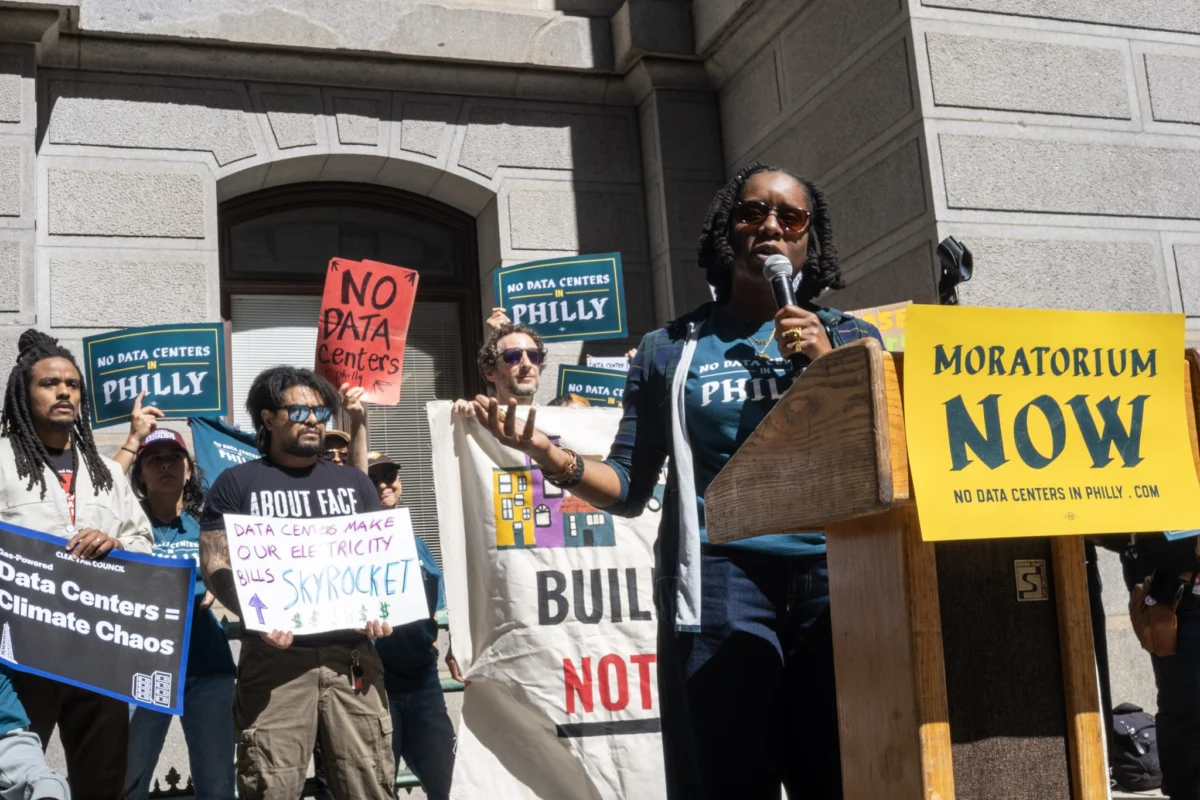
Across the United States, a contentious debate is unfolding as communities confront the prospect of new AI data centers being erected in their backyards. While data center developers and their powerful tech clients tout visions of burgeoning job markets and robust economic growth, this optimistic narrative has failed to resonate with a significant portion of the American public. A recent Gallup poll indicates that a majority of Americans oppose the construction of data centers in their local areas, with environmental and energy concerns consistently ranking as primary objections. This growing unease is amplified by the lived experiences of individuals like Shawmar Pitts, a lifelong resident of Southwest Philadelphia’s Grays Ferry neighborhood, who understands firsthand the profound and often detrimental impact of unchecked industrialization on communities.
Pitts’ childhood was inextricably linked to the imposing presence of what was once the East Coast’s largest oil refinery. The sprawling complex, a symbol of American industrial might, cast a long shadow over his formative years. His community bore witness to the devastating consequences of this proximity, as friends and family members succumbed to a litany of chronic health conditions. It wasn’t until 2018, when the environmental justice group Philly Thrive began outreach in his neighborhood, that Pitts began to connect the dots between his neighbors’ ailments and the industrial giant next door. The organization was raising awareness about a proposed expansion of the refinery, and their informational tables laid bare the grim reality of living in the shadow of such an operation.

"I read the information they had on the table about how living near the refinery affects you, and I’m looking at all the sicknesses on this paper, and I’m like, ‘My mother has this, my sister has that, my next-door neighbor suffers from this’ — every house, someone has something on that list," Pitts recounted to TechCrunch. This stark realization was a turning point for him, igniting a fierce commitment to the cause. "From that point, I was all the way in," he declared.
Today, Pitts has transitioned from a concerned resident to a leading advocate, serving as the managing co-director of Philly Thrive. He is now at the forefront of a movement pushing for a data center moratorium in Philadelphia. While no formal construction proposals have yet materialized, city officials have identified two potential sites for future data centers: one in Northeast Philadelphia and another within Pitts’ own Grays Ferry neighborhood. This looming possibility has galvanized local opposition, mirroring a nationwide trend of residents pushing back against the relentless expansion of data infrastructure.
The pushback is particularly pronounced in communities that bear the indelible marks of past industrial endeavors. For these residents, the promises of innovation and economic advancement offered by data center companies ring hollow, overshadowed by memories of environmental degradation and health crises. Sonya Sanders, president of Philly Thrive’s board, articulated this sentiment forcefully at a recent rally held at Philadelphia’s City Hall. "We don’t want data centers," Sanders stated emphatically. "We don’t want the pollution, we don’t want the noise, and we know they’re not going to bring us more jobs."

Sanders’ personal tragedy underscores the deep-seated anxieties fueling this opposition. Her husband, also a Grays Ferry resident, died of a rare bone cancer in 2020. She firmly believes that his illness was a direct result of the refinery’s emissions, citing his non-smoking, non-drinking lifestyle. "In my eyes, they killed him," she testified, her voice thick with emotion. "The pollution killed him. I believe he would be here today if he wasn’t silently murdered, because it was the pursuit of profit that killed him." Her powerful words paint a grim picture of environmental injustice, where the pursuit of profit has, in her view, led to the loss of innocent lives.
While a data center may not possess the immediate and visible destructive capacity of the now-defunct Philadelphia Energy Solutions refinery – a facility that once processed a staggering 335,000 barrels of crude oil daily – its environmental footprint is far from negligible. The insatiable appetite of the AI industry is driving an unprecedented surge in data center construction. BloombergNEF projects that by 2035, U.S. data centers will consume more natural gas than Germany and Japan combined, a projection that has nearly doubled in just nine months. This escalating demand raises serious concerns about energy consumption and the environmental consequences of relying on fossil fuels.
Natural gas, while considered a cleaner alternative to other fossil fuels like oil, is far from benign. The combustion of a single cubic foot of natural gas releases approximately 60 grams of carbon dioxide. The projected increase in data center demand is expected to generate an additional 1 million metric tons of greenhouse gas pollution daily, a figure that represents roughly 12% of current U.S. greenhouse gas emissions. This alarming statistic aligns with the findings of Harvard University researchers, who in 2021 determined that fossil fuel air pollution is responsible for one in five deaths worldwide. The proliferation of data centers, fueled by the relentless pursuit of AI advancement, threatens to exacerbate this global health crisis.

Annie Fox, an attorney with the Clean Air Council, highlighted the specific environmental risks posed by data centers during the Philadelphia rally. "A typical data center planned in Pennsylvania has hundreds of diesel engines that spew air pollution," she explained. "And even if they’re supposedly reserved for emergencies, the government has already said that the data center should use those rather than drawing from an overstressed electrical grid during some heat waves." Fox warned that such scenarios are likely to become more frequent as climate change intensifies. "We can expect that to get more frequent… Fossil fuel-hungry data centers will worsen climate change, making those heatwaves more frequent and severe," she cautioned.
The growing chorus of opposition has not gone unnoticed by policymakers. In New York, Governor Kathy Hochul has taken a significant step by signing an executive order that temporarily halts the approval of new permits for large data center projects. "Progress shouldn’t arrive with a higher utility bill, deleted water supply, or noise pollution," Hochul stated at a press conference. "These data centers can only be built, should only be built in places that want them." This directive underscores a growing recognition that community consent and environmental considerations must be paramount in the development of such critical infrastructure.
Beyond New York, a wave of data center moratoriums has swept across several U.S. cities, including Denver, Indianapolis, Asheville, Charlotte, and Reno. These pauses in construction are primarily intended to provide city officials with the necessary time to thoroughly investigate the potential environmental, economic, and social impacts of data centers before granting further approvals. This proactive approach allows for more informed decision-making and ensures that development aligns with community needs and values.

Donna Greenberg, a Philadelphia resident who attended the "No Data Centers in Philly" rally, voiced her multifaceted concerns. "I’m worried about pollution," she told TechCrunch. "I’m worried about surveillance and the fact that they’re going to have access to information they have no business knowing, and I’m concerned that they’re going to be using water and electricity that takes away from the people and the neighborhoods who need it." Her anxieties reflect a broader apprehension about the unchecked power of technology companies and their potential to strain limited resources and compromise individual privacy.
The "No Data Centers in Philly" campaign kicked off with a significant show of community solidarity, drawing over 100 attendees to City Hall. The energetic rally, filled with passionate chants, signaled a determined effort to make their voices heard by city council members. Pitts expressed his profound appreciation for the collective action, stating, "I just think that our community standing up and fighting back is tremendous. It takes a lot of effort and a lot of people." This grassroots mobilization highlights the power of community organizing in the face of powerful industrial and technological forces, emphasizing that the fight for environmental justice and sustainable development requires sustained engagement and broad-based support. The debate over AI data centers is thus evolving from a technical discussion about infrastructure into a fundamental question about community autonomy, environmental stewardship, and the equitable distribution of progress.
