
 By admin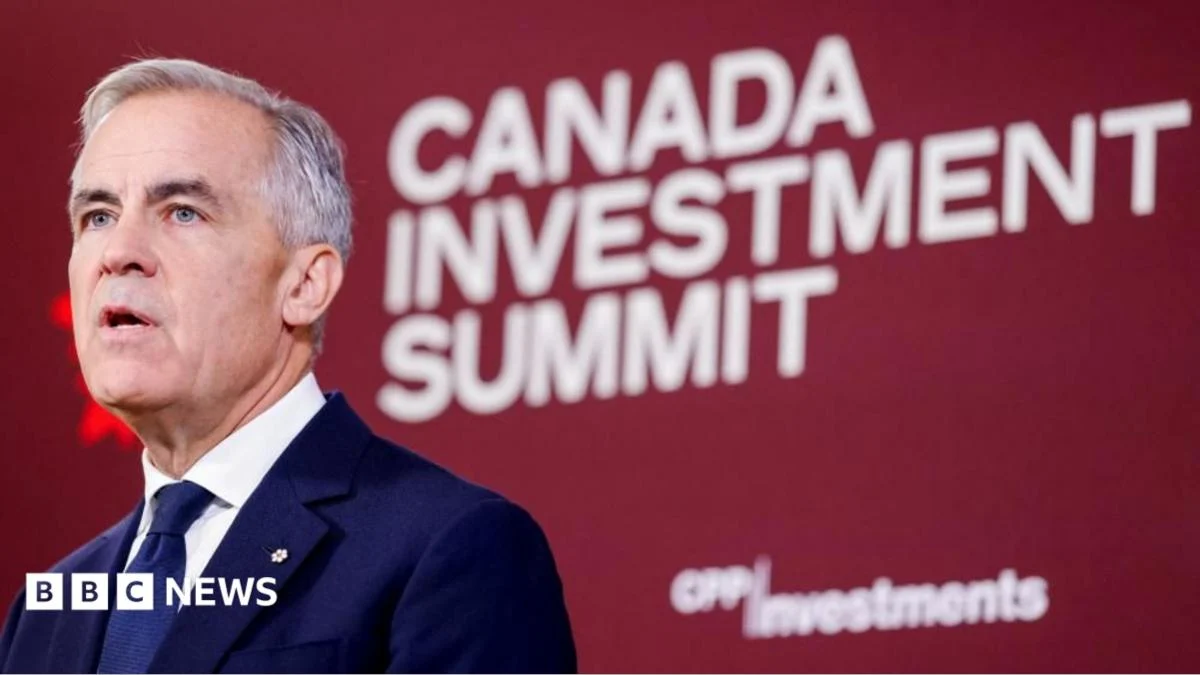
In a bold move to bolster its economy and reduce its reliance on its southern neighbour, Prime Minister Mark Carney is actively positioning Canada as a premier "safe harbour" for international investors seeking stability amidst a volatile global geopolitical and economic landscape. This strategic initiative was central to a high-stakes summit convened by Ottawa, where over 100 of the world’s most influential investors, representing a staggering C$120 trillion (approximately $86 trillion USD or £64 trillion GBP) in assets, were courted. Carney’s ambitious pledge to attract C$1 trillion in new investments over the next five years underscores his determination to fortify Canada’s economic resilience, particularly as trade disputes with the United States create friction and necessitate the cultivation of deeper economic partnerships with Europe, Asia, and the Middle East.
The summit, held in Toronto, served as a crucial test of Carney’s ability to translate his promises into tangible investment. The Prime Minister’s office described the event as an opportunity for these deep-pocketed financiers to "peer into our shop window," showcasing a vast array of over 160 potential projects spanning critical sectors such as data centres, energy pipelines, and port expansions. To sweeten the deal, the Canadian government presented a suite of new tax incentives, including a notable "mega deduction" measure, and emphasized its commitment to streamlining the approval process for large-scale projects. This push for efficiency is a direct response to economic analysts who have consistently pointed to the need for significant policy reforms in Canada, including more competitive tax and regulatory frameworks, and ensuring a robust supply of skilled labour, to attract substantial foreign investment. Carney explicitly stated Ottawa’s commitment to offering "predictability" for major proposed projects, aiming for a one-year review timeline and a clear directive: "if we’re going to say no, a quick no is necessary." This decisive approach aims to cut through bureaucratic red tape and provide investors with the certainty they crave.

A significant announcement emerging from the summit was Prime Minister Carney’s groundbreaking plan to open up four of Canada’s busiest airports – in Toronto, Vancouver, Montreal, and Calgary – to private investment. This strategic shift, aimed at generating billions of dollars, is intended to be reinvested into vital transport infrastructure, including the development of smaller regional airports. Historically, Canada’s airports have operated under a not-for-profit governance model, a stark contrast to many developed nations that permit varying degrees of private sector involvement. Carney’s proposed model retains federal ownership of the underlying land and assets, while allowing private entities to invest in and manage airport operations. However, this proposal has not been without its critics. Labour unions, including the Canadian Labour Congress, have voiced strong opposition, warning of detrimental impacts on both workers and passengers. Lily Chang of the Canadian Labour Congress stated, "In the middle of a trade war, handing profitable public infrastructure over to private investors is exactly the wrong move," expressing concerns that privatization could lead to increased costs and reduced service quality.
Despite such concerns, the summit itself appears to have been a considerable success, with the Prime Minister’s office reporting nearly C$500 billion in new investments across diverse sectors such as critical infrastructure, digital technology, energy, and defence. Artificial intelligence (AI) infrastructure projects, in particular, garnered significant investor interest. Aidan Gomez, co-founder of AI firm Cohere, highlighted Canada’s unique advantages for such ventures, citing its cold climate, ample space, and a "clean" energy grid, all of which are conducive to building robust data centres and supporting the burgeoning AI industry. Dave McKay, CEO of RBC, one of Canada’s largest banks, echoed the positive sentiment, noting a "consistency of message" between the Prime Minister and the executives in attendance, suggesting a unified vision for Canada’s economic future. This alignment is crucial for fostering confidence among investors who are looking for a stable and predictable environment.
The context of strained US-Canada relations loomed large over the summit. Prime Minister Carney, whose political career has been marked by a firm stance on trade with the United States, addressed American executives directly, acknowledging the recent trade disputes that have led to tit-for-tat tariffs and a breakdown in formal trade talks. The imposition of new US tariffs on Canadian goods, with further bans on items like alcohol and motorcycles imminent, underscored the ongoing challenges. However, Carney was keen to emphasize that the relationship, though tested, was far from over. "To our American friends, let me say this," he declared. "We will always be neighbours, and Canada will continue to be the US’s most important partner in many key areas. After all, even at times of disagreement during our long history, we have always maintained deep ties." This message sought to reassure American businesses of Canada’s enduring commitment to the bilateral relationship, even as it diversifies its international partnerships.

However, not all were celebrating Carney’s investment drive. Protests erupted outside the summit’s opening night gala, with demonstrators accusing the Carney government of orchestrating a "great Canadian sell-off" of public resources and infrastructure to corporate interests. Advocacy group Dogwood, represented by Kai Nagata, voiced concerns that a significant portion of the potential investors were American, raising fears of Canada becoming too closely aligned with or even absorbed by the US. "Let’s be clear, every piece of our country that we sell off to American billionaires brings us closer to becoming the 51st state," Nagata stated, capturing the sentiment of those who view the government’s outreach as a capitulation of national sovereignty. This opposition highlights a growing debate within Canada about the balance between attracting foreign investment and protecting national assets and identity.
Looking beyond the immediate US context, Prime Minister Carney is set to embark on a crucial trip to Europe, where he will address the EU parliament and initiate discussions aimed at forging a "unique security and economic alliance" with the bloc. This diplomatic pivot signifies a broader strategy to diversify Canada’s international economic relationships. RBC CEO Dave McKay emphasized the importance of this diversification, stating, "I think this is an ‘and’. We have to encourage our governments and encourage our leaders to look at opportunities to diversify trade and grow." He further noted that while proximity makes a strong US-Canada link inevitable, "Canadians have woken to opportunities in Asia and in Europe," suggesting a new era of global engagement for the nation. This strategic broadening of horizons is seen as essential for long-term economic stability and growth, mitigating the risks associated with over-reliance on any single trading partner. The success of these future diplomatic and economic ventures will hinge on Canada’s ability to present itself not just as a stable investment destination, but as a proactive and reliable global partner.
