
 By admin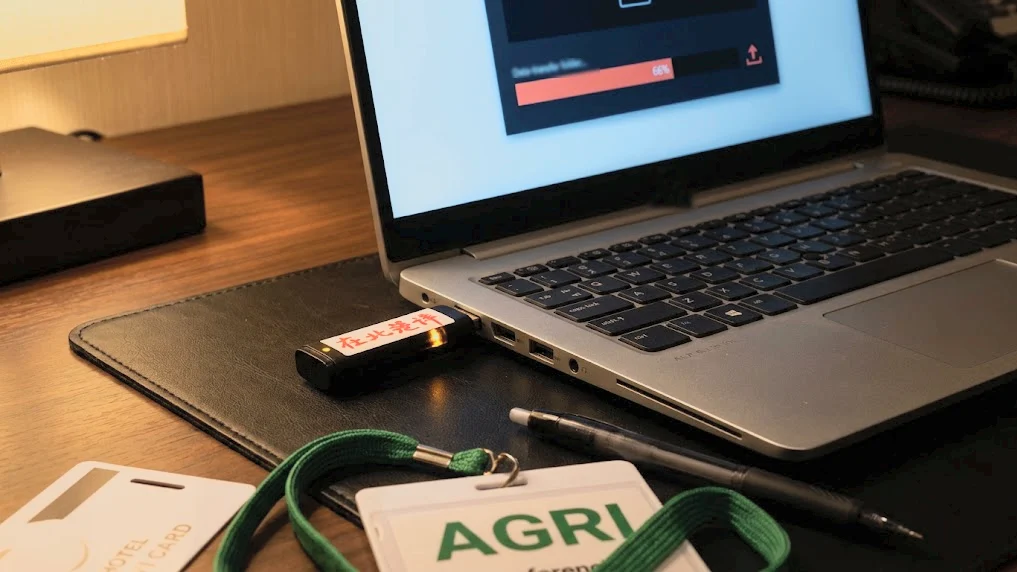
This spring, a sophisticated cyber espionage campaign orchestrated by a Chinese state-linked hacking group, tracked by cybersecurity firm CrowdStrike as OVERCAST PANDA, achieved a significant breakthrough by compromising executive laptops at an agricultural industry conference held on Hainan Island. In a move that bypassed conventional digital defenses, the attackers eschewed typical phishing or network intrusion tactics. Instead, they employed a highly audacious physical access strategy, gaining entry into hotel rooms to directly infect unattended devices with malware via USB drives while their targets were occupied with evening engagements.
CrowdStrike, a leading authority in threat intelligence and adversary tracking, detailed this alarming campaign in its recently released 2026 Threat Hunting Report. The report, which meticulously catalogues the evolving landscape of cyber threats, highlighted the novel methodology employed by OVERCAST PANDA. In an exclusive interview with VentureBeat at Fal.Con 2026, Adam Meyers, CrowdStrike’s senior vice president of counter adversary operations, provided specific details on the operation’s timeline. He revealed that intruders breached two hotel rooms sequentially, with the first entry occurring around 8 p.m. local time and the second by 9:57 p.m. During these brief windows of opportunity, the attackers directly wrote a sophisticated backdoor known as FlowCloud onto each laptop’s storage media before rebooting the machines and departing, leaving no trace of network intrusion, phishing emails, or compromised credentials obtained through typical login page attacks.
The timeline of these targeted intrusions, as dated by the 2026 Threat Hunting Report, spans between March and May 2026. Meyers, who authorized the release of these specific timestamps for publication, emphasized that CrowdStrike’s specialized threat hunting unit, OverWatch, successfully disrupted the intrusions. However, their assessment indicates that OVERCAST PANDA is "almost certainly" poised to continue such operations. The FlowCloud malware itself is not new; it has a history predating this campaign by several years. Proofpoint had previously documented its use in 2020, noting its delivery via phishing attacks targeting the U.S. utilities sector. More recently, NTT Security’s Security Operations Center (SOC) had been tracking USB-delivered infections utilizing similar techniques against overseas branches of Japanese organizations since early 2022.
Security researchers have long recognized the vulnerability of an unattended laptop to physical access tampering, a tactic commonly referred to as an "evil maid attack." This concept was first publicly demonstrated by Joanna Rutkowska in 2009, who showcased its effectiveness using a bootable USB stick to compromise devices protected by encryption. According to Meyers, such physical-access operations are relatively rare among the vast roster of 290 named adversaries that CrowdStrike actively tracks. He contrasted OVERCAST PANDA’s approach with that of MUSTANG PANDA, another group whose methods involve a victim inadvertently plugging in a dropped USB stick. What Meyers identified as particularly novel in this instance was the confluence of physical hotel room entry, executed by a state intelligence service, with direct malware deployment. Crucially, the attackers opted to boot the target machines from a USB drive rather than relying on the user to inadvertently execute a malicious file from it.
The insidious nature of the attack became apparent the following morning when the compromised executives powered on their laptops. Upon booting, a pre-configured trigger activated, loading the FlowCloud backdoor. This initiated a cascade of malicious activities, including keylogging, screen capture, unauthorized file collection, and the harvesting of sensitive credentials, effectively giving the attackers unfettered access to the executives’ digital lives.
"We have the visibility once the machine boots up," Meyers explained to VentureBeat. The FlowCloud malware is designed to activate a registry key or a similar trigger shortly after the operating system loads. It is at this precise post-boot stage that CrowdStrike’s Falcon sensor can detect its presence. The critical vulnerability exploited by OVERCAST PANDA lies in the temporal gap between the USB write operation and the subsequent boot-up – the hours during which the laptop remained compromised and undetected before the executive logged back in.
CrowdStrike’s public disclosure of this sophisticated attack occurred approximately one month prior to its major announcement of an expanded AI security product suite at Fal.Con 2026. The newly unveiled offerings include Falcon Guardian, SafeMind, the Agentic Identity Provider, and AI Gateway, signaling a significant push into AI-driven cybersecurity solutions.
Why Existing Security Tools Missed the Mark
The effectiveness of OVERCAST PANDA’s attack highlights a critical blind spot in many contemporary cybersecurity architectures. Traditional Endpoint Detection and Response (EDR) solutions, for instance, require the operating system to be loaded and their agent to be running before they can provide any detection or protection. Multi-factor authentication (MFA) solutions are designed to trigger during login attempts, while phishing training aims to educate users about suspicious emails. Similarly, AI agent security solutions are predicated on the existence of an agent to secure.
In this instance, OVERCAST PANDA bypassed all of these standard defenses at the point of entry. The initial compromise was executed at a layer below the running operating system, beneath the EDR agent, and entirely outside the authentication stack. While Falcon was eventually able to detect FlowCloud once its process initiated after the boot sequence, the implant and its activation trigger were already deeply embedded on the disk, rendering immediate remediation difficult.
"Hotel entry is a very common thing," Meyers observed. "Talk to any corporate physical security person. They’re generally aware of hotel entry, but I think what is unique is the combination of hotel entry with deployment of malware." This underscores the critical distinction between awareness of a potential threat vector and the active, sophisticated exploitation of it by a determined adversary.
Meyers posited that China’s Ministry of State Security (MSS) is likely the entity behind OVERCAST PANDA. He theorized that the individuals entering the hotel rooms were either direct officers or agents of the MSS or the Ministry of Public Security, or potentially compromised hotel housekeeping staff who were either bribed or coerced into assisting the operation. The report also revealed a separate intrusion occurring in mid-2026 that targeted a U.S.-based media professional using the exact same tradecraft. The targeting of an agricultural conference is particularly noteworthy, as it aligns with intelligence collection priorities that Meyers has previously linked to China’s long-term strategic objectives, often outlined in its five-year plans.
CrowdStrike’s Fal.Con Announcements and the Dawn of Runtime Security
The recent Fal.Con event served as a major platform for CrowdStrike to showcase its advancements in AI-powered cybersecurity. In a significant joint announcement, Nvidia CEO Jensen Huang joined CrowdStrike CEO George Kurtz on stage to unveil SafeMind, an agentic cybersecurity system built upon Nvidia’s Nemotron open models and CrowdStrike’s extensive threat intelligence data. Addressing the Fal.Con audience, Meyers highlighted the escalating volume of vulnerabilities, noting that 7,400 CVEs were registered in June 2026 alone – a staggering 96% increase compared to June 2025. CrowdStrike’s proactive involvement in responsible disclosure accounted for approximately 2,400 of these CVEs, representing roughly 30% of all registered vulnerabilities that month.
Furthermore, Falcon Guardian, CrowdStrike’s innovative runtime security layer designed specifically for AI agents operating on endpoints, was officially launched. CrowdStrike President Mike Sentonas announced its immediate availability during the Day 2 proceedings. AI Gateway, which functions as a component of Guardian, is slated for a September release as a hosted service, with a hybrid version to follow. AJ Shipley, CrowdStrike’s chief product officer, informed VentureBeat that CrowdStrike intends to integrate a SafeMind model directly into Guardian within the next couple of weeks, enhancing its capability for detecting malicious prompts.
The escalating threat landscape, quantified by CrowdStrike’s research, underscores the critical need for these new security solutions. The report indicates that AI agent-triggered detection leads have grown at a rate 2.5 times faster than human-triggered leads, according to OverWatch’s analysis. Concurrently, cloud-conscious eCrime activity has surged by an alarming 171% over the reporting period. Vishing (voice phishing) intrusions have doubled in the first half of 2026 when compared to the latter half of 2025. The eCrime group SNARKY SPIDER, in particular, has demonstrated a disturbing acceleration in its attack timelines, transitioning from account takeovers to data exfiltration in under five minutes after compromising SSO-integrated SaaS applications.
A common thread running through all of these evolving threats is their reliance on network connectivity, active operating systems, live user sessions, or operational cloud workloads. This is precisely where the OVERCAST PANDA campaign diverged, exploiting a physical vector that sidestepped these digital dependencies.
The Uncomfortable Truth: Firmware and Policy as the Ultimate Defenses
"It’s a solvable problem," Meyers stated with conviction, "It’s just an inconvenient solution, which means that a lot of people don’t do it." The controls that could have effectively blunted the OVERCAST PANDA campaign are, in fact, well-established, relatively inexpensive, and address different facets of the attack chain.
CrowdStrike itself has been offering firmware attack detection and BIOS settings auditing capabilities through its Falcon sensor since May 2019, including a Dell SafeBIOS integration that surfaces BIOS verification telemetry within the Falcon console. The ability to audit security-related BIOS settings on the laptops that executives routinely carry has been a feature within the platform for seven years. The decision to actively apply these capabilities to travel devices, rather than a lack of product functionality, represents the core gap.
Disabling external boot capabilities within the Unified Extensible Firmware Interface (UEFI) directly removes the USB-based attack vector. Implementing a BIOS administrator password effectively enforces this disabled state. Pre-boot authentication, requiring a human to supply a PIN or cryptographic key before the operating system loads, ensures that even if a foreign boot environment is loaded, the encrypted volume remains inaccessible. For post-compromise detection, firmware monitoring can identify tampering after the fact.
"Don’t bring anything with you that you’re not comfortable with handing over to a foreign intelligence service," Meyers strongly advised. He shared his personal practice of using temporary laptops and dedicated email accounts for overseas trips while at CrowdStrike, meticulously wiping the devices upon his return. He further cautioned that the exposure begins even before reaching the destination, at customs, where officials can seize devices and compel logins. His assessment of hotel safes was blunt: "They have master keys to that stuff."
The Tyranny of Scale: Why Network Threats Dominate Security Budgets
The overall number of intrusions tracked by CrowdStrike OverWatch saw a modest increase of approximately 4% during the reporting period, following a significant 27% rise the previous year. CrowdStrike attributes this plateau to a strategic shift by adversaries towards more complex and resource-intensive campaigns, exemplified by the OVERCAST PANDA hotel room operation.
Despite the sophistication of the hotel room attack, Meyers expressed greater concern regarding network-based threats. When pressed to compare OVERCAST PANDA’s physical campaign with the REVENANT SPIDER case he presented at Fal.Con – an eCrime group that leveraged AI to compromise 17 victims with custom web shells in a mere 48 minutes – Meyers unequivocally chose REVENANT SPIDER as the more significant concern.
"You can’t intrude on hotel rooms at scale," he asserted. "You can’t intrude on physical devices at scale. And even then, it’s just one device." He further elaborated that such physical intrusions typically target a specific individual and rarely lead to broader network pivots. "REVENANT SPIDER, they’re moving at that speed and they’re using AI across the board, and that’s a whole other threat, and I think that’s more concerning for the average enterprise."
The stark reality is that network-speed, AI-powered intrusions are inherently scalable, while physical-access tradecraft is not. Consequently, security budgets are overwhelmingly allocated to address the threats that impact the largest number of machines. The challenge of detecting subtle compromises on a single machine, like the one exploited by OVERCAST PANDA, often receives less attention and fewer resources. However, for the targeted executives at the agricultural conference, the chosen method was precisely what made the attack effective in a domain where network-based defenses were rendered irrelevant.
The Conference Itself as a Threat Model
The executives attending conferences are the primary targets in campaigns like this, and the window of vulnerability extends from the moment their laptops are left unattended until they are next powered on. The security vendors exhibiting at Fal.Con 2026 were, in essence, offering solutions for this very same runtime protection gap to attendees whose own devices carried identical vulnerabilities.
A significant impediment to comprehensive security is organizational fracture. Falcon Guardian, for example, might be deployed by one team, while the critical task of configuring BIOS settings on travel laptops falls under the purview of another. The Agentic Identity Provider could be implemented by the identity governance team, while the decision regarding whether executives should carry production-access machines to international conferences might rest with a different department. Moreover, the budget line item for cloud threat defense often operates in complete isolation from the policies governing travel device security.
Meyers, drawing from his own experiences, shared anecdotes of companies planning high-stakes board meetings in potentially compromised locations, highlighting a disconnect between operational needs and security imperatives. "I’ve talked to companies where they’re like, we’re having a board meeting in Shanghai, and I’m like, why would you do that?"
Essential Pre-Trip Security Measures for Leaders
Before embarking on their next international journey, security leaders must implement a series of critical audits and configurations for every executive laptop. The fundamental gap exploited by OVERCAST PANDA remains the ability to boot from a USB drive. For Windows laptops, the primary target of FlowCloud, the following steps are paramount:
Enforce Full-Disk Encryption with Pre-Boot Authentication: A BitLocker configuration relying solely on a Trusted Platform Module (TPM) is a known weakness against physical access attacks. Researchers from SCRT demonstrated in 2021 how the volume master key could be extracted from the LPC bus using an inexpensive FPGA module. Similarly, the Dolos Group achieved the same over SPI the same year. OVERCAST PANDA’s ability to write a backdoor and its post-boot trigger directly to the Windows volume indicates that the targeted machines were either unencrypted or protected by a configuration that the attackers were able to bypass. Implementing pre-boot authentication with a PIN or a USB key introduces a crucial human verification step, ensuring that the encrypted storage remains inaccessible until this authentication is successfully completed.
Verify Secure Boot and Update Revocation Lists: Secure Boot is designed to validate the digital signatures of boot components, effectively blocking most unauthorized bootloaders. However, it does not inherently prevent booting from external media, and malicious, signed shims can still facilitate bypasses. ESET research published in July 2026 detailed 11 legacy Microsoft-signed UEFI shims that allowed untrusted code to execute at boot on any machine that trusts Microsoft’s third-party certificate. While Microsoft has since revoked these in its June 9, 2026 DBX update, laptops that have not received this crucial update remain vulnerable. To mitigate this, it is essential to lock the boot order at the UEFI level, disable one-time boot menus, and implement a robust BIOS administrator password that covers both the setup utility and any boot-override key functionality. Meyers’ observation that many of these settings are often overlooked due to the perceived inconvenience of their implementation is a critical point.
Issue Dedicated Travel Devices: For international conferences, organizations should issue dedicated travel-only devices that are strictly prohibited from accessing production systems. These devices should not store credentials for internal tools, nor should they have persistent VPN configurations.
"If they can get their hands on it, they can own it," Meyers stated, echoing a well-known adage from the DEF CON security conference. The Falcon sensor’s ability to detect FlowCloud is contingent on the operating system booting and the malware initiating its execution. The critical exposure window remains the hours between the initial USB write and the subsequent login, during which the compromised laptop sits closed and vulnerable.
"It’s cheap to buy a couple of laptops and a couple of phones," Meyers concluded, emphasizing that the controls necessary to close this significant security gap are a handful of firmware settings and the deliberate deployment of secure travel devices. The fundamental question remains whether organizations are actively implementing these readily available, albeit inconvenient, protective measures.
