
 By admin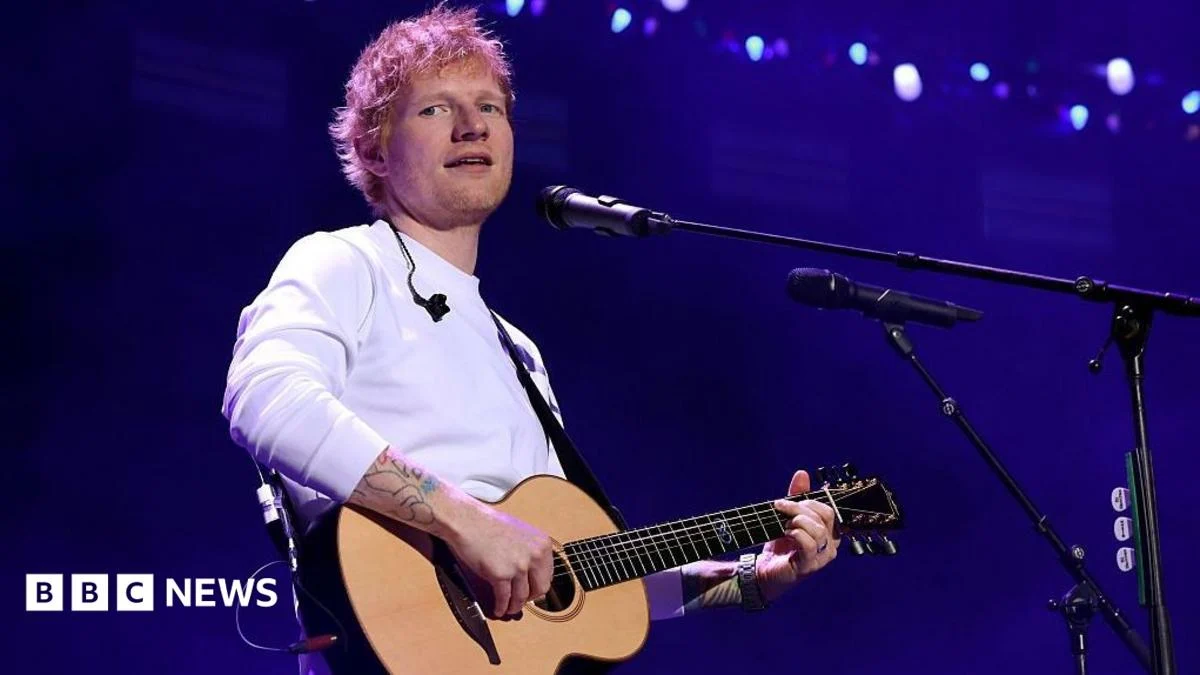
Singer-songwriter Ed Sheeran made a poignant and unexpected solo appearance on stage at his latest concert, acknowledging the recent controversy surrounding American rapper Macklemore’s removal from the tour due to his pro-Palestinian remarks. Sheeran, visibly grappling with the unexpected spotlight on his activism, opened his Philadelphia show with a heartfelt apology to his fans for any perceived missteps, stating, "I never wanted to be an activist musician but this has put me in the middle of an important and passionate argument about free speech and the most complex political issue on the planet." This marked the first time the global superstar had personally addressed the escalating situation, which has cast a shadow over the remaining US leg of his highly anticipated "Loop Tour."
The Philadelphia sports stadium, usually buzzing with pre-show energy from multiple opening acts, presented a starkly different atmosphere on Saturday evening. Several musicians had reportedly withdrawn from supporting Sheeran in solidarity with Macklemore, leaving the stage bare except for the artist and his guitar. This stripped-down setting amplified the intimacy of Sheeran’s address, allowing his words to resonate deeply with the assembled audience. He emphasized his commitment to creating an inclusive environment, declaring, "My concerts have always been a safe space for everyone," and reiterated his dedication to his fans as the driving force behind his decision to proceed with the performance.
Sheeran then directly confronted the core of the controversy, stating, "Now, I want to address the question of where I stand in the situation in Israel and Palestine, and whether my doing this concert here tonight implies where I stand." He articulated a long-held desire to remain apolitical in his professional life, explaining, "I have tried in my career not to be a political commentator of any kind, because I want my music and shows to be about unity, not division; about humanity, not politics." However, he admitted that the current situation had compelled him to break that self-imposed silence, recognizing it as a profound humanitarian crisis that he could no longer ignore. "But this is a humanitarian issue, and I cannot hide how I feel about it anymore," he declared.
His statement then moved to a nuanced expression of his feelings regarding the ongoing conflict. Sheeran acknowledged the deep historical context and pain associated with the events, stating that what transpired in Israel during the October 7, 2023 attacks was "horrific and compounded centuries of Jewish pain." This acknowledgment of Israeli suffering was immediately followed by a strong condemnation of the ongoing situation in Gaza. He described it as "catastrophic and unjustifiable and disproportionate," his voice conveying a profound sense of sorrow. "My heart has been broken by the scale of devastation and loss of civilian lives, of children’s lives, and this systemic injustice we’re seeing unfold in the West Bank cannot be overlooked," he added, highlighting the immense human cost of the conflict.
Sheeran revealed that he is actively engaged in a process of learning and seeking ways to contribute positively. "I am trying to work out how to make a contribution that helps victims of these terrible times and listening and learning, because I do not know enough," he confessed, underscoring his humility and commitment to understanding the complexities of the situation before taking further action. He concluded his impassioned statement with a hopeful vision for his concert, expressing his wish that it could serve as a sanctuary where individuals from all backgrounds and belief systems could come together in shared appreciation of music. "I hoped that my concert could be a place where everyone could gather irrespective of their beliefs," he stated, reinforcing his core message of unity.
The ripple effects of the Macklemore controversy have not been confined to the stage. Reports indicate a noticeable impact on ticket sales for the remaining dates of Sheeran’s US tour. Ticket prices have reportedly been reduced, and sales have declined, a testament to the polarized public reaction and the potential for fans to align their purchasing decisions with their political convictions. Sheeran has been vocal in clarifying his position on Macklemore’s exclusion, asserting that the decision was made by his promoters, not by him personally. This distinction, while attempting to distance him from the direct act of censorship, has done little to quell the broader debate about artistic freedom and the responsibility of global artists in addressing sensitive geopolitical issues.
The public’s response at the Philadelphia concert offered a microcosm of the diverse perspectives surrounding the controversy. A handful of attendees, when approached by the BBC, expressed a prevailing sentiment of determination to enjoy the musical performance while simultaneously championing the principle of free speech. One married couple, who had invested a significant $450 per ticket, articulated their respect for Macklemore’s right to express his views, irrespective of whether they personally agreed with them. This stance highlights a segment of the audience prioritizing the broader principle of open discourse, even when it leads to uncomfortable situations.
Another group of two women, who admitted to securing a "deal" on their tickets due to the price drop, shared their dual support for a free Palestine and their enduring love for Ed Sheeran’s music. Their presence at the concert signifies a desire to separate artistic enjoyment from political stances, or perhaps to express solidarity through their continued patronage. This perspective suggests that for some fans, the music itself remains the primary draw, and the controversy, while acknowledged, does not necessarily preclude them from attending.
Perhaps the most striking illustration of the generational divide in understanding and engagement came from a family who allowed their two teenage daughters, 15-year-old Victoria and 13-year-old Sadie, to be interviewed. When asked about the controversy and Macklemore’s removal from the tour, their response was a disarmingly candid, "Who is Macklemore?" This highlights a significant segment of younger audiences who may be less attuned to the intricacies of the music industry’s political landscape or the specific artists involved in such disputes. For them, the immediate concern might be the music and the concert experience itself, rather than the peripheral controversies that have impacted its staging. This generational gap underscores the evolving ways in which young people consume media and engage with cultural events, often through different lenses than older demographics.
The underlying complexities of the Israel-Palestine conflict, a deeply entrenched geopolitical issue with a long and tragic history, provide crucial context for understanding the fervent reactions and the pressure placed upon public figures like Ed Sheeran. The conflict, rooted in competing historical narratives, territorial disputes, and deep-seated animosities, has resulted in immense human suffering for both Israelis and Palestinians. The October 7th attacks by Hamas, which resulted in the deaths of approximately 1,200 Israelis and the taking of over 240 hostages, were met with a devastating military response by Israel in Gaza. This response has led to widespread destruction, a severe humanitarian crisis, and the deaths of tens of thousands of Palestinians, predominantly civilians. International bodies, including the United Nations, have repeatedly voiced concerns over the disproportionate nature of Israel’s military actions and the dire humanitarian conditions in Gaza.
The debate surrounding free speech in the context of this conflict is particularly contentious. Critics of Israel’s actions often argue that expressing solidarity with Palestinians or criticizing Israeli policy is met with censorship or accusations of antisemitism, stifling legitimate discourse. Conversely, those who defend Israel’s right to security often view pro-Palestinian rhetoric as antisemitic or supportive of terrorism. This polarized environment makes it incredibly difficult for artists and public figures to navigate the issue without facing significant backlash from one side or the other. Macklemore’s explicit condemnation of Israel’s actions and his use of terms like "genocide" placed him squarely in the crosshairs of this heated debate.
The decision by Sheeran’s promoters to remove Macklemore, while Sheeran himself claims he did not make the final call, raises questions about the commercial pressures faced by major artists. In an era where social media can amplify outrage and boycotts, promoters and record labels often prioritize avoiding controversy to protect revenue streams. This can lead to a silencing of dissenting voices or a reluctance to engage with complex political issues, even when artists may wish to do so. Sheeran’s statement, therefore, can be seen as an attempt to reclaim agency and express his personal convictions, even if it comes at a financial and reputational cost.
The notion of a concert as a "safe space" also takes on added layers of meaning in this context. For some, a safe space is one free from political pronouncements that might alienate or offend. For others, it is a space where diverse perspectives are welcomed and where individuals can express their truths without fear of reprisal. Sheeran’s attempt to balance these competing interpretations highlights the challenge of creating truly inclusive environments in a politically charged world. His commitment to unity, while admirable, is tested by the deeply divisive nature of the issues at hand.
The long-term implications of this controversy for Ed Sheeran and the music industry remain to be seen. Will his candid statement lead to greater understanding or further polarization? Will other artists feel emboldened to speak out, or will the pressure to remain apolitical intensify? The responses from fans, ranging from understanding to indifference, suggest a complex and multifaceted public, where individual priorities and levels of engagement with global affairs vary significantly. The teenagers’ obliviousness to Macklemore’s identity is a stark reminder that the impact of such controversies is not uniformly felt across all demographics, and that the cultural conversation is constantly evolving. Ultimately, Sheeran’s solo performance and his heartfelt address represent a significant moment in the intersection of celebrity, activism, and the enduring power of music to both unite and divide.
