
 By Rifan Muazin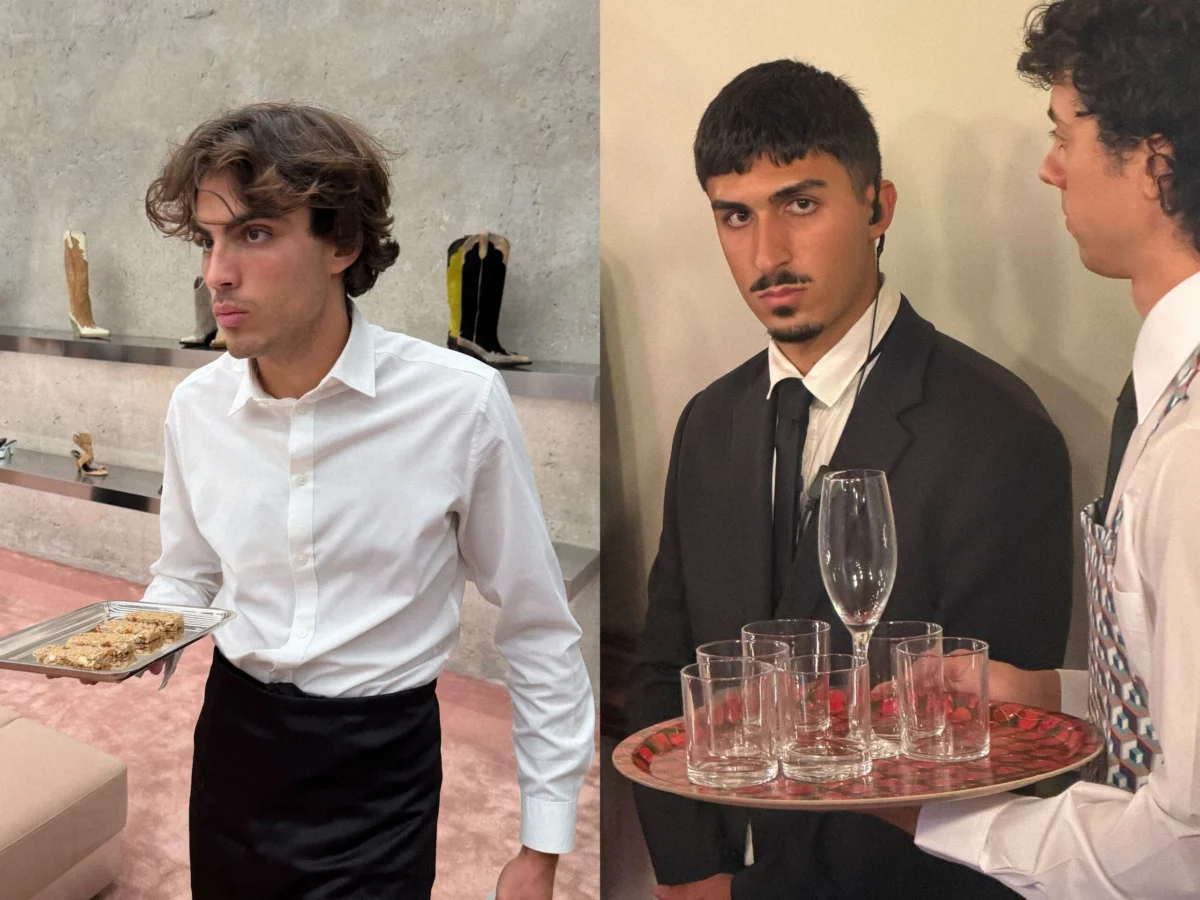
When the heavy velvet curtains of a high-fashion show finally part, the audience’s collective gaze is traditionally fixed on the garments—the architectural draping of a coat, the shimmering embroidery of a gown, or the avant-garde silhouette of a new sneaker. Yet, for the seasoned industry insider, the spectacle of Fashion Week extends far beyond the wooden planks of the catwalk. In the periphery of the flashing bulbs and the rhythmic bass of the soundtrack lies a meticulously choreographed ecosystem of human activity. There are the frantic publicists with their headsets, the stoic front-row celebrities shielded by oversized sunglasses, and the cadres of assistants navigating the chaos with surgical precision. However, in recent seasons, a new demographic has moved from the shadows of the background into the direct line of sight: a curated staff of alluringly handsome servers, security guards, and doormen who look as though they could have just stepped off the very runway they are guarding.

Hiring attractive individuals for front-facing service roles is not a revolutionary marketing tactic; it is a strategy as old as the luxury industry itself. From the "Lobby Boys" of grand European hotels to the shirtless greeters that once defined the Abercrombie & Fitch era of the early 2000s, the use of "aesthetic labor" has long been a tool for brand positioning. But within the specific, high-pressure environment of the modern Fashion Week circuit, these staffers—frequently referred to by agencies as "atmosphere models"—have become an increasingly conspicuous and essential component of the brand experience. These are not merely employees; they are living extensions of a brand’s visual identity, cast with the same rigor as the models who wear the seasonal collections. They mirror the house’s specific taste, often embodying a very particular aesthetic: typically thin, high-cheekboned, and possessing a certain boyish, ethereal charm that suggests they are more at home in a boutique than a catering kitchen.

In the fashion capital of Paris, this phenomenon has earned its own colloquialism. Industry veterans often refer to these eye-candy servers as the "cravate rouge," a term derived from the distinctive red neckties they are sometimes required to wear while weaving through crowds of editors and influencers with trays of vintage champagne. The presence of the "cravate rouge" signals a certain level of prestige and attention to detail. In an era where luxury brands are engaged in a relentless arms race for digital engagement and "viral moments," every single touchpoint matters. If a guest is handed a glass of water, the brand ensures that the person handing it to them is as aesthetically pleasing as the glass itself.

The summer of 2024 provided a perfect case study in this hyper-curated hospitality. As a blistering heat wave descended upon Paris, the house of Celine, under the creative direction of Michael Rider, took measures to ensure their guests remained both hydrated and enchanted. The brand deployed a small army of young men dressed in crisp, starch-white shirts to distribute glass bottles of water. These were not standard plastic bottles; they were heavy glass vessels printed with the iconic Celine triomphe logo. The servers themselves were chosen to reflect the brand’s signature "Indie Sleaze" and "Parisian Chic" crossover—disheveled but expensive hair, lean frames, and a nonchalant elegance. Similarly, Dior’s approach to security for their Spring 2026 show redefined the concept of "muscle." Instead of the traditional, imposing figures in black suits, Dior opted for "floppy-haired cuties" clad in soft gray cashmere sweaters and tailored slacks. They were tasked with "security," but their primary function was to soften the brand’s image, creating an atmosphere of approachable luxury rather than exclusionary gatekeeping.

This intersection of service and high fashion has found a dedicated chronicler in Valerio Farris. A photographer and PR creative strategist based in Milan, Farris has spent the last few seasons documenting the "dashing camerieri" (waiters) he encounters while navigating the city’s dense schedule of shows and presentations. For Farris, the interest in these staffers is deeply personal. He spent much of his youth working for his parents’ catering company, a background that gave him a unique perspective on the invisible labor that powers glamorous events. "I grew up in the service industry as a cater waiter, so I always really have my eye on those types of people in any type of environment," Farris explains. Now that his professional life involves overseeing high-level fashion communications, he finds himself fascinated by the way these service roles have been elevated into a form of performance art.

During the most recent Milan Fashion Week, Farris took his documentation a step further, capturing portraits of the men who populate the "atmosphere" of the city’s most exclusive parties. His photographs reveal a diverse but consistently striking group of individuals. Some are students working their way through university, while many others are professional models who haven’t quite broken into the main show circuit yet. As Farris notes, "They’re not just boys who wandered off the street and are holding a tray. They’re just kind of thrust into these super random but highly, highly curated spaces."

The spaces these men inhabit are often surreal, reminiscent of a scene from a high-budget film or an episode of Sex and the City. One might find a row of handsome men holding silver platters lined with artisanal chocolates and flutes of champagne at a luxury lingerie launch, or a group of impeccably dressed doormen standing in silent, statuesque formation outside a 17th-century palazzo. This is the "Samantha Jones" effect—the idea that the service should be as much of an aphrodisiac as the product being sold. By surrounding their products with beautiful people, brands leverage the "halo effect," a psychological phenomenon where the positive traits of one person (in this case, physical attractiveness) are subconsciously transferred to the objects around them.

The sociological implications of this trend are worth examining. In his book The Managed Heart, sociologist Arlie Russell Hochschild explored the concept of "emotional labor," but "aesthetic labor" takes this a step further. It requires employees to not only manage their feelings but to embody a physical standard that aligns with a corporate brand. In the fashion world, where the "brand" is beauty itself, the line between employee and product becomes increasingly blurred. These staffers are part of the "scenery," but as Farris argues, they are a part of the scenery that deserves to be acknowledged. "There’s something that’s very obviously being presented," he says, referring to the clothes or jewelry on display. "I always thought it was quite funny to turn your back and pick up on something that was a bit more supposed to be ‘part of the scenery.’ But they’re gorgeous and they’re fantastic and they deserve their own kind of shot as well."

The digital age has only amplified the visibility of these "atmosphere models." In the past, a handsome waiter might have been a fleeting memory for an attendee; today, he is a potential viral sensation on TikTok or Instagram. "Hot waiter" sightings have become a sub-genre of Fashion Week content, with users sharing clips of anonymous servers at Gucci or Prada events, often garnering hundreds of thousands of views. This digital footprint has turned what was once a background role into a front-facing marketing opportunity. Brands are aware that a guest’s selfie is more likely to be shared if there is a striking person in the background, further incentivizing the rigorous casting of service staff.

Farris’s project has resonated so strongly with his followers that he has been approached with the idea of turning his "camerieri" series into a physical product. He draws a humorous comparison to a famous Italian souvenir. "Have you ever traveled to Rome? They sell this calendar of hot priests," he says, referencing the Calendario Romano, which features handsome members of the Catholic clergy. "And I was like, ‘Oh wait, this would be really funny to do a Milanese version with, like, hot waiters.’"

As the fashion industry continues to evolve, the role of the atmosphere model is likely to become even more integrated into the storytelling process of a runway show. We are moving toward a "total theater" approach to fashion, where every element—from the scent of the room to the cheekbones of the person checking the guest list—is part of a unified narrative. While the clothes will always be the stars of the show, the "cravate rouge" and the "dashing camerieri" have proven that in the world of high fashion, the scenery is just as important as the stage. By turning the lens away from the runway and toward the tray-bearers, photographers like Farris are reminding us that the allure of Fashion Week is built on a foundation of human beauty that extends to every corner of the room. In this highly curated world, even a glass of water is an opportunity for a masterpiece.
