
 By admin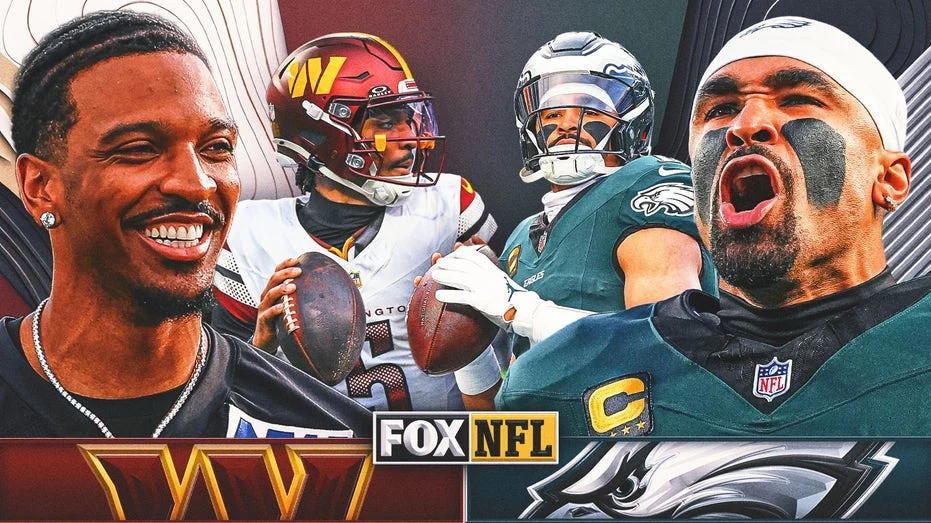
In the fickle landscape of the NFL, where momentum can evaporate faster than a desert mirage, the Eagles and Commanders find themselves at a critical juncture, their quarterback situations once brimming with promise now shadowed by uncertainty. It was a mere 19 months ago that both franchises basked in the glow of perceived quarterback supremacy. The Philadelphia Eagles, fresh off a Super Bowl LIX triumph where Jalen Hurts hoisted the Vince Lombardi Trophy and claimed MVP honors in a dominant performance against the Kansas City Chiefs, were widely considered the league’s apex predator. Simultaneously, the Washington Commanders were celebrating their first NFC Championship Game appearance in over three decades, propelled by the electrifying debut of rookie sensation Jayden Daniels. This dual emergence seemed to herald the dawn of a new, compelling quarterback rivalry, setting the stage for years of thrilling NFC East clashes.
However, the upcoming 2026 season opener marks the first confrontation between Hurts and Daniels since that pivotal playoff game, and the narrative surrounding both signal-callers has undergone a dramatic volte-face. Both quarterbacks are entering the season on the heels of frustrating 2025 campaigns that have inevitably cast a pall of doubt over their long-term viability as franchise cornerstones. The looming offseason will see both Hurts and Daniels vying for substantial contract extensions, a prospect that carries immense weight given their contractual situations. Hurts will have just one year remaining on the extension he inked in 2023, while Daniels will be navigating his third NFL offseason – a critical period where first-round quarterbacks typically secure their inaugural lucrative deals, or risk falling into contract purgatory, a fate that befell Bryce Young in Carolina.
Consequently, the stakes for both Hurts and Daniels in 2026 are starkly defined: a resurgent season is the golden ticket to a lucrative payday, but a continuation of last year’s struggles could place contract negotiations on indefinite hold. For Daniels, the bar for a successful season is arguably set lower, given the Commanders’ projected standing in the NFC East’s bottom half. For the third-year pro, simply completing the full 17-game schedule while remaining healthy would be a significant victory. Should Daniels achieve this milestone and recapture the dynamic form he displayed in his rookie year, Washington is expected to offer him a blank check in the spring. Yet, the current state of the Commanders’ offense makes a repeat of that magical rookie season a challenging proposition to envision.

The offensive line has been a persistent concern for Washington, and the unit is poised to be further weakened in 2026 with the indefinite absence of star left tackle Laremy Tunsil, who is sidelined with a torn triceps. Adding to the challenge, the onus will fall upon first-year offensive coordinator David Blough, a coach with only three seasons of experience, to devise strategies that mitigate this substantial weakness. It would not be entirely surprising if Daniels struggles to fully rebound, and the Commanders may exhibit hesitation in committing a top-market deal to a player coming off two disappointing seasons, particularly if additional injuries arise. While Washington wouldn’t be obligated to move on from Daniels, they would likely postpone contract discussions until the following offseason, a scenario that typically bodes ill for a first-round quarterback.
Daniels’ 2025 season revealed specific areas for improvement, notably in his targeting of the intermediate areas of the field. This was less a matter of reluctance and more an issue of execution, with his accuracy rate on intermediate throws experiencing a nearly 10% decline compared to his rookie campaign, according to Pro Football Focus. His film from 2025 was replete with poorly placed passes, a trend that cannot be solely attributed to Daniels himself. He was often forced to throw into tighter windows, exacerbated by the Commanders’ depleted receiving corps for much of last season, particularly with Terry McLaurin sidelined due to injury. At one point, veteran tight end Zach Ertz, despite his valuable contributions, became Daniels’ most reliable target against man coverage. The reality of a 35-year-old tight end being the primary option on crucial downs presents a significant impediment for any quarterback.
Daniels’ regression from his rookie to sophomore season can largely be attributed to his performance against man coverage and the blitz, two elements intrinsically linked. Washington’s lack of receivers capable of exploiting aggressive defensive schemes meant that Daniels was frequently compelled to force throws into tight windows, a situation where his accuracy suffers. He demonstrates greater efficacy when throwing with touch into the gaps of zone defenses, a luxury he was afforded infrequently last season.
Fortunately, the Commanders’ offense is poised for improvements in 2026 that should better equip them to handle aggressive coverage schemes. The addition of Stefon Diggs via free agency brings a receiver renowned for his production against tight man-to-man coverage. McLaurin is healthy once again, and the team has prioritized acquiring explosive athletes to round out the receiving corps, including third-round pick Antonio Williams and former first-round selection Treylon Burks. Despite these enhancements, it remains unlikely that this will constitute a truly elite receiving unit, necessitating a step forward from Daniels as an intermediate passer to maximize its potential.

Meanwhile, in Philadelphia, Eagles General Manager Howie Roseman recently defended Jalen Hurts, dismissing notions that his tenure in the city is nearing its end, despite the team’s persistent struggles in the passing game over recent seasons. "I think the bottom line for us… is winning football games," Roseman stated during a recent appearance on the "Move the Sticks" podcast. "And all [Hurts] does is win football games… for me, the barometer is winning football games." While Roseman’s public remarks are unlikely to delve into the granular details of quarterback evaluation, this sentiment presents a reductive view of Hurts’ value, seemingly tying it directly to the team’s win-loss record. If the Eagles experience a downturn this season, and the passing offense fails to show marked improvement, will the front office’s perception of Hurts undergo a recalibration? If so, the upcoming season carries significant implications for his future in Philadelphia.
For Hurts, the concern regarding supporting talent is less pronounced, as he remains surrounded by high-caliber players, even after the trade of his former top receiver, A.J. Brown. However, he will be working under an inexperienced offensive coordinator in Sean Mannion, who arrives from Green Bay. While Hurts is no stranger to offensive coordinator transitions, this marks his first NFL experience learning an entirely new offensive system from the ground up. Mannion represents Nick Sirianni’s fifth offensive coordinator in Philadelphia, and notably, it’s the first time Sirianni has looked outside his established coaching tree for such a pivotal hire. This is not expected to be a subtle rebranding; the Eagles’ offense is slated for a significant overhaul. Hurts will likely operate under center far more frequently, with a reduction in shotgun and spread formations. The new scheme is anticipated to resemble the offenses employed by the San Francisco 49ers and Los Angeles Rams, emphasizing under-center play, condensed formations, and extensive play-action passing.
This, at least, is the stated intention. In April, a report by ESPN surfaced, detailing growing frustration within the Eagles organization regarding Hurts’ perceived reluctance to step outside his established comfort zone, a factor cited as a contributor to the passing game’s struggles over the past three seasons. A key excerpt from the report stated: "He has pushed back on changes that would diversify the scheme, sources said, including when it comes to him going under center more. He has shown a reluctance to let it rip at times, particularly against zone coverage."
The ESPN report also alluded to friction between Hurts and former offensive coordinator Kellen Moore regarding the utilization of pre-snap motion. Moore, who has been calling plays in the NFL since 2019, is a proponent of this tactic, though he reportedly scaled back its usage in 2024 to accommodate Hurts’ preferences. While sources close to Hurts have denied some of these claims, the upcoming season will serve as a definitive arbiter. Mannion’s offensive system is fundamentally built upon the very tactics that are purportedly outside of Hurts’ comfort zone. This scheme is contingent on effective pre-snap motion, consistent under-center play, and a quarterback willing to "let it rip" over the middle of the field against zone coverage.

Hurts’ hesitation to throw into the middle of the field is not a new phenomenon. According to Next Gen Stats, Hurts targeted the middle third of the field at the league’s lowest rate in 2025, marking the fifth consecutive season he has held this distinction. With four different offensive coordinators during this span, the common denominator appears to be the quarterback himself. A prevailing theory suggests that Hurts, while possessing a keen understanding of his own limitations, may not possess elite arm strength. His avoidance of the middle of the field mirrors a similar tendency in Jared Goff’s game: throws into tight zone windows with consistent success are not within his perceived repertoire, and perhaps not a sustainable winning strategy. While this approach may at times limit offensive explosiveness, it demonstrably curtails turnovers. An example from the Eagles’ loss to the Broncos last season illustrates this point: Hurts is seen contemplating a "stick" throw to wide receiver DeVonta Smith between two zone defenders, before ultimately opting against it and delivering an out-of-structure heave downfield. Conversely, when throwing windows are clearer, or when the Eagles are in a late-game catch-up scenario where turnovers are a less significant concern, Hurts has shown a willingness to take shots over the middle.
For this new scheme to prove successful, one of two outcomes is likely necessary: either Mannion possesses the innovative acumen of an offensive guru like Kyle Shanahan, consistently creating clear throwing lanes for Hurts over the middle, or Hurts must embrace greater risk, even if it entails a marginal increase in his interception totals.
Sunday’s season opener will offer the inaugural glimpse into the revamped offenses in both Washington and Philadelphia. While it is imperative to afford these first-year coordinators and their respective quarterbacks a period of adjustment to their new environments, the specific defensive matchups present an ideal stress test for both Daniels and Hurts. How will Daniels fare against an Eagles secondary renowned for its ability to close throwing windows as effectively as any defense in the league? Will Hurts exhibit comfort operating under center, turning his back to the defense on play-action, against a Washington scheme meticulously designed around pre-snap disguises and post-snap chaos? The answers to these pivotal questions will resonate far beyond the final score on Sunday, profoundly influencing the trajectory of the Eagles and Commanders in 2026 and shaping the confidence levels in their franchise quarterbacks for the foreseeable future.
