
 By Rifan Muazin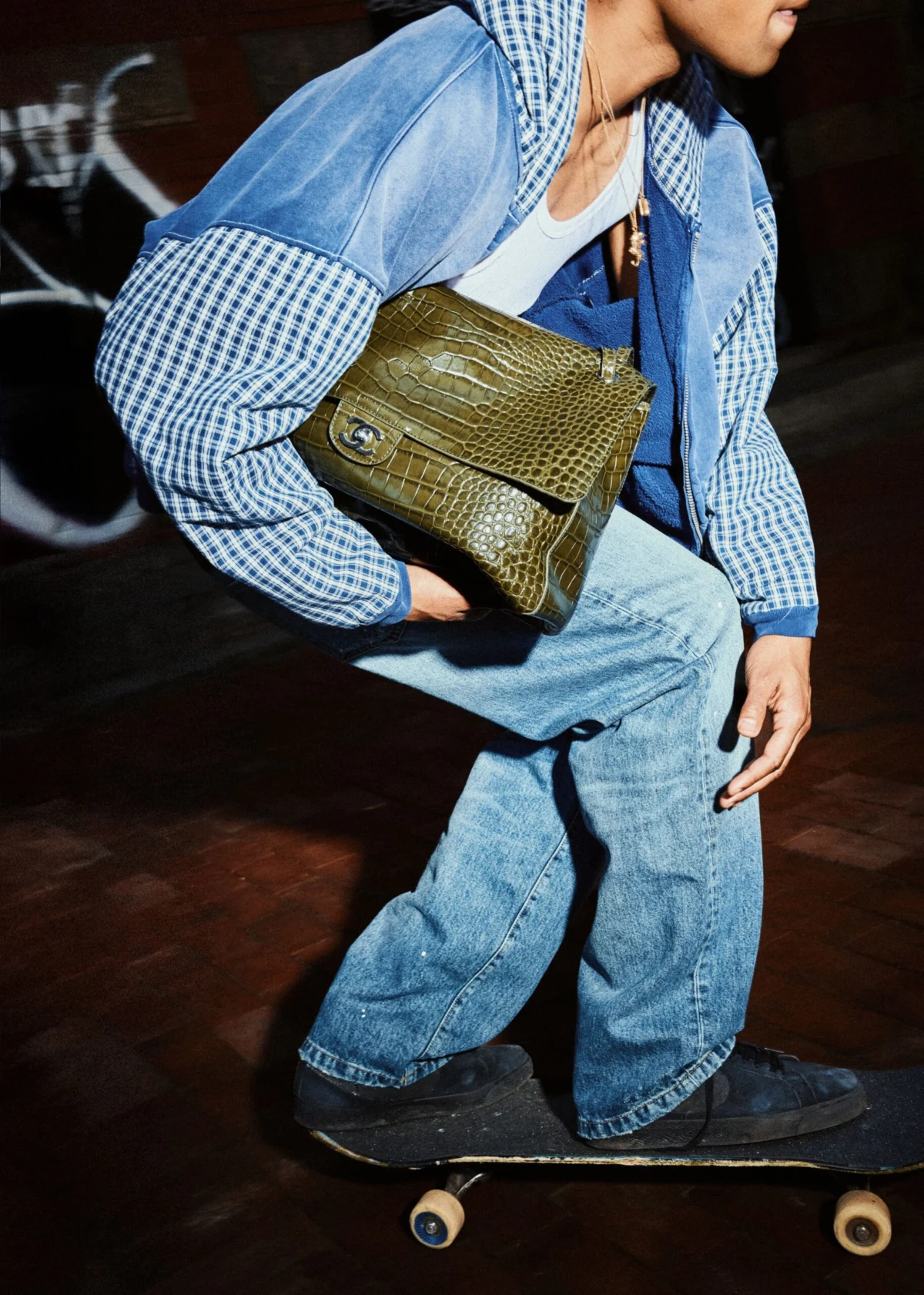
While there are plenty of soft, sexy bags on the market, we can’t stop staring at the sumptuous Chanel Flapbag. From the supernova Fall-Winter 2026 collection, this bag is a lavish landing place for your phone, keys, and wallet. Plush, croc-embossed, and adorned with those gleaming interlocked C’s on the front, it represents a radical departure from the utilitarian backpacks and "laptop-lugging" work bags that have long dominated the male commute. This specific iteration of the Flapbag, seen on the runways and increasingly on the arms of the Hollywood elite, challenges the notion that a man’s accessories must be rugged or invisible. Instead, it offers a tactile experience—a mix of exotic textures and heritage branding that serves as a focal point for an entire outfit.
But perhaps the best reason to invest in a really nice handbag? Manifesting an abundance mentality. As the great-vibes philosopher Luka Sabbat once explained: He carries a purse because he’s “only got four pockets, and they already full.” This isn’t just a logistical solution; it’s a psychological one. The act of carrying a high-end bag is an admission that you have more to carry—more resources, more ideas, more wealth, more life—than a pair of denim trousers can reasonably accommodate. Money out, money in—right? This philosophy suggests that by creating the space for abundance (in the form of a $5,000 tote or a $9,000 Bottega), you are signaling to the universe, and perhaps more importantly to yourself, that you are a person of substance and capacity.
The shift we are seeing in 2026 is the culmination of a decade-long evolution. For years, the "crossbody" served as a gateway drug for men. It was small, sporty, and could be justified as a more secure version of a fanny pack. But the current trend, led by the likes of Elordi—who has been photographed with everything from a Bottega Veneta Cassette to a Louis Vuitton Speedy—is about scale and elegance. We are moving toward "Big Bag Energy." These are bags that do not apologize for their size or their price tag. They are statement pieces that bridge the gap between high fashion and daily life.
If croc-embossed Chanel feels a little too outré or perhaps too closely associated with the classic feminine "it-bag" lineage, the market has responded with what we might call "The All-Time Greats." These are pieces for the man who wants the pedigree of a heritage house but prefers a slightly subtler, more architectural approach to luxury.
Consider, for example, the Bottega Veneta Large Andiamo Bag. Priced at approximately $8,900, it is the definition of a "power bag." Crafted from the brand’s signature Intrecciato leather, the Andiamo features a top handle and a sliding braided strap that allows it to be carried in multiple ways. It is a masterpiece of leatherwork that eschews loud logos in favor of recognizable craft. Under the creative direction of Matthieu Blazy, Bottega Veneta has become the gold standard for "quiet luxury" that still feels incredibly modern and masculine. The Andiamo, in particular, has a slouchy yet structured silhouette that feels right at home next to a double-breasted overcoat or a simple white tee and vintage jeans. It is a bag for the man who understands that true status is whispered, not screamed.
Then there are "The New-School Contenders." The classics aren’t going anywhere (except maybe to Sotheby’s, where vintage Hermès and Chanel continue to break auction records). But if you’re looking for a lower-key bag with insider street cred, any one of these alternatives makes for a righteous flex now—and an heirloom your kids will be stoked to inherit later.
Lemaire’s Large Croissant Bag, retailing for around $1,980, has become a cult favorite for a reason. Its ergonomic shape is designed to wrap around the body, making it feel more like a part of your silhouette than an external attachment. Made from soft nappa leather with topstitched seams that mimic the layers of a pastry, it’s the ultimate "IYKYK" (If You Know, You Know) accessory. It’s practical, gender-neutral, and possesses a minimalist cool that works perfectly for the urban creative who needs to carry a tablet and a notebook without looking like he’s headed to a corporate board meeting.

For those who want to lean even further into the "slouchy" aesthetic, Phoebe Philo’s Large Slouch Cabas Bag in toffee suede is a revelation. Since launching her eponymous label, Philo has doubled down on the idea of "maximalist minimalism." At $4,700, the Slouch Cabas is an investment in texture. The suede is buttery, the proportions are oversized, and the vibe is one of effortless sophistication. It is a bag that looks better the more you use it, developing a patina and a shape that reflects the life of its owner. It’s the kind of bag you throw your whole life into before jetting off to a weekend in Tangier.
However, the luxury landscape isn’t limited to European fashion houses. A burgeoning movement of "Indie Upstarts" is redefining what American leather goods can be. Looking to shop closer to home? These days, there’s a glut of small-batch American leather specialists churning out brolic, hardbody bags that promise to age better than 95% of the Constitution. These brands focus on "over-built" construction and traditional tanning methods that appeal to the man who appreciates a well-made boot or a heavy-duty denim jacket.
Ezra Arthur, based in Phoenix, Arizona, offers the Audrey Nubuck Suede XL Bag for a relatively accessible $800. This is a "workhorse" luxury bag. It’s large, durable, and made from premium nubuck that feels rugged yet refined. It’s the kind of bag that can handle being tossed into the passenger seat of a vintage Land Rover or the overhead bin of a flight to Tokyo. It represents a different kind of "abundance"—not the flash of a logo, but the abundance of quality and durability.
Similarly, Adam Wade Wagner is making waves with his Vegetable-Tanned Leather Tote Bag. At $3,400, it sits at a higher price point, reflecting the intense labor and high-quality materials involved in its creation. Vegetable tanning is an ancient process that uses natural tannins found in bark and leaves; it takes much longer than modern chrome tanning but results in a leather that is incredibly durable and develops a deep, rich character over time. Wagner’s tote is "hardbody"—it’s stiff at first but softens with age, becoming a unique record of the owner’s journeys. It’s a bag for the man who wants an heirloom, something that feels grounded in history but looks perfectly at home in a modern wardrobe.
The rise of the "Big, Beautiful Bag" for men is more than just a trend; it is a reflection of a broader cultural shift toward self-expression. We are living in an era where the "rules" of fashion are being rewritten in real-time. The idea that a man should only carry what fits in his pockets is as outdated as the idea that he shouldn’t wear pink or pearls. As we look toward the latter half of the 2020s, the handbag has become a symbol of a man who is comfortable in his own skin and confident in his taste.
Whether it’s a $9,000 Bottega or a $800 Ezra Arthur, these bags offer something that a wallet or a backpack simply cannot: a sense of occasion. They turn the mundane act of carrying your things into a stylistic choice. They allow for a level of coordination and contrast that adds depth to an outfit. Most importantly, they challenge the viewer to reconsider their own biases about what is "appropriate" for a man to carry.
In the end, the "abundance mentality" is about more than just money or pockets. It’s about the abundance of choice. It’s about the freedom to carry a bag because it’s beautiful, because the leather feels incredible, and because it makes you feel like the best version of yourself. So, can a big boy carry a big, beautiful bag? Not only can he, but in 2026, he probably should. The only question left is: which one are you going to manifest first?
