
 By admin
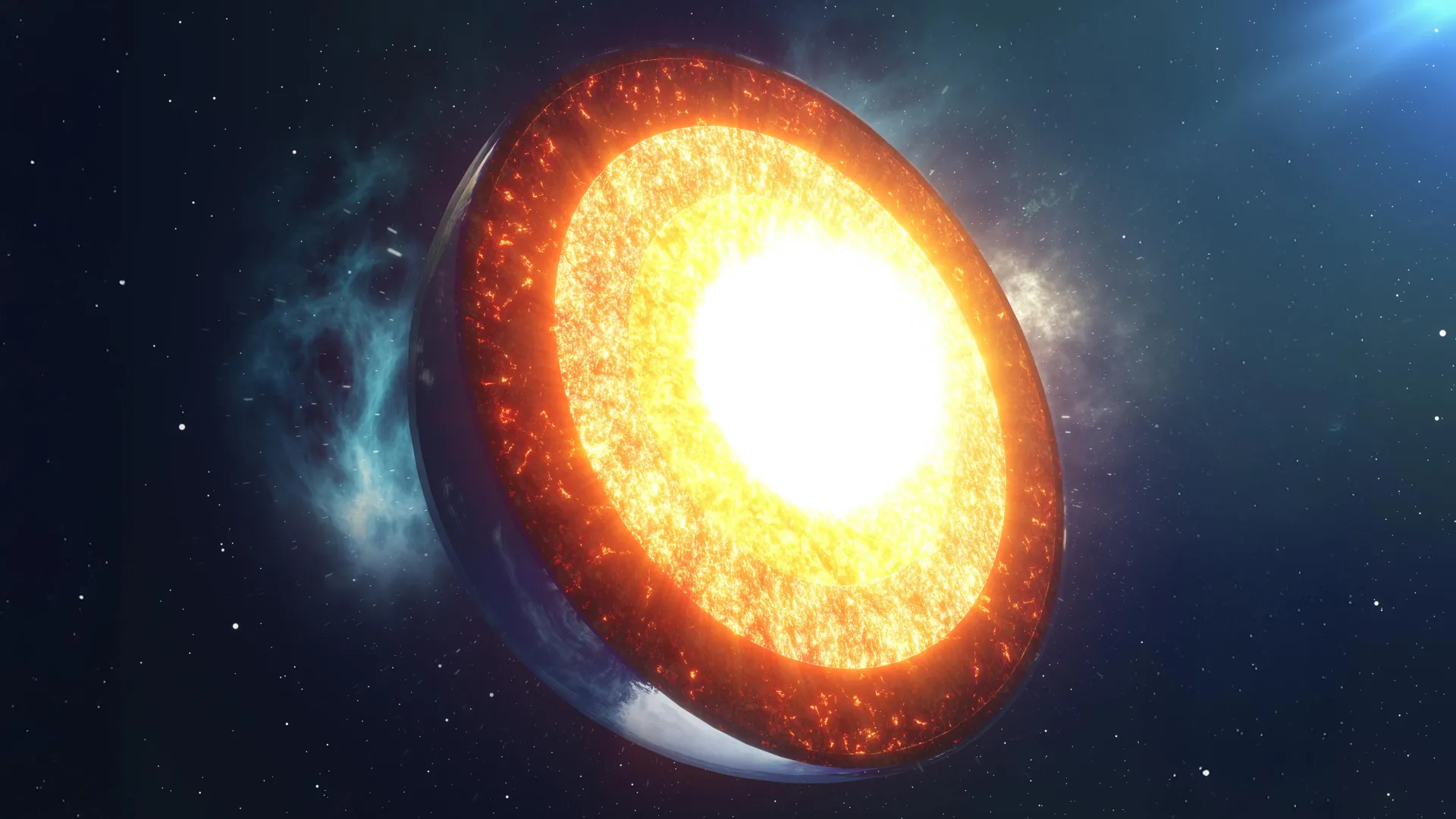
For decades, geophysicists have meticulously tracked these deviations, attributing them to a complex interplay of forces both external and internal. Tidal forces exerted by the Moon and Sun, atmospheric and oceanic currents, and even major seismic events can momentarily alter Earth’s spin. However, one of the most significant and persistent drivers of these millisecond changes originates from within the Earth itself: a mysterious exchange of angular momentum between its liquid outer core and the surrounding solid mantle. This deep-seated dance has been observed for roughly three decades, with scientists noting that the liquid outer core does not always rotate at a constant speed, its pace subtly accelerating or decelerating over multi-decade cycles. Crucially, the Earth’s mantle, the vast, rocky layer extending nearly 3,000 kilometers from the crust, responds in the opposite direction, akin to an ice skater pulling in or extending their arms to control their spin. When the core speeds up, the mantle imperceptibly slows; when the core lags, the mantle gains a tiny burst of speed. This reciprocal relationship is a fundamental consequence of the law of conservation of angular momentum, dictating that the total rotational energy of a closed system, such as Earth, must remain constant. Even these minute adjustments in the mantle’s rotation are sufficient to manifest as the observed changes in the length of a day.
Unraveling a Deep Earth Enigma: The Gravitational Torque Hypothesis
Despite the established knowledge of this core-mantle momentum exchange, the precise mechanism driving it has remained a significant enigma in geophysics. The extreme pressures, temperatures, and sheer depths involved make direct observation impossible, forcing scientists to rely on indirect measurements and sophisticated theoretical models. How exactly do these vast, distinct layers communicate and transfer rotational energy across their boundary?
A groundbreaking new study, published on September 23 in the prestigious journal Nature, offers a compelling solution to this long-standing mystery. University of Alberta physics PhD student Huifeng Zhang and professor Mathieu Dumberry propose that subtle changes in the rotational speed of Earth’s solid inner core – the planet’s scorching-hot, innermost region – can generate what they term a "gravitational torque." This isn’t just about general gravitational attraction; it’s about the nuanced interaction between specific, asymmetrical mass distributions deep within the planet.
The inner core, contrary to a perfectly smooth, idealized sphere, is understood to possess slight irregularities in its shape and density. These asymmetries could arise from various processes, including uneven crystallization of iron alloys at its boundary with the liquid outer core, thermal convection patterns, or even the lingering effects of ancient impacts or planetary formation dynamics. Similarly, the mantle, while largely solid, is not perfectly uniform. It contains regions of varying density, such as massive upwellings known as mantle plumes, downwelling tectonic plates in subduction zones, and heterogeneous compositions resulting from billions of years of geological activity.
Zhang and Dumberry’s work posits that as the inner core’s rotation rate subtly shifts, its slightly irregular gravitational field interacts with these uneven distributions of mass within the mantle. This interaction creates a "gravitational torque" – a twisting force – that can subtly tug on the mantle, influencing its rotational speed. Imagine a slightly lopsided spinning top whose wobble causes it to subtly push and pull on an uneven surface. This internal gravitational tug, though minuscule, is precisely calibrated to induce the observed millisecond alterations in the length of Earth’s day. The elegance of this solution lies in its ability to connect the deepest part of the planet, the inner core, to the surface phenomenon of day length variability through a fundamental force: gravity.
The Dynamic Equilibrium: Competing Forces at the Core-Mantle Boundary
The story of Earth’s rotation, however, is not solely dictated by this newly proposed gravitational torque. The core-mantle boundary (CMB) – the sharp, tumultuous interface between the liquid outer core and the solid lower mantle – is a critical zone where several powerful forces are constantly at play, shaping our planet’s dynamics. This boundary is characterized by extreme temperature gradients, intense pressures, and a dramatic shift in material properties, making it one of the most dynamic and least understood regions within Earth.
At this crucial interface, another significant force acts in opposition to the gravitational torque: the core-mantle boundary torque (CMBT). This torque encompasses a combination of frictional and electromagnetic drag. The liquid iron alloy of the outer core is highly conductive and vigorously convects, generating Earth’s powerful magnetic field through a process called the geodynamo. This magnetic field, in turn, interacts with the lower part of the mantle, particularly the D” layer (pronounced "D double prime"), which lies directly above the outer core and is thought to have some electrical conductivity. This interaction creates electromagnetic forces that can effectively "drag" the mantle, transferring momentum.
Furthermore, there is a viscous coupling, a form of friction, between the churning liquid outer core and the solid, though plastically deforming, lower mantle. This friction also contributes to the CMBT, acting as a brake on the relative motion between the core and the mantle. Both the electromagnetic drag and the viscous friction generate torques that effectively oppose the gravitational pull, serving as a damping mechanism. They resist excessive changes in the relative rotation rates of the core and mantle, thereby helping to limit how much Earth’s day length can fluctuate.
According to Zhang and Dumberry, the small, observed variations in the length of a day are not due to any single force acting in isolation, but rather arise from subtle, continuous shifts in the delicate balance between the newly identified gravitational torque and the established core-mantle boundary torque. When the gravitational tug strengthens or weakens, or when the resistive forces of friction and electromagnetic drag fluctuate, the equilibrium is momentarily disturbed, resulting in a slight acceleration or deceleration of the mantle and, consequently, a change in the length of our day. This dynamic equilibrium underscores the complexity and interconnectedness of Earth’s internal systems.
A Living Core: Redefining Earth’s Deepest Interior
Beyond providing a compelling explanation for a long-standing geophysical mystery, the findings of Zhang and Dumberry offer profound new insights into the nature of Earth’s deepest interior, particularly the enigmatic inner core. For decades, the inner core, composed primarily of solid iron-nickel alloy, has often been conceptualized as a relatively rigid and static body, slowly growing as the outer core material crystallizes onto its surface.
However, the new research suggests a far more dynamic picture. The authors state that the inner core appears to "deform viscously" on a remarkably short geological timescale – approximately 10 years. "Viscous deformation" in a solid body doesn’t imply melting; rather, it refers to a slow, plastic flow or creep under immense pressure and high temperatures, where the material gradually changes shape without fracturing. This is analogous to how glaciers, though solid ice, flow over land over extended periods.
The implication of a 10-year timescale for such deformation is truly significant. It suggests that Earth’s innermost region is not an inert, unyielding sphere, but rather a body that can dynamically respond to the forces acting upon it much more rapidly than previously thought. This accelerated dynamism could be driven by internal convection within the inner core itself, by localized melting and recrystallization processes at its boundary, or by the stresses induced by the planet’s overall rotation and the geodynamo in the outer core.
This revelation has far-reaching implications for our understanding of several fundamental Earth processes. A more dynamic inner core could play a more active role in the generation and maintenance of Earth’s magnetic field, potentially influencing its stability and reversals over geological time. It could also affect the transfer of heat from the core to the mantle, which in turn drives mantle convection and ultimately powers plate tectonics on the surface. Understanding the inner core’s deformational behavior could also refine our interpretations of seismic waves that pass through it, offering a more accurate picture of its structure and composition.
Looking Ahead: The Future of Geodynamics
The work by Zhang and Dumberry represents a significant leap forward in geophysics, bridging disparate observations of Earth’s rotation with the intricate physics of its inaccessible deep interior. It underscores the power of theoretical modeling combined with precise observational data in unraveling the planet’s most profound secrets.
The next steps for research will undoubtedly involve further refining these models, potentially incorporating more complex representations of inner core asymmetry, mantle heterogeneity, and the precise coupling mechanisms at the CMB. Experimental geophysics, simulating extreme core conditions in laboratories, and increasingly sophisticated seismic tomography – which uses earthquake waves to create 3D images of Earth’s interior – will be crucial for validating and expanding upon these theoretical predictions.
Ultimately, understanding the subtle dance of Earth’s core and mantle, and how it dictates the length of our day, is more than an academic exercise. It is a fundamental quest to comprehend the engine that drives our living planet, from the protective shield of its magnetic field to the tectonic forces that shape its surface and influence its climate over vast stretches of time. Each millisecond gained or lost in a day tells a story of the powerful, unseen forces at work beneath our feet, reminding us that even the most seemingly constant aspects of our world are in fact in a perpetual state of dynamic flux.
