
 By admin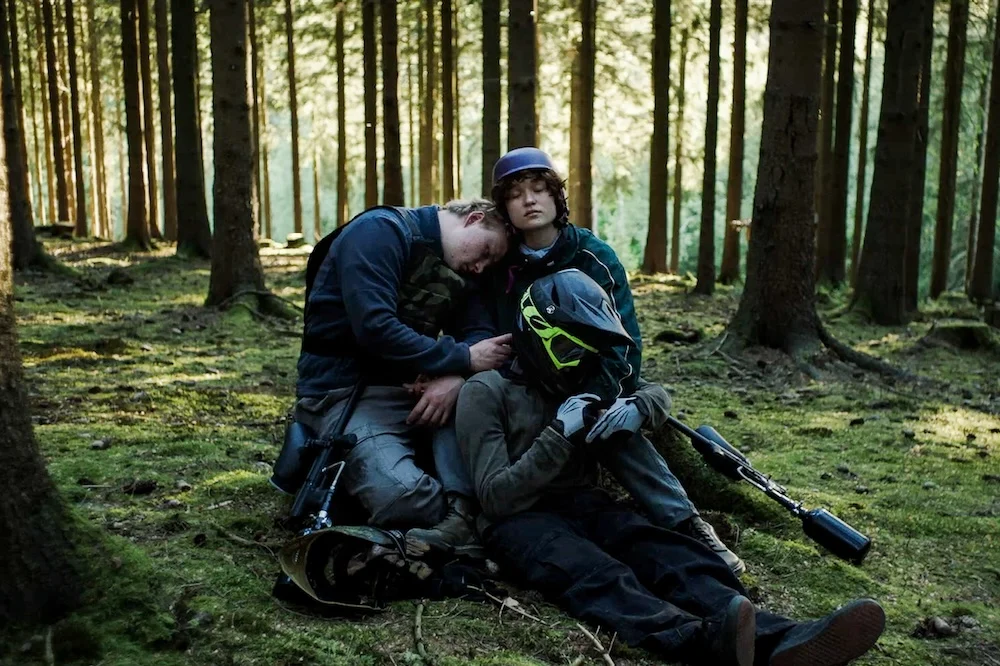
The tumultuous journey through adolescence, often painted as a desolate wasteland, is more aptly represented by the dense, interconnected ecosystem of a forest for the interdependent trio at the core of Jannis Lenz’s "Oasis," a disquieting and meticulously crafted debut feature from the German-born, Austrian-trained filmmaker. Retreating from the pressures and ostracization of their German hometown, three high-schoolers forge an arcane, shared reality within the surrounding woods, a sanctuary that offers them solace, unwavering support, and an unburdened space to explore the boundaries of their identities and desires. Yet, Lenz’s steady, melancholic gaze imbues the film with a pervasive ambivalence, leaving the audience to ponder whether this self-created haven is a balm or a trap, and if in finding each other, these adolescents risk losing themselves to the wider world. This existential quandary echoes the timeless adage: the forest can be lost for the trees, a sentiment that resonates deeply within the film’s nuanced exploration of youthful alienation.
At the heart of this insular world is Lukas, portrayed with a subtle, unsettling intensity by Florian Geißenmann. He is a boy defined by his quietude, his artistic sensibilities, and a profound inclination towards introspection, traits that, in hindsight, are often retrospectively attached to individuals who become perpetrators of violence. This association, however, is merely a shadow of a potential future, a chilling descriptor that he, unfortunately, embodies in his quiet solitude. His social standing within the school is not actively antagonistic, despite the inherent social handicap of having his father, Martin (Godehard Giese), as a teacher at the very institution he attends. Martin, who has been Lukas’s sole parent since the recent passing of his mother, navigates this delicate professional and personal dynamic with a subdued weariness. Lukas’s social landscape begins to shift, however, when he forms an unlikely bond with Andi (Anton Petzold), a larger, wounded adolescent whose father, a soldier, has recently been stationed at a nearby military base. This friendship, seemingly innocuous, marks a discernible decline in Lukas’s already limited social capital within the school. Initially, this perceived loss doesn’t significantly perturb Lukas, as he possesses an unshakeable reliance on his closest confidante, Maya (a truly breakout performance by Mathilda Smidt). Maya, who seemingly lives without parental supervision in a sprawling, sun-drenched house, attends a specialized music academy. The film opens with an appropriately strange and rhythmic cadence, featuring Maya’s vocal exercises as her class practices their plosives and sibilants, a sonic landscape that foreshadows the unconventional world the trio will inhabit.
The visual language of "Oasis" is as deliberate as its narrative, with cinematographer Alexander Dirninger, who also co-penned the elegantly sparse screenplay with Lenz, observing the slow-burning action with a cool, detached dispassion. This stylistic choice compels the viewer to actively engage with the characters’ behaviors, often taking time to decipher the underlying motivations and emotions at play. This deliberate withholding of information, while a powerful narrative tool, can, at times, become slightly wearisome, particularly during a somewhat protracted middle act. However, this approach is not unexpected, given Lenz’s formative apprenticeship with key figures from the school of severe Austrian formalism. The film can be glibly summarized as "Michael Haneke goes to High School," a comparison that highlights its commitment to a stark, observational style that prioritizes psychological depth over overt exposition. For instance, it takes several scenes for the audience to comprehend Lukas’s seemingly peculiar actions. When he meticulously cuts the shoulder pads out of his deceased mother’s blouses and tapes them around his torso, it’s not a manifestation of some dysfunctional grieving process. Instead, he is ingeniously constructing a homemade flak vest, a protective garment for his clandestine meetings with Andi in the woods, where they engage in high-stakes paintball gun duels. His taped-up t-shirt, far from being genuine Kevlar, offers little in the way of actual protection, as evidenced by the livid, baseball-sized bruise that blossoms on his shoulder after one such encounter.
Following one of their intense paintball skirmishes, Lukas and Andi find themselves in a quiet field, the companionable silence punctuated only by the rhythmic, hypnotic whomp-whomp of nearby wind turbines. They sit, smoking cigarettes, their unspoken connection palpable. The sound design, a masterclass in atmospheric storytelling by Nora Czamler and Benedikt Palier (who also contributes the disquieting, echoey score), is particularly superb, amplifying the emotional weight of their shared stillness. Yet, beneath this veneer of calm, a storm is brewing. Unbeknownst to them in that moment, a video depicting Andi’s brutal humiliation at the hands of his classmates has begun to circulate virally on social media. In the ensuing days, Andi’s reactions to the escalating taunts manifest in occasional defensive outbursts, which inevitably draw the unwanted attention of school authorities, further isolating him.
Lukas, perhaps paralyzed by the fear of becoming a target himself, rarely intervenes in Andi’s public torment. This passivity elicits a frustrated outburst from Andi later in the film: "Why don’t you ever do anything?" Nevertheless, Lukas does introduce Andi to Maya, and in a subtle, almost organic process, the three of them begin to form a potent, almost symbiotic bond. They gently, tentatively, coax each other into increasingly peculiar, unsavory, and undeniably sex-adjacent—though never explicitly sexual—games of touching, biting, and bruising. These rituals evolve from a mere outlet for their inarticulate feelings of shame and anger into a deeply ingrained inlet, drawing them further into a potentially unhealthy, yet undeniably potent, emotional co-dependence. This deepening entanglement serves to further estrange them from their peers, solidifying their status as outsiders within the already rigid social hierarchy of high school.
The adults in their lives remain largely oblivious to the true nature of their children’s struggles and the intricate dynamics of their self-constructed world. Martin, Lukas’s father, expresses concern over his son’s surly withdrawal from their formerly amicable father-son dinners and spontaneous Guitar Hero sessions. However, this concern is rooted in a superficial understanding of Lukas’s inner life. Similarly, the school principal, the faculty, and the concerned parents of Lukas and Andi’s classmates operate under the assumption that they possess an innate understanding of their children’s best interests. Yet, they possess only the vaguest notion of what truly captivates and consumes their children’s attention and emotional energy. Lenz’s film subtly draws a parallel between the group dynamics at play among the teenagers and those observed among their supposed guardians. It suggests that the instinct to solidify one’s position within a group by ostracizing or targeting its most vulnerable members is not a trait that diminishes with age; rather, it simply metastasizes into more sophisticated, and often more insidious, variants.
In a particularly jarring attempt to sway Lukas’s sympathies away from Andi, the school counselor, Britta Hammelstein, delivers a statement that is as ethically questionable as it is clinically unsound: "Sometimes the victim role is a personal choice." This pronouncement, delivered by a supposed therapeutic professional, is profoundly disturbing. However, regardless of the adults’ misguided interventions, their efforts to separate the trio only serve to draw them closer together, propelling them towards ever more intimate acts of mutual masochism and self-harm. The film poses a critical question: are these increasingly intense rituals a valuable pressure valve, a means of defusing potentially antisocial behavior before it escalates? Or are they an early stage of escalation, a rehearsal for actual, non-consensual, outward-directed violence? Are these games an exorcism of their inner demons, or are they simply practice for something far more destructive? As Lenz’s taut, self-contained narrative begins to unravel in its final act, which some might find disappointingly open-ended, the film leaves the audience to contemplate the ultimate fate of this clandestine club. What becomes of their arcane rites and secret ceremonies when the ostensibly safe, accepting space that fostered their existence reveals itself to be less of an oasis and more of an ephemeral mirage, a fleeting illusion in the harsh reality of the world? The enduring power of "Oasis" lies in its refusal to offer easy answers, instead immersing the viewer in the complex, often uncomfortable, psychological landscape of adolescent alienation and the desperate search for connection.
