
 By admin
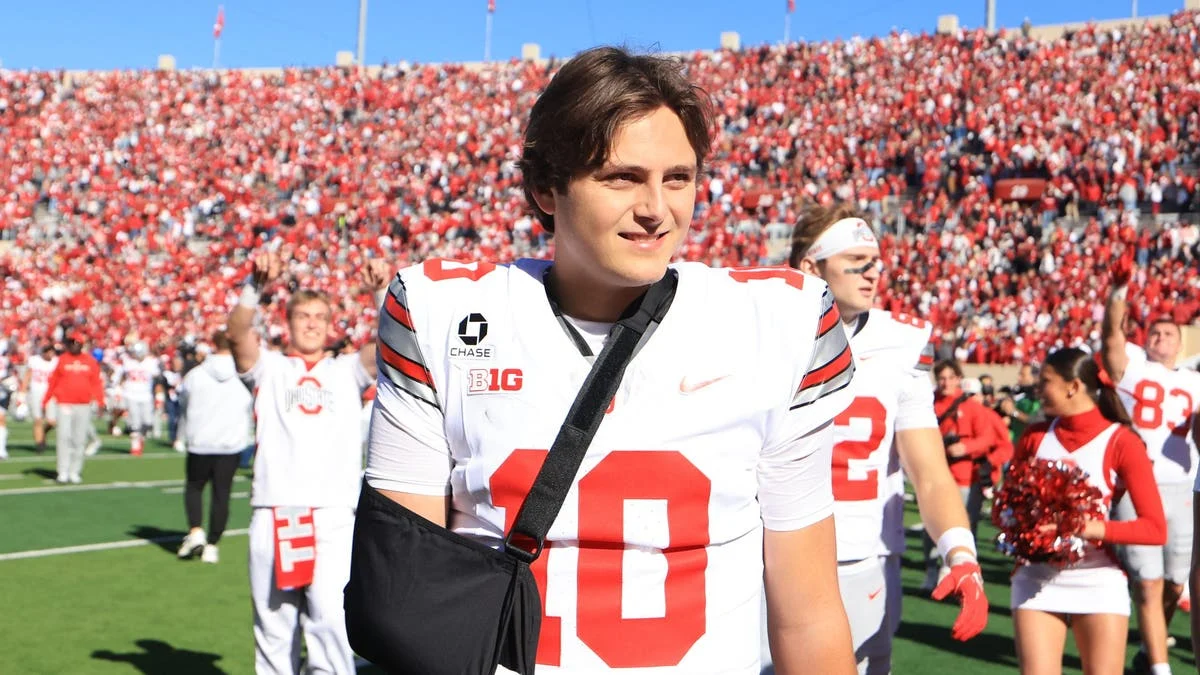
The celebratory mood following Ohio State’s hard-fought 19-15 victory over Indiana in Bloomington last Saturday has been significantly dampened by a serious injury to starting quarterback Julian Sayin. The win, which served as a measure of revenge for a previous Big Ten championship game loss, may have come at a steep price, as Sayin’s absence casts a considerable shadow over the Buckeyes’ remaining season and their hopes for a national championship. The extent of the injury, confirmed by head coach Ryan Day on Tuesday, has left the team facing a daunting challenge: navigating the crucial latter half of the season and potential postseason play without their primary signal-caller.
Sayin, who had established himself as a key offensive weapon for Ohio State, entered Week 7 tied for fourth nationally with 17 passing touchdowns and ranked sixth among FBS quarterbacks with an impressive 1,772 passing yards. His consistent performance had been a driving force behind the Buckeyes’ 6-1 record, their sole defeat coming against a formidable Texas team. However, with approximately eight minutes remaining in the fourth quarter against Indiana, Sayin was forced to leave the field and head to the locker room, a moment that quickly turned from a potential game-sealing drive into a source of significant anxiety for the Ohio State faithful.
On Tuesday, three days after the game, head coach Ryan Day delivered a stark update: Sayin is "out indefinitely." More concerningly, the program is reportedly preparing for the scenario that Sayin might miss the remainder of the regular season and the entire postseason. This grim prognosis underscores the severity of the injury and the profound impact it will have on the Buckeyes’ strategic planning and on-field execution in the coming weeks and months.
The pivotal moment that led to Sayin’s injury occurred in the fourth quarter against the Hoosiers. On a first-and-10 play from Indiana’s 38-yard line, Sayin was sacked by the Hoosiers’ defense. While he managed to recover the fumbled ball, the play itself appears to have been the catalyst for his departure from the game. Prior to this unfortunate incident, Sayin had been having a productive outing, completing 15 of his 29 passes for 235 yards, with two touchdowns and two interceptions. His ability to move the ball and orchestrate the offense had been a hallmark of Ohio State’s success, making his sudden absence a significant tactical blow.
Following the sack, Sayin did not return to the field to continue playing in the game against Indiana. However, he was visible on the sidelines towards the end of the contest. Upon emerging from the locker room, he was observed with his throwing arm, his right arm, in a sling. This visual confirmation of an injury to his primary passing limb amplified the concerns surrounding his condition and hinted at the potential long-term implications of the ailment.
Ohio State’s head coach, Ryan Day, faced immediate questions about Sayin’s injury following the Buckeyes’ hard-fought victory. In an on-field interview with FOX Sports’ Jenny Taft, Day acknowledged the situation, stating, "I don’t have [an update] right now. Obviously, that was a big blow to us, but the rest of the team picked it up for us." While this response demonstrated a commendable focus on the team’s resilience in the immediate aftermath, it also conveyed the uncertainty surrounding Sayin’s status.
Later, at his post-game press conference, Day offered a slightly more detailed, albeit still cautious, update. As reported by Ben Portnoy, Day initially indicated that Sayin was expected to be sidelined for a couple of weeks. This initial assessment, while concerning, suggested a potentially manageable recovery period. However, the subsequent update from Day on Tuesday revealed a far more serious outlook, moving beyond a simple two-week absence to an indefinite period of unavailability.
The head coach’s definitive statement on Tuesday painted a clear picture of the team’s revised expectations. "We’re not going to put any timeline on his recovery, but he is out indefinitely," Day declared. "Based on the nature of the injury, we are putting a plan for him not being available for the regular season, and then also, him not being available for the postseason." This strategic foresight, while difficult to accept for fans, is a pragmatic approach that prioritizes the long-term health of their quarterback and the team’s overall strategic planning. It signals a shift in focus from managing a short-term absence to preparing for a significant period without their starting quarterback.
With Julian Sayin sidelined, the spotlight now falls squarely on Ohio State’s backup quarterback, true freshman Luke Fahey. Fahey, a three-star recruit from Mission Viejo, California, according to 24/7 Sports’ composite ratings, entered the Indiana game in the fourth quarter when Sayin was injured. This Week 7 contest marked only the third game of the season for Fahey, having previously seen action in Ohio State’s wins against Ball State and Kent State in September. Throughout the year, Fahey has completed 9 of his 11 passes for 203 yards, with two touchdowns and two interceptions. While these statistics show promise, the pressure of stepping into the starting role for a team with championship aspirations is immense, and Fahey’s experience is limited. The Buckeyes’ offensive scheme and their ability to execute at a high level will undoubtedly be tested with a freshman quarterback under center.
The remaining schedule for Ohio State presents a formidable gauntlet, further amplifying the impact of Sayin’s injury. Following their victory over Indiana, the Buckeyes stand at 6-1, with their lone loss coming against the highly-touted Texas Longhorns. After a crucial bye week in Week 8, Ohio State faces a challenging stretch that includes a road game against USC, a program with its own rich history and significant talent. The implications of Sayin’s absence for these critical matchups, and indeed for the entire remainder of the regular season, are profound. The team’s ability to maintain its winning trajectory and secure a spot in the College Football Playoff will hinge on the performance of their backup quarterback and the overall adaptability of the coaching staff.
Ohio State’s remaining regular-season schedule is as follows:
- Week 8: BYE
- Week 9: at USC – A high-profile road game against a conference rival that will immediately test the Buckeyes’ depth at quarterback.
- Week 10: vs. Michigan State – A home game that should, on paper, be a more manageable contest, but any Big Ten game can present surprises.
- Week 11: at Northwestern – Another road game against a conference opponent, requiring sustained focus and execution.
- Week 12: vs. Iowa – A potentially crucial conference clash that could have significant implications for Big Ten championship contention.
- Week 13: vs. Michigan – The ultimate test for any Ohio State team, the rivalry game against Michigan will be even more intense with the added pressure of a new starting quarterback.
The severity of Sayin’s injury and the uncertainty surrounding his return create a compelling narrative arc for the Buckeyes’ season. While the team demonstrated resilience in overcoming Indiana without him for a significant portion of the game, the long-term outlook is far from clear. The development of Luke Fahey, the strategic adjustments made by Coach Day and his staff, and the overall mental fortitude of the team will be critical in determining whether Ohio State can navigate this challenging period and contend for the ultimate prize. The road ahead is undoubtedly more arduous, and the Buckeyes will need to rally together, showcasing the depth and character that define championship-caliber programs. The focus now shifts from celebrating a hard-won victory to meticulously planning for a future that, just days ago, seemed far more secure. The impact of Julian Sayin’s injury will be a defining storyline for Ohio State’s 2024 season.
