
 By Titik Puspa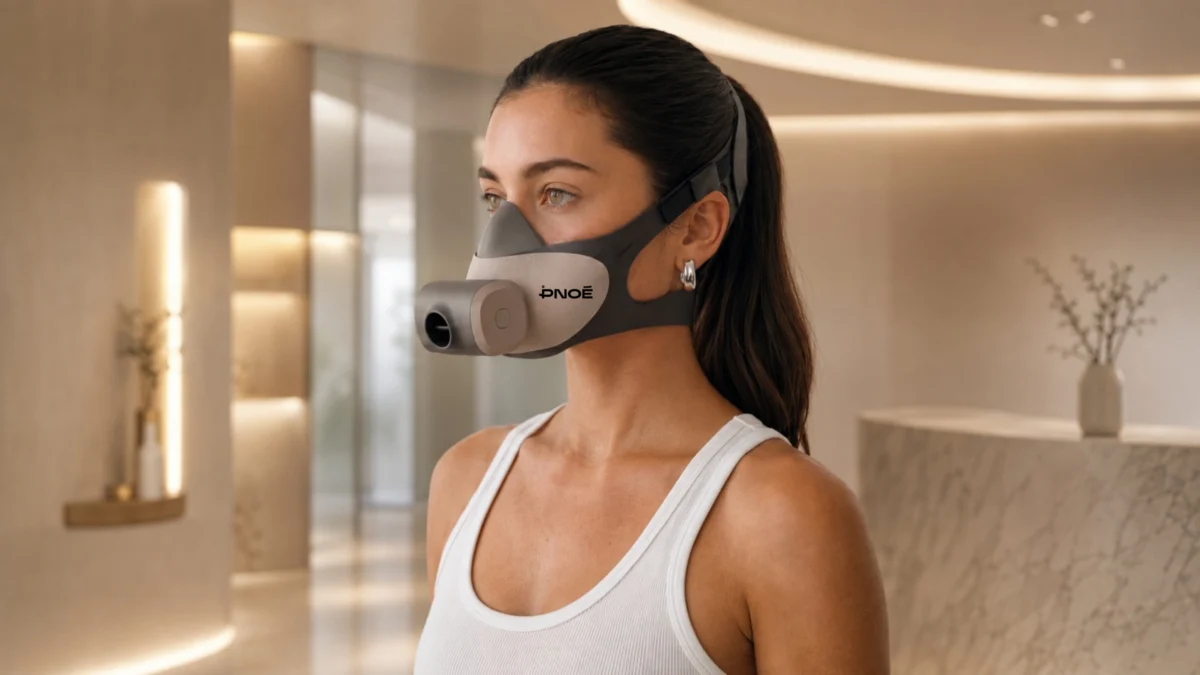
A striking new device from PNOë, poised for its public debut on October 1st, is set to revolutionize the wellness industry. While its initial appearance might evoke comparisons to the iconic mask worn by Batman’s formidable foe, Bane, its true purpose is far more benevolent and deeply rooted in scientific advancement. This innovative mask, designed to cover the nose and mouth and secure around the back of the head, meticulously measures a user’s oxygen consumption and carbon dioxide exhalation. The sophisticated data gleaned from this simple, eight-minute breathing test is then transformed into actionable advice, guiding individuals on optimal nutrition, personalized training regimens, and ultimately, the company’s ambitious vision for extending human lifespan.
PNOë, a company with its operational headquarters in Malden, Massachusetts, and significant operations in Athens, Greece, is about to launch the PNOë 2.0, a significant upgrade to its existing technology. The pivotal enhancement lies in its self-administered functionality. Co-founder and CEO Apostolos Atsalakis explained the user experience during a recent Zoom call from the company’s Athens office: "Someone can walk into a gym, just wear the mask, push the button, sit down, and breathe for eight minutes. That’s it. It’s that easy." This democratization of advanced metabolic testing is a critical development. Previously, the PNOë device necessitated a trained operator, thereby limiting its accessibility to specialized sports labs and hospitals. The self-serve nature of the PNOë 2.0 promises to unlock a vast new market, making advanced physiological insights available in fitness centers that may lack dedicated staff, and potentially even in pharmacies and other community health hubs.
The scientific underpinnings of PNOë’s technology are not novel; they are built upon the robust foundation of metabolic testing, a practice that has been instrumental in understanding human energy production for over a century. This field analyzes the gaseous composition of a person’s breath to precisely gauge how their body metabolizes fuel. For decades, metabolic testing has been considered the gold standard for measuring VO₂ max, a critical metric representing the maximum amount of oxygen the body can utilize during strenuous physical activity. VO₂ max is widely recognized as a key indicator of cardiorespiratory fitness and overall physical conditioning. However, the traditional deployment of this science has been hampered by the requirement for bulky, expensive, and complex equipment, confining its use primarily to elite athletes undergoing rigorous testing in specialized sports laboratories or to patients in clinical settings. This historical limitation has effectively placed advanced metabolic insights out of reach for the general population, relegating them to the exclusive domain of professional athletes and high-level executive wellness programs.
What the decade-old PNOë aims to achieve is the delivery of the same scientific accuracy and diagnostic power, but within a portable, user-friendly package. Crucially, this is coupled with intelligent software designed to translate complex physiological data into readily understandable and actionable recommendations. "We made it accessible to everyone," Atsalakis emphasized, highlighting the company’s core mission. The PNOë 2.0 test is engineered to capture an impressive 23 distinct biomarkers. Beyond the precise measurement of VO₂ max, these biomarkers include the resting metabolic rate (RMR), which quantifies the number of calories an individual burns at rest, and metabolic flexibility, a crucial indicator of how efficiently the body can switch between utilizing fats and carbohydrates for energy. Atsalakis passionately argues that these metabolic metrics offer insights that traditional blood tests simply cannot provide, such as answering fundamental questions about an individual’s precise caloric needs or dictating the most effective training strategies for their unique physiology.
The timing of the PNOë 2.0’s release appears exceptionally opportune. The concept of VO₂ max has surged in popularity within longevity circles, fueled by a growing body of research that consistently links higher levels of cardiorespiratory fitness with a reduced risk of mortality. Atsalakis himself considers VO₂ max to be the single most potent predictor of human longevity, viewing PNOë’s data as a comprehensive scorecard for the rapidly expanding and increasingly sophisticated wellness industry.
The design of the new device reflects a significant leap forward in terms of both portability and user experience. The PNOë 2.0 is notably smaller and more compact than its predecessor, featuring a streamlined design with fewer components. This intentional reduction in complexity, according to Atsalakis, enhances its overall reliability. The development process was a collaborative effort with Milan-based Design Group Italia, involving what Atsalakis described as "a lot, a lot, a lot of iterations." This extensive design phase was necessitated by the unprecedented nature of creating a self-administered metabolic testing device, a challenge that required innovative solutions and persistent refinement.
Furthermore, the PNOë 2.0 addresses a practical concern that has become increasingly salient in a post-pandemic world: hygiene and shared usage. The device is ingeniously designed with detachable electronics from the silicone mask and straps. This allows for multiple individuals to share the core hardware, a significant cost-saving measure, while each user maintains their own personal, hygienic mask. This thoughtful engineering not only enhances accessibility but also promotes a more sustainable and shared approach to advanced health monitoring.
Despite its advanced clinical capabilities and aspirations, PNOë maintains a cautious stance regarding its claims. The device has not yet received clearance from the U.S. Food and Drug Administration (FDA), and Atsalakis is explicit about the company’s boundaries: "we do not provide medical recommendations." Instead, PNOë positions itself firmly within the wellness technology sector, drawing parallels to other consumer health devices. "It’s like a body composition device, like a scale," Atsalakis explained. "A doctor cannot prescribe medication based on our results." This clear demarcation is crucial for regulatory compliance and managing user expectations, ensuring the device is utilized as a tool for personal insight and optimization rather than a substitute for professional medical diagnosis.
Looking ahead, the potential for PNOë’s technology to evolve into a diagnostic tool is a compelling prospect. Researchers have long investigated the possibility of identifying specific compounds in human breath as indicators of various diseases, including certain types of cancer. Atsalakis believes that the ever-growing repository of data collected by PNOë could, in the future, empower the company to assist in flagging potential health issues. However, he readily acknowledges that the realization of such diagnostic capabilities is "definitely a couple of years away," with significant regulatory hurdles anticipated to extend this timeline further. "We’re not there yet," he stated candidly, underscoring the company’s commitment to a phased and responsible approach to innovation.
The genesis of PNOë can be traced back to Atsalakis’s doctoral research at the University of Cambridge, where his work in sensing technologies intersected with the burgeoning field of wearable devices. Fascinated by the profound physiological information that could be extracted from human breath, he envisioned a future where such insights were readily accessible. He co-founded the company with Panos Papadiamantis, a childhood friend who now serves as the company’s Chief Product Officer, bringing together complementary expertise and a shared vision.
The startup gained significant traction by participating in Y Combinator’s Winter 2019 batch, a period when the concept of "longevity" was nascent and not yet the burgeoning industry it is today. Since then, PNOë has successfully raised approximately $22 million in funding, including a recently closed $11 million round. Notable investors include 50 Years, an investment firm focused on long-term societal challenges, and Lars Rasmussen, the co-founder of Google Maps, who is now based in Athens, further solidifying the company’s European ties.
PNOë’s business model is exclusively business-to-business (B2B), selling its devices and services to companies that then offer them to their clientele. This strategy has proven highly effective, with prominent clients such as Equinox, where the device is available at nearly all of its fitness clubs, Four Seasons hotels, Red Bull, the NBA, the Mount Sinai Health System, and the popular med spa chain Restore Hyper Wellness. Atsalakis noted that approximately 85% of PNOë’s business originates from the United States, which he characterizes as "by far the most advanced market globally" for longevity-focused wellness solutions. The company is actively pursuing international expansion, with growing presence in Europe and strategic partnerships facilitating reach into Latin America and Asia.
The subscription model for businesses typically ranges from $400 to over $1,000 per month. This comprehensive package, which Atsalakis refers to as a "business in a box," covers not only the hardware and software but also provides essential training and marketing materials. PNOë further enhances the value proposition by integrating its test results with the specific services offered by its business clients. This allows gyms and spas to provide highly personalized recommendations for their offerings based on a customer’s unique metabolic profile. Atsalakis mentioned that many clients leverage the PNOë test as an integral part of their customer onboarding process, positioning it as a sophisticated assessment that bridges the gap between the generalized data provided by smartwatches and a comprehensive clinical examination.
The competitive landscape for personal health monitoring is undeniably crowded and rapidly evolving. Tech giants like Apple, Garmin, and Whoop are leveraging heart-rate data to estimate VO₂ max, while consumer-facing devices such as Lumen utilize breath analysis to gauge fat and carbohydrate metabolism. At the higher end of the spectrum, traditional, cumbersome metabolic carts continue to be the benchmark in professional laboratory and hospital settings. PNOë differentiates itself by offering a scientifically validated metabolic assessment that is both highly accurate and remarkably accessible.
With a dedicated team of 110 employees, PNOë reports that it has recently achieved profitability while maintaining an impressive growth rate exceeding 100% year-over-year. Atsalakis outlined the company’s ambitious plans for the near future, including the intention to raise a Series B funding round within the next six to twelve months. The primary objective of this capital infusion will be to further expand the reach of their innovative mask – Bane comparisons and all – placing it on the faces of an ever-growing number of individuals eager to unlock the secrets of their metabolism and optimize their journey toward enhanced health and longevity.
