
 By admin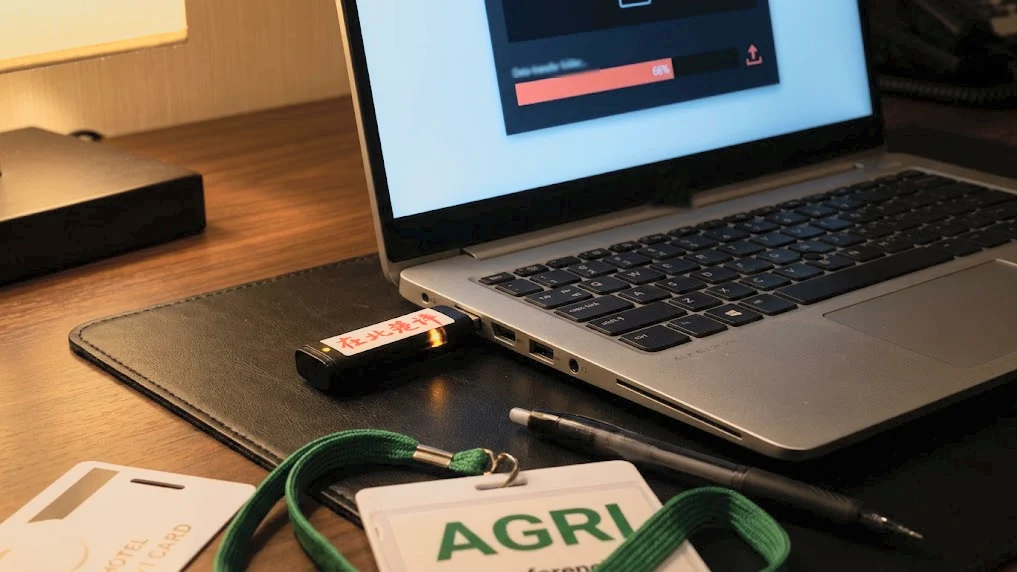
A sophisticated cyberattack, bypassing conventional defenses like phishing and network intrusion, saw Chinese state-linked hackers gain access to executive laptops at an agricultural industry conference on Hainan Island this spring. The audacious operation, meticulously detailed by cybersecurity firm CrowdStrike and dubbed an "evil maid attack," involved physically entering hotel rooms and infecting devices with malware via a USB stick while their owners were away, typically during evening hours. CrowdStrike, which tracks the group as OVERCAST PANDA, revealed the campaign in its 2026 Threat Hunting Report, highlighting a novel approach that exploits physical access to bypass robust digital security measures.
The timeline of the intrusions, shared by Adam Meyers, CrowdStrike’s senior vice president of counter adversary operations, paints a clear picture of the operation. An intruder entered one hotel room around 8 p.m. local time and a second by 9:57 p.m. The attackers then wrote a backdoor known as FlowCloud directly to each laptop’s storage. The machines were subsequently rebooted, leaving no trace of network intrusion, phishing emails, or compromised credentials. This method fundamentally subverted standard security protocols that rely on network perimeters, user awareness, and authentication mechanisms.
CrowdStrike’s OverWatch team disrupted these intrusions, which occurred between March and May 2026. They assess that OVERCAST PANDA will almost certainly continue its operations, leveraging similar tactics. The FlowCloud malware itself is not new; Proofpoint documented its use in 2020, delivered via phishing to U.S. utilities. More recently, NTT Security’s Security Operations Center has tracked USB-delivered FlowCloud infections at overseas branches of Japanese organizations since early 2022, underscoring its persistent threat.
The term "evil maid attack" was coined by security researcher Joanna Rutkowska in 2009, who demonstrated how a bootable USB stick could be used to compromise an unattended laptop. While physical access operations are relatively rare among the 290 named adversaries tracked by CrowdStrike, OVERCAST PANDA’s execution represents a significant evolution. Unlike the "MUSTANG PANDA" variant, which relies on the victim plugging in a dropped USB stick, this campaign involved direct physical access to the devices themselves. Meyers identified the innovation as the confluence of state intelligence services orchestrating hotel room entries with direct malware deployment, booting the target machine from the USB rather than depending on user interaction to initiate the infection.
When the targeted executives powered on their laptops the following morning, the FlowCloud backdoor would activate. This initiated a range of malicious activities, including keylogging, screen capture, file collection, and credential harvesting. Meyers explained to VentureBeat that CrowdStrike’s visibility begins once the operating system boots up. A registry key or similar trigger starts FlowCloud shortly after the OS loads, allowing the Falcon sensor to detect its presence. The critical vulnerability lies in the period between the USB write operation and the next boot—hours during which the laptop remains compromised and undetected before the executive logs back in.
CrowdStrike’s disclosure of this campaign occurred a month prior to their announcement of an expanded AI security product suite at Fal.Con 2026, which included Falcon Guardian, SafeMind, the Agentic Identity Provider, and AI Gateway. These new offerings aim to address the evolving threat landscape, which includes sophisticated attacks like the one perpetrated by OVERCAST PANDA.
Why Existing Security Tools Missed the Mark
The effectiveness of the OVERCAST PANDA attack highlights a fundamental weakness in many traditional cybersecurity tools. Endpoint Detection and Response (EDR) solutions require the operating system to be loaded and their agent to be running to function. Multi-Factor Authentication (MFA) is triggered by login attempts, phishing training addresses malicious emails, and AI agent security focuses on securing active agents. OVERCAST PANDA bypassed all of these at the point of entry. The initial compromise was executed below the level of the running operating system, beneath the EDR agent, and prior to the authentication stack. While Falcon eventually detected FlowCloud once its process began after boot, the implant and its activation mechanism were already embedded on the laptop’s disk.
"Hotel entry is a very common thing," Meyers remarked, noting that corporate physical security teams are generally aware of such risks. "But I think what is unique is the combination of hotel entry with deployment of malware." Meyers believes that China’s Ministry of State Security (MSS) is behind OVERCAST PANDA, with the individuals entering the rooms being either MSS or Ministry of Public Security officers, or potentially bribed or coerced hotel housekeeping staff. The report also details a mid-2026 intrusion targeting a U.S.-based media professional using identical tradecraft. The targeting of an agricultural conference aligns with intelligence collection priorities that Meyers has previously linked to China’s national five-year plans.
CrowdStrike’s Fal.Con Announcements and the Dawn of Runtime Security
At Fal.Con 2026, Nvidia CEO Jensen Huang joined CrowdStrike CEO George Kurtz to unveil SafeMind, an agentic cybersecurity system built on Nvidia’s Nemotron open models and CrowdStrike’s extensive threat intelligence. Meyers informed the Fal.Con audience about the escalating volume of vulnerabilities, noting that 7,400 CVEs were registered in June 2026, a staggering 96% increase over June 2025. CrowdStrike contributed approximately 30% of these, with 2,400 CVEs submitted via responsible disclosure.
Falcon Guardian, CrowdStrike’s new runtime security layer for AI agents on the endpoint, was launched during the event. AI Gateway, a component of Guardian, is slated for release as a hosted service in September, with a hybrid version to follow. AJ Shipley, CrowdStrike’s chief product officer, indicated that a SafeMind model will be embedded into Guardian to detect malicious prompts within weeks.
The threats these new products are designed to combat are significant. CrowdStrike’s OverWatch team observed that AI agent-triggered detection leads grew at 2.5 times the rate of human-triggered leads. Cloud-conscious eCrime activity surged by 171% during the reporting period. Vishing intrusions doubled in the first half of 2026 compared to the latter half of 2025, with the eCrime group SNARKY SPIDER demonstrating alarming speed, moving from account takeover to data exfiltration in under five minutes after compromising SSO-integrated SaaS applications. Crucially, these pervasive threats operate at the network level and assume a running operating system, an active user session, or a live cloud workload—precisely the elements that the OVERCAST PANDA attack circumvented at its initial stage.
Firmware and Policy: The Unconventional Controls
"It’s a solvable problem," Meyers stated regarding the "evil maid" attack, "It’s just an inconvenient solution, which means that a lot of people don’t do it." The controls that would have mitigated the OVERCAST PANDA campaign are neither new nor expensive, but they require proactive implementation and policy enforcement. CrowdStrike has offered firmware attack detection and BIOS settings auditing through its Falcon sensor since May 2019, including Dell SafeBIOS integration. The ability to audit security-related BIOS settings on executive laptops has been available for seven years, but applying it to travel devices is a strategic decision rather than a product deficiency.
Disabling external boot in UEFI firmware is a primary defense, effectively removing the USB attack vector. A BIOS administrator password prevents unauthorized changes to these settings. Pre-boot authentication, requiring a PIN or USB key, ensures that even if a foreign boot environment is loaded, the encrypted data volume remains inaccessible until human verification. Firmware monitoring can detect tampering after the fact.
Meyers’ advice is stark: "Don’t bring anything with you that you’re not comfortable with handing over to a foreign intelligence service." He advocates for the use of temporary laptops and separate email accounts for overseas travel, with devices being wiped upon return. The security exposure can begin even before departure, as officials at customs can seize devices and compel logins. He also dismisses the security of hotel safes, noting, "They have master keys to that stuff."
The Priority Fight: Why Scale Dictates Security Budgets
Intrusion attempts tracked by CrowdStrike OverWatch have shown a plateauing growth rate, with an approximate 4% increase over the reporting period following a 27% rise the previous year. CrowdStrike attributes this to a shift towards more complex and resource-intensive campaigns, exemplified by the OVERCAST PANDA hotel room operation.
Despite the sophistication of the "evil maid" attack, Meyers expressed greater concern about network-based threats. When asked to compare OVERCAST PANDA’s hotel room campaign with the REVENANT SPIDER case—an eCrime group using AI to compromise 17 victims with custom web shells in just 48 minutes—Meyers favored REVENANT SPIDER. His reasoning is rooted in scalability: "You can’t intrude on hotel rooms at scale. You can’t intrude on physical devices at scale. And even then, it’s just one device." The physical intrusion targets a specific individual, and the compromise rarely escalates to wider network access. In contrast, REVENANT SPIDER’s speed and AI-driven approach across the board represent a more pervasive and concerning threat for the average enterprise.
Network-speed, AI-powered intrusions offer immense scalability, while physical-access tradecraft does not. Security budgets naturally gravitate towards threats that impact the largest number of machines. However, the targeted nature of the OVERCAST PANDA operation, specifically aimed at executives attending an agricultural conference, demonstrates a state intelligence service’s deliberate choice of a slow, unscalable method precisely because it can succeed where network-based attacks falter.
The Conference as the Threat Model
The executives attending conferences are the explicit targets of such campaigns, and the critical window for compromise begins only once the machine boots. The cybersecurity vendors exhibiting at events like Fal.Con are offering solutions for runtime protection, addressing the same inherent vulnerability present in attendees’ own laptops. The true challenge lies in organizational fracture. Falcon Guardian might be deployed by one team, while BIOS configuration for travel laptops falls under another. Identity and Access Management (IAM) solutions operate independently of travel policies, and the budget for cloud security is disconnected from decisions about the devices executives carry on international trips. Meyers, having experienced both sides of this dynamic, has encountered companies that proceed with high-stakes board meetings in sensitive international locations without adequately considering the amplified risks.
Essential Pre-Trip Security Measures for Leaders
Before embarking on international travel, security leaders must audit every executive laptop for its USB boot status. If a device can be booted from a USB drive, it possesses the same exploitable gap that OVERCAST PANDA leveraged. For Windows laptops, which FlowCloud targets, the following steps are crucial:
Enforce full-disk encryption with pre-boot authentication. A BitLocker configuration relying solely on a TPM is a known vulnerability against physical access. Researchers have demonstrated the ability to extract volume master keys from the LPC bus using inexpensive hardware. OVERCAST PANDA’s ability to write a backdoor and its post-boot trigger to the Windows volume implies either unencrypted devices or configurations that were successfully bypassed. Pre-boot authentication, requiring a PIN or USB key, mandates a human step before storage becomes accessible, rendering the implanted malware inert until that point.
Verify that Secure Boot is enabled and the revocation list is current. Secure Boot validates the digital signatures of boot components, preventing most unauthorized bootloaders. However, it may still allow external media to boot, and signed shims can sometimes facilitate bypasses. Recent research has highlighted legacy Microsoft-signed UEFI shims that allowed untrusted code to run at boot on systems that trusted Microsoft’s third-party certificate. If a laptop has not received the relevant revocation updates, it may still be vulnerable. Locking the boot order at the UEFI level, disabling one-time boot menus, and implementing a BIOS administrator password that secures both the setup utility and any boot-override keys are essential. Meyers points out that many organizations neglect these settings due to their perceived inconvenience.
Issue dedicated travel-only devices for international conferences. These devices should have no access to production systems, no saved credentials for internal tools, and no persistent VPN configurations. As Meyers aptly put it, referencing an old DEF CON adage, "If they can get their hands on it, they can own it." The critical exposé window for Falcon is the period between the USB write and the next login, when the laptop is closed and compromised.
"It’s cheap to buy a couple of laptops and a couple of phones," Meyers concluded, emphasizing that the controls necessary to close the "evil maid" attack window involve a few firmware settings and a spare laptop. The ultimate question remains whether organizations have prioritized and deployed these fundamental, albeit inconvenient, security measures.
