
 By admin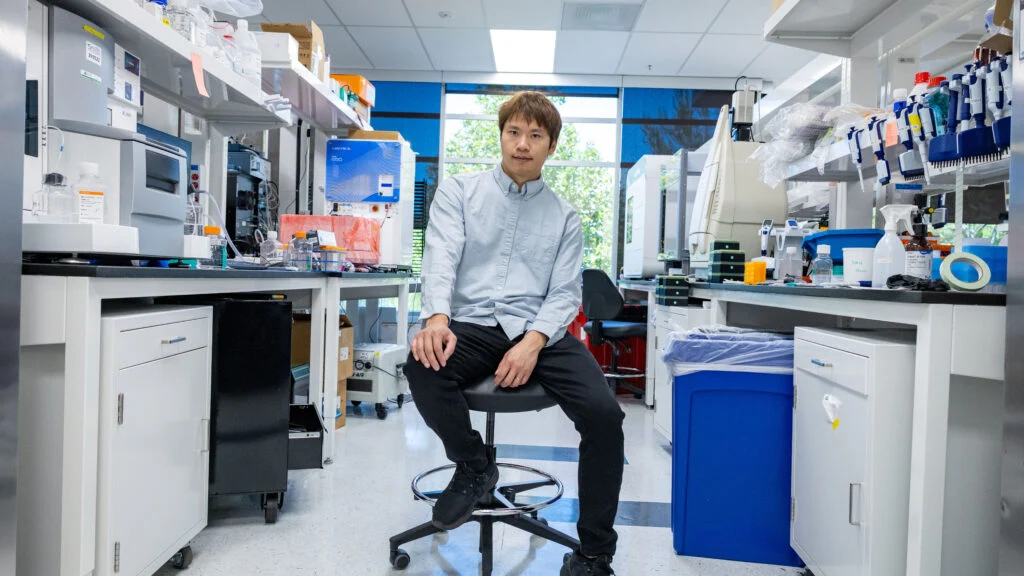
By all rights, Felix Wong and his company should be in Massachusetts. To look at Wong’s resume is to view a roadmap of the Commonwealth’s most prestigious intellectual corridors. Born in Quincy and raised in the suburban quiet of Braintree, Wong is a product of the Massachusetts public school system, graduating from Braintree High School before embarking on a decade-long journey through the ivory towers of Cambridge. He earned two degrees from Harvard University and completed a rigorous post-doctoral fellowship at the Massachusetts Institute of Technology (MIT). His family remains rooted in the state, and his chosen field—biotechnology—is the very industry that Boston has dominated with an iron grip for the better part of two decades.
Yet, on a temperate afternoon in August 2026, Wong found himself thousands of miles from the familiar brick-and-mortar laboratories of Kendall Square. Instead, he was in Redwood City, California, navigating the sun-drenched pathways near his office, shaded by the vibrant purple blooms of jacaranda trees. As the co-founder of Integrated Biosciences, a startup at the vanguard of using artificial intelligence to combat age-related diseases, Wong’s presence in Silicon Valley is more than a personal choice; it is a signal of a seismic shift in the life sciences landscape.
For years, the narrative of biotechnology was written in the shadow of the Longwood Medical Area and the gleaming glass towers of East Cambridge. Boston was the undisputed "hub," a place where the proximity of world-class hospitals like Massachusetts General and academic powerhouses like Broad Institute created a self-sustaining ecosystem of discovery. But as the industry enters the era of "Tech-Bio"—a hybrid discipline where software engineering and machine learning are as vital as molecular biology—the gravity of the industry is shifting westward.
Wong’s trajectory reflects a growing trend among young founders who view the traditional biotech model as overly cautious and tethered to a legacy mindset. While Boston excels at the "Bio" of biotech—the wet labs, the clinical trials, and the proximity to Big Pharma—Silicon Valley offers the "Tech" infrastructure that is increasingly necessary for the next generation of drug discovery. Integrated Biosciences, the firm Wong leads, is built on the premise that aging is a programmed biological process that can be decoded through high-throughput screening and sophisticated AI models. To build such a company, Wong realized he needed more than just biologists; he needed the world’s best software architects and data scientists, many of whom are more comfortable in the coffee shops of Palo Alto than the pubs of Central Square.
The decision to relocate or plant roots in California is often framed as a search for a specific "creative spirit," a term Wong uses to describe the West Coast’s appetite for high-risk, high-reward ventures. In Massachusetts, the biotech scene is often characterized by a "platform-first" approach, where companies are built around a specific biological insight and nurtured through years of venture capital rounds often led by the same handful of local firms. In Silicon Valley, the culture is increasingly "intelligence-first." The goal is to build systems that can learn, predict, and iterate at a speed that traditional laboratory work cannot match.
Integrated Biosciences is a prime example of this philosophy. The company focuses on senolytics—a class of small molecules that can selectively induce the death of senescent or "zombie" cells. These cells, which stop dividing but refuse to die, accumulate as we age, secreting inflammatory signals that contribute to everything from Alzheimer’s to fibrosis. While the concept of senolytics has been around for over a decade, Wong’s team is using AI to scan billions of potential compounds to find the ones that are not only effective but also have the lowest toxicity profiles. This level of computational intensity requires a talent pool that is deeply integrated with the Silicon Valley tech ecosystem.
The economic implications of this migration are not lost on Massachusetts policymakers. For years, the state has relied on the Life Sciences Act, a billion-dollar initiative launched by former Governor Deval Patrick and renewed by subsequent administrations, to provide tax incentives and grants to keep companies local. However, the 2026 landscape is different. While the Massachusetts Life Sciences Center continues to pour money into workforce development and lab space, it cannot easily replicate the sheer concentration of venture capital and software talent found in the Bay Area.

Data from the first half of 2026 suggests that while Boston still leads in total square footage of laboratory space, California has begun to pull ahead in "AI-Bio" venture funding. According to industry analysts, nearly 45% of all seed and Series A funding for biotech startups utilizing generative AI was concentrated in the San Francisco-San Jose corridor over the last eighteen months. The reason is simple: investors in the Valley are more comfortable with the "burn fast, learn fast" model of software development, which is increasingly being applied to early-stage drug discovery.
Furthermore, the physical landscape of biotech is changing. In the 2010s, a startup needed a multimillion-dollar wet lab to even begin testing a hypothesis. In 2026, much of the initial work—the modeling, the protein folding simulations, and the virtual screening—can be done on a cloud server. This "lab-lite" approach allows founders like Wong to prioritize intellectual capital over physical infrastructure. When the time comes for physical validation, the globalized nature of contract research organizations (CROs) means that a company in Redwood City can have its experiments run in a facility in Singapore or even back in Worcester, Massachusetts, without the founders ever needing to leave their desks in California.
Despite the pull of the West, the loss of talent like Wong is a stinging critique of the current Boston environment. Wong is not just any founder; he is a homegrown talent, the kind of individual the Massachusetts education system is designed to produce. His departure suggests that the cultural divide between the two coasts is widening. In Boston, there is a reverence for the "PI" (Principal Investigator) and the academic lineage of a project. In Silicon Valley, there is a reverence for the "Disruptor," the person who can take a disparate set of tools—like AI and longevity research—and forge something entirely new.
Wong’s reflections on the jacaranda trees and the hiking trails of Northern California are more than just a comment on the weather. They represent a lifestyle shift that has become a competitive advantage for California. As the cost of living in both Boston and the Bay Area remains astronomical, the "quality of life" argument often tilts toward the West for a generation of scientists who value the outdoor-centric, wellness-focused culture of California. For a company focused on "age-related diseases" and "longevity," there is a certain poetic resonance in being located in a place that obsessively pursues the optimization of the human body and mind.
However, the story of Integrated Biosciences is not necessarily one of "either-or." The biotech world of the late 2020s is increasingly decentralized. While Wong is based in Redwood City, the connections he forged at MIT and Harvard remain vital. The intellectual "bridge" between the two hubs is busier than ever, with many companies maintaining a "bicoastal" existence—keeping their computational teams in the Valley and their clinical and regulatory teams in the Boston-Washington D.C. corridor.
Yet, for the Massachusetts leadership, the "Wong Case" serves as a warning. If the state wants to maintain its crown as the life sciences capital, it must evolve beyond being a landlord for Big Pharma and a benefactor for academic labs. It must find a way to foster the same "creative spirit" that Wong found in the shade of the jacarandas. It must become a place where the next generation of AI engineers feels as much at home as the next generation of molecular biologists.
As the sun began to set over the Santa Cruz Mountains, Wong’s focus remained on the future. His company is currently moving toward its next phase of development, with several AI-identified compounds slated for pre-clinical trials. Whether those trials eventually lead to a breakthrough that extends the human healthspan remains to be seen. What is certain, however, is that the journey to that breakthrough is being mapped out on California soil, led by a man who, by all rights, should have been doing it in the heart of Massachusetts. The jacaranda trees may not have the history of the elms of Harvard Yard, but for Felix Wong and the new wave of biotech pioneers, they represent the new frontier of discovery.
