
 By admin
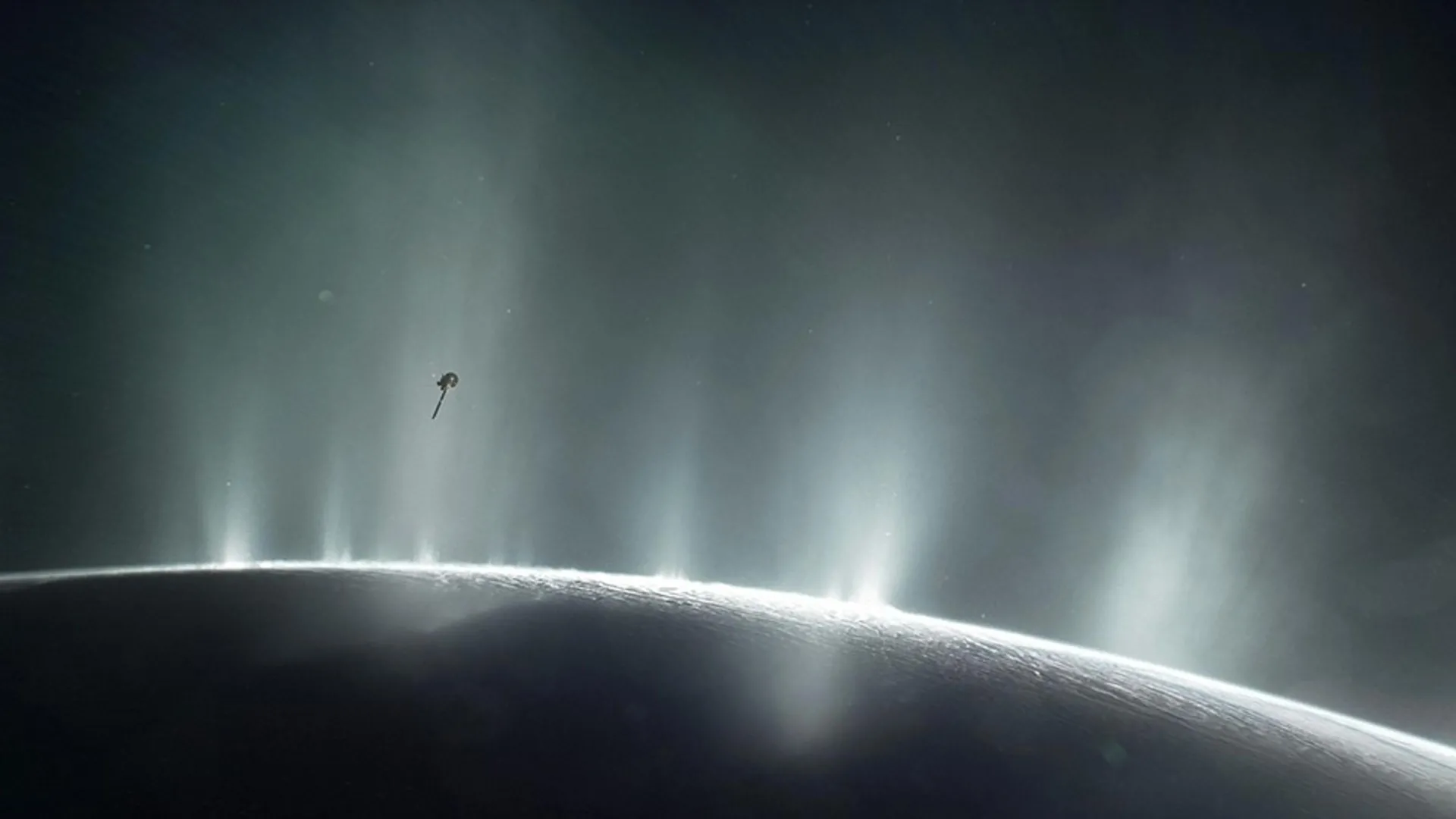
An international team of researchers, including experts from the Earth-Life Science Institute (ELSI) at the Institute of Science Tokyo, has now delved deeper into the complex journey of this ocean water. Their investigation focused on understanding the physical and chemical transformations that occur as the subsurface liquid makes its perilous ascent from the deep ocean, through the icy crust, and eventually freezes into the tiny, chemically diverse ice grains detected in space. This research sheds new light not only on the mechanics of cryovolcanism but also on the chemical processes that could be shaping the very building blocks of life within Enceladus.
Cassini’s Revelations: A Surprisingly Diverse Chemical Signature
Between 2004 and 2017, NASA’s Cassini spacecraft executed multiple daring flybys through Enceladus’s plumes and through Saturn’s E-ring – a diffuse ring composed almost entirely of material continuously supplied by Enceladus’s eruptions. A key instrument on board, the Cosmic Dust Analyzer (CDA), was instrumental in measuring the composition of individual ice particles. The CDA works by vaporizing and ionizing incoming dust grains upon impact, then analyzing the resulting ions to determine their mass and charge, thereby revealing their chemical makeup. This allowed scientists to build a detailed picture of the ejected material.
A dedicated team led by Professor Frank Postberg at Freie Universität Berlin meticulously examined 961 mass spectra derived from a specific type of particle, known as "Type 3" grains. These particles were particularly rich in salts, indicating their direct origin from the subsurface ocean. Initially, based on the assumption that these grains were simply small, representative samples of the global ocean water, scientists might have anticipated them to exhibit broadly similar mixtures of dissolved salts. If the ocean was a homogenous body, its ejected particles should, statistically, reflect that homogeneity.
However, the reality proved far more complex and intriguing. The analyses revealed that the chemical compositions of these individual ice grains varied dramatically. Some particles were found to be exceptionally rich in sodium chloride (common table salt), while others contained significantly higher amounts of carbonates, phosphates, or potassium chloride. This striking diversity immediately presented a scientific puzzle. One particularly curious pattern emerged: chloride and carbonate salts rarely appeared together within the same sodium-rich particle. This suggested a non-random distribution, hinting at underlying processes that were altering the chemical makeup of the water before it froze and escaped into space.
The fundamental question that arose from Cassini’s observations was profound: If all of these diverse ice grains originated from the same global ocean, a body expected to be relatively well-mixed, why did their chemical compositions differ so dramatically? The answer, the researchers hypothesized, must lie in the physical and chemical processes occurring during the transition from liquid ocean to frozen plume particle.
Recreating Enceladus’s Ocean Droplets in the Laboratory
To unravel this enigma, Professor Yasuhito Sekine and his colleagues at ELSI embarked on a series of sophisticated laboratory experiments. Their approach was to recreate, under controlled conditions, the freezing process of ocean water droplets analogous to those believed to erupt from Enceladus. The researchers carefully prepared laboratory droplets containing the major salts thought to be present in Enceladus’s ocean, based on previous Cassini data and geochemical models. These included sodium chloride, carbonates, potassium chloride, and phosphates, mimicking the expected brine composition.
The team then subjected these droplets to various experimental conditions, systematically varying their sizes and, critically, their cooling rates. They froze droplets ranging from relatively small to around 200 micrometers in diameter, under different cooling speeds. After the droplets had solidified, the scientists meticulously studied how the various chemical elements were distributed within the resulting ice grains. This was achieved using advanced analytical techniques that could map the elemental composition across the frozen samples.
The results of these laboratory simulations were illuminating and provided a crucial piece of the puzzle. They unequivocally demonstrated that the speed at which the droplets froze played a major, indeed dominant, role in determining the final distribution of salts within the ice.
Specifically, in droplets approximately 200 micrometers across, the salts became distinctly separated into different regions within the frozen ice when the freezing occurred relatively slowly, at a rate of approximately 10 Kelvin (K) per minute or less. This phenomenon, known as fractional crystallization or cryo-concentration, occurs because as water freezes, it tends to exclude dissolved impurities, forcing them into unfrozen pockets of brine. Different salts have different solubilities and crystallization points, leading them to separate and concentrate in distinct areas as the ice front progresses slowly. In contrast, when the droplets froze more quickly – at rates faster than 10 K/min – their chemical ingredients remained much more evenly mixed, essentially trapped in place before they had sufficient time to migrate and separate.
"What truly surprised us was the realization that the remarkable diversity seen by Cassini in the E-ring particles could, in fact, emerge from droplets originating from essentially the same ocean water," explained Professor Sekine. "Our carefully designed experiments vividly show that when relatively large ocean droplets freeze slowly, different salts can physically separate and become localized within them. If these larger, slowly frozen droplets are later subjected to mechanical stress and broken apart, they can produce a multitude of much smaller ice grains, each possessing very different chemical compositions from its neighbors." This provided a compelling physical explanation for Cassini’s perplexing observations.
A Slower, More Complex Journey Through Enceladus’s Ice
These groundbreaking laboratory findings have profound implications for our understanding of the dynamic processes occurring within Enceladus’s icy crust and the mechanics of its cryovolcanism. Earlier studies and models generally assumed a relatively straightforward and rapid process: seawater spray from the subsurface ocean would freeze quickly as it ascended and then rapidly move toward space soon after leaving the ocean. This "fast freeze, fast escape" model implied that the plume particles would largely represent the bulk ocean composition.
However, the new experiments point to a dramatically different and far more intricate scenario. The results suggest that the ocean droplets may initially move much more slowly through a complex, tortuous underground vent system, following complicated and circuitous pathways through an elaborate network of fractures and channels within the moon’s ice shell before they finally approach the surface and erupt into space.
The researchers propose a revised model for the journey of these ocean particles:
- Initial Formation: Deep within the ice shell, perhaps at the interface between the ocean and the base of the fractures, ocean spray first forms droplets ranging from tens to hundreds of micrometers in size.
- Slow Ascent and Freezing: As these droplets begin their ascent, they move slowly through the deeper, narrower, and potentially more insulated sections of the vent system. In this environment, the droplets experience a gradual decrease in temperature, allowing them to freeze slowly. This slow freezing process, consistent with the laboratory findings, provides ample time for different dissolved salts to separate and concentrate into distinct regions within the freezing droplet. This creates a heterogeneously composed, larger ice particle.
- Rapid Acceleration and Fragmentation: Closer to the moon’s surface, the conditions within the vents change dramatically. The pressure drops significantly, and the escaping gas (primarily water vapor) begins to accelerate rapidly. This rapid flow of gas can entrain the now slowly frozen, larger droplets. These accelerated droplets can then slam into the walls of narrower icy channels at high speeds. These energetic collisions act as a natural pulverizing mechanism, breaking the larger, heterogeneously frozen droplets into numerous much smaller fragments.
- Chemically Diverse Escape: Crucially, each of these smaller fragments can originate from a different salt-rich region within the original, larger frozen droplet. This fragmentation process effectively "sorts" the chemical components, creating a population of individual ice grains, each with a very different chemical composition, just as Cassini observed. These diverse fragments are then ejected into space, becoming part of Saturn’s E-ring, carrying with them a complex chemical record of their journey.
"The Cassini data showed us unequivocally that these salt-rich grains are far more chemically diverse than an average ocean composition would suggest," said Professor Postberg, reflecting on the implications. "Combining those precise observations with the results from the freezing experiments now provides us with a robust physical explanation: Cassini likely sampled fragments of larger frozen ocean droplets, with each fragment preserving different chemical components that became separated during their protracted journey towards the surface. Furthermore, the relative abundance of each individual component within the subsurface ocean is then reflected in the statistical frequency or number of fragments in which a particular component is found." This provides a statistical link between the observed particle diversity and the underlying ocean chemistry.
Enceladus as a Natural Chemical Laboratory: Implications for Future Missions
The discovery of this cryo-concentration and fragmentation process holds especially important implications for future missions designed to explore Enceladus. As droplets freeze and subsequently break apart, individual chemical compounds – not just salts, but potentially organic molecules as well – can become significantly concentrated within particular grains. Earlier research, for instance, has already indicated that various organic substances can also become separated from one another and appear at elevated concentrations in certain ice particles.
This natural "sample preparation" process performed by Enceladus could make future in-situ analysis or even potential sample return missions considerably easier and more fruitful. On Earth, analytical laboratories routinely spend considerable effort, resources, and time separating and concentrating specific chemicals from dilute or complex mixtures before they can be accurately analyzed. Enceladus, it appears, performs both of these crucial "sample preparation" steps naturally and efficiently: its cryovolcanic processes effectively separate the chemical components and, in many cases, concentrate them within a fraction of the ejected ice particles. This pre-concentration means that compounds that might be highly diluted and challenging to detect in the bulk Enceladus ocean, and mixed with many other substances, could become much easier to identify and characterize when concentrated into individual ice grains. This is a game-changer for instrument design and analytical strategies for future probes.
Possible Implications for Prebiotic Chemistry and the Origins of Life
Beyond the immediate implications for geological and astrobiological missions, the phenomenon of slow freezing and cryo-concentration could have another profound consequence, particularly for the field of prebiotic chemistry – the chemical processes that are thought to have preceded and ultimately led to the emergence of life.
As ice crystals grow during slow freezing, small, highly concentrated pockets of liquid brine may remain trapped between them. Within these microscopic, transient environments, not only salts but also crucial organic compounds can become dramatically concentrated. This localized concentration is of immense importance for prebiotic chemistry. One of the major challenges in understanding the origins of life is overcoming the "dilution problem": how molecules that are typically very dilute in large bodies of water could have come into sufficiently close contact with one another to react and form more complex structures like polymers (e.g., proteins, nucleic acids). These brine pockets offer a potential solution, acting as miniature reaction vessels where molecular encounters and reaction rates are significantly enhanced.
Furthermore, much of the material erupted from Enceladus’s plumes eventually falls back onto the moon’s surface, particularly in the south polar region. This means that the freezing, concentration, and subsequent recycling process could potentially happen again and again over geological timescales. This cyclical process could act as a continuous chemical reactor, repeatedly concentrating and processing organic and inorganic compounds, potentially fostering the conditions necessary for increasingly complex chemical evolution.
Understanding precisely how Enceladus forms and processes its ice grains therefore accomplishes more than simply explaining Cassini’s unusual and diverse measurements. It offers invaluable new clues about the hidden, dynamic environment beneath the moon’s surface, providing a deeper understanding of its geochemistry and potential for habitability. Moreover, this knowledge may prove critical in helping future spacecraft correctly interpret the particles they collect, allowing them to accurately assess the moon’s potential for sustaining life and to potentially identify the elusive signs of life itself. The icy plumes of Enceladus continue to whisper secrets of a potentially living ocean, and this research brings us closer to deciphering their complex language.
