
 By admin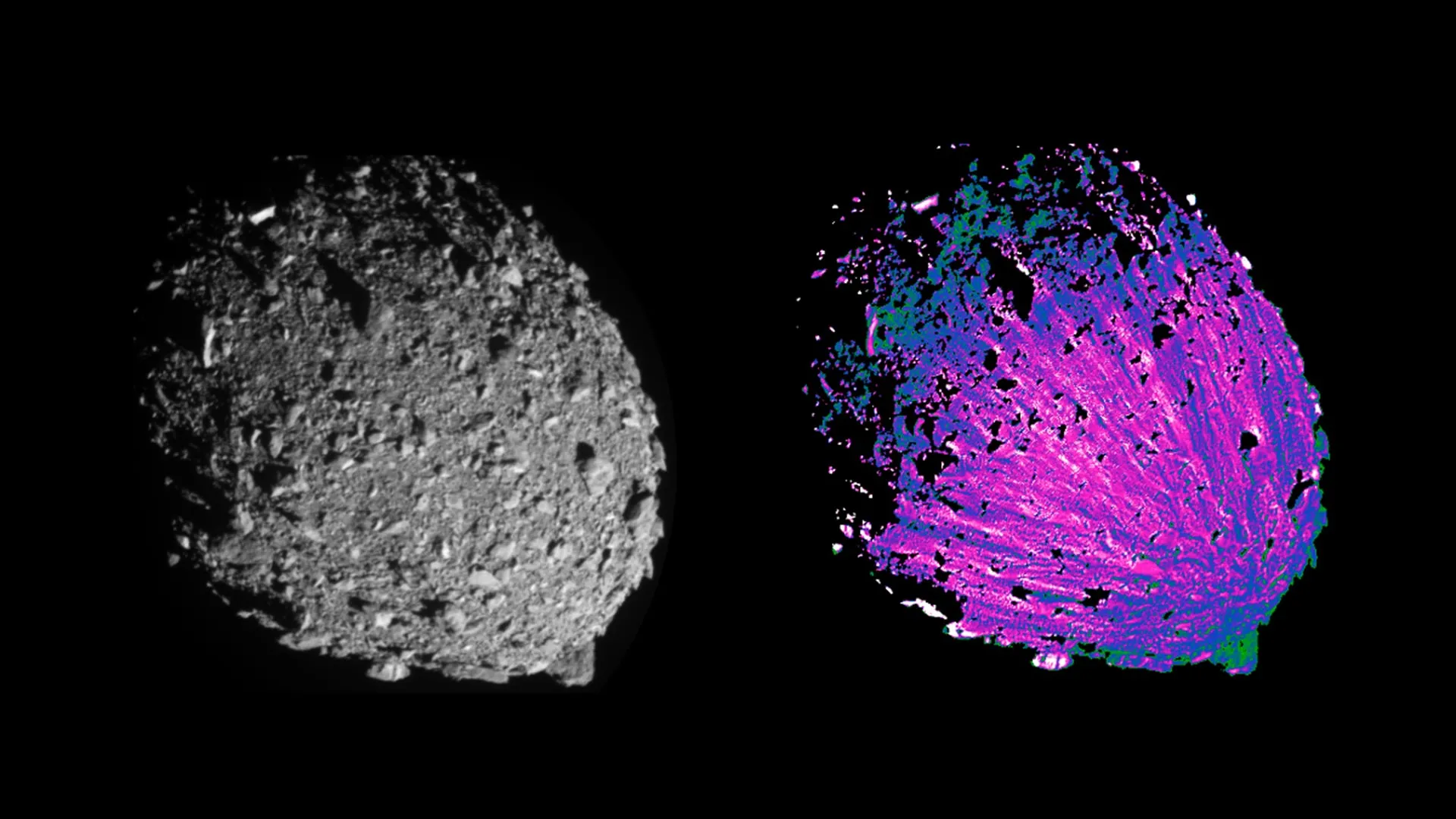
This transformative discovery stems from an intricate and painstaking analysis of images captured by NASA’s Double Asteroid Redirection Test (DART) spacecraft in 2022. Just moments before DART’s intentional collision with Dimorphos, the smaller moonlet of the binary asteroid system Didymos, the spacecraft’s cameras recorded unprecedented close-up views of Dimorphos’s rugged surface. Within these images, scientists observed peculiar bright, fan-shaped streaks—markings that provide the first direct visual evidence that material can naturally travel from one asteroid to another within a binary system. The profound implications of these findings, published on March 6, 2026, in The Planetary Science Journal, are expected to significantly advance scientific comprehension of asteroid evolution and enhance strategies for defending Earth against potential asteroid threats.
"At first, we thought something was wrong with the camera, and then we thought it could’ve been something wrong with our image processing," explained Jessica Sunshine, the paper’s lead author and a distinguished professor with joint appointments in UMD’s Department of Astronomy and Department of Geological, Environmental, and Planetary Sciences. This initial skepticism underscored the novelty of the observation. "But after we cleaned things up, we realized the patterns we were seeing were very consistent with low velocity impacts, like throwing ‘cosmic snowballs.’ We had the first direct proof for recent material transport in a binary asteroid system." Sunshine’s comments highlight the journey from anomaly to profound scientific insight, revealing a hidden, active process shaping these celestial bodies.
Unveiling the YORP Effect in Action
Beyond confirming material exchange, the observations from the DART mission also provide the first visual confirmation of a long-theorized but never directly observed process: the Yarkovsky-O’Keefe-Radzievskii-Paddack (YORP) effect. This phenomenon describes how sunlight, absorbed and re-emitted by an asteroid’s surface, can create a tiny, continuous thrust that subtly but steadily accelerates the asteroid’s rotation. Over vast spans of time, this gradual spin-up can reach a critical point where centrifugal forces overcome the asteroid’s weak gravity, causing loose material to be flung off its surface. In many cases, this ejected debris can coalesce to form a small companion moon, giving rise to binary asteroid systems like Didymos and Dimorphos.
Sunshine elaborated on how this mechanism likely played a crucial role in the formation and evolution of the Didymos system itself. The distinctive marks left by these so-called "cosmic snowballs" on Dimorphos strongly suggest that debris, spun off from the larger primary asteroid Didymos due to the YORP effect, subsequently landed on its smaller companion. This visual evidence bridges a significant gap in planetary science, transforming the YORP effect from a theoretical model into an observable process with tangible consequences for asteroid morphology and dynamics. Understanding the YORP effect is paramount for comprehending how asteroids evolve, how binary systems form, and critically, how their surfaces might change over time, potentially impacting future deflection missions.
Detecting Hidden Streaks in DART Images: A Triumph of Image Processing
The discovery of these subtle streak patterns was far from straightforward. The streaks were not immediately visible in the raw images beamed back by the DART spacecraft. Unlocking this hidden data required months of meticulous and innovative analysis by the UMD research team. UMD astronomy research scientist Tony Farnham and former postdoctoral researcher Juan Rizos spearheaded the development of specialized image processing techniques. Their challenge was formidable: to painstakingly remove optical artifacts, shadows cast by numerous boulders, and complex lighting variations that obscured the faint evidence of material transfer.
"We ended up seeing these rays that wrapped around Dimorphos, something nobody’s ever seen before," Farnham recounted, describing the breakthrough moment. "We couldn’t believe it at first because it was subtle and unique." The difficulty was compounded by DART’s unique flight path. The spacecraft approached Dimorphos almost directly head-on, meaning the lighting and viewing angles remained remarkably constant throughout the final moments of the encounter. While advantageous for its primary mission of kinetic impact, this uniformity made it exceptionally challenging for scientists to differentiate between genuine surface features and mere optical illusions caused by consistent illumination.
To rigorously confirm the authenticity of the streaks, the researchers employed a multi-pronged approach. They meticulously traced the fan-shaped patterns back to a specific source region near the edge of Dimorphos. Crucially, this source location was offset from the point where the Sun was directly overhead, providing strong evidence that the patterns were not merely a trick of sunlight or shadows. Furthermore, the team refined their three-dimensional model of Dimorphos. "As we refined our 3D model of the moon the fan-shaped streaks became clearer, not fainter," Farnham explained. "It confirmed to us that we were working with something real." This iterative process of modeling and image correction was essential to validate the subtle observations, transforming faint anomalies into undeniable proof.
The Physics of "Cosmic Snowballs": Slow-Moving Asteroid Debris
Prior to this study, scientists had gathered indirect evidence and developed theoretical models suggesting that the YORP effect could indeed increase the spin rate of small asteroids to the point of ejecting surface material. However, the updated models generated by the University of Maryland team, anchored by the direct visual evidence from DART, provide the first definitive confirmation of this process in action. These sophisticated models not only confirm the phenomenon but also precisely pinpoint the specific regions on Dimorphos where debris launched from Didymos ultimately landed.
Further detailed calculations, spearheaded by UMD alum Harrison Agrusa (M.S. ’19, Ph.D. ’22, astronomy), offered crucial insights into the kinematics of this material transfer. Agrusa’s analysis determined that the debris leaving Didymos was traveling at an astonishingly slow speed of only 30.7 centimeters per second. To put this into perspective, this speed is significantly slower than a typical human walking pace, which averages around 130 centimeters per second.
"That would explain the distinctive fan-shaped marks," Sunshine noted. "Instead of even spreading, these slow-moving impacts would create a deposit rather than a crater. And they are centered on the equator as predicted from modeling material spun off the primary." This slow velocity is key: it means the "cosmic snowballs" don’t excavate impact craters as faster projectiles would. Instead, they gently settle, creating distinct accumulation patterns—the fan-shaped streaks—that accumulate over time. The equatorial distribution of these deposits further corroborates the YORP effect, as material spun off a rotating body is typically ejected from its equator. This understanding of low-velocity accretion offers a new paradigm for how asteroid surfaces evolve, suggesting that gradual deposition plays a significant role alongside more energetic cratering events.
Laboratory Experiments Recreate "Cosmic Snowballs"
To further validate their compelling explanation, the UMD researchers conducted a series of ingenious laboratory experiments. Led by former UMD postdoctoral associate Esteban Wright, the team utilized UMD’s Institute for Physical Science and Technology to simulate the conditions of these low-velocity impacts. In these tests, researchers dropped marbles into a bed of fine sand that contained scattered pieces of painted gravel, carefully chosen to represent the irregular boulders littering Dimorphos’s surface. High-speed cameras meticulously recorded the results of these simulated impacts.
The experiments proved remarkably insightful. They clearly demonstrated that the larger "boulders" on the simulated asteroid surface effectively blocked some of the incoming particles while allowing others to pass through the gaps between them. This differential blocking and passage of material precisely replicated the ray-like patterns, or streaks, observed on Dimorphos. The physical experiments provided tangible, Earth-bound confirmation of the mechanisms at play in space.
Complementing these physical tests, computer simulations performed at Lawrence Livermore National Laboratory reached the same conclusion. These sophisticated numerical models confirmed that regardless of whether the incoming object was a solid rock, like the marbles used in the lab, or a looser clump of dust, the presence of surface boulders would inevitably sculpt the incoming material into the distinctive fan-shaped patterns observed on Dimorphos. This multi-faceted approach, combining direct space observation, theoretical modeling, laboratory experiments, and computer simulations, provides a robust and compelling case for the new understanding of binary asteroid activity.
"We could see these marks on Dimorphos from that footage captured by the DART spacecraft right before the big collision, proof that there was material exchange between it and Didymos," Sunshine reiterated, emphasizing the significance of the visual evidence. She also offered a tantalizing prospect for future observations: "The fan line deposit should extend to side of the moon we did not hit, and there is a possibility it was not destroyed by the impact."
Hera Mission May Reveal More Clues and Advance Planetary Defense
The implications of this discovery extend far beyond fundamental asteroid science, directly impacting our strategies for planetary defense. Knowing that binary asteroids are dynamic systems constantly exchanging material changes how we might assess their stability, predict their long-term evolution, and plan potential deflection missions. The composition and distribution of surface material, including loosely bound regolith, are critical factors in designing effective kinetic impactors or other mitigation techniques.
The European Space Agency’s Hera mission, a follow-up spacecraft, is strategically scheduled to reach the Didymos system in December 2026. Hera’s primary objective is to conduct a detailed post-impact survey of Dimorphos, meticulously examining the crater left by DART and assessing the changes to the moonlet’s orbit and physical characteristics. This new research provides Hera with an additional, unforeseen scientific objective. The spacecraft could determine whether the delicate streak patterns, created by millions of years of "cosmic snowball" impacts, survived the violent DART collision. Furthermore, Sunshine and her colleagues anticipate that Hera might even detect new ray patterns created by boulders that were dislodged and redistributed when DART struck Dimorphos, offering a unique opportunity to witness the formation of such features in real-time cosmic history.
"These new details emerging from this research are crucial to our understanding of near-Earth asteroids and how they evolve," Sunshine concluded, underscoring the broader impact of their work. "We now know that they’re far more dynamic than previously believed, which will help us improve our models and our planetary defense measures." This enhanced understanding of asteroid activity and material transport is vital for refining models of asteroid evolution, predicting their behavior, and ultimately, safeguarding our planet from potential future impacts. The DART mission, while designed as a planetary defense test, has unexpectedly opened a new window into the complex, dynamic lives of binary asteroids, revealing them as active participants in a slow, cosmic ballet of give and take.
The paper, "Evidence of Recent Material Transport within a Binary Asteroid System," was published on March 6, 2026, in The Planetary Science Journal. This groundbreaking research was supported by critical funding from NASA (Contract No. 80MSFC20D0004), the U.S. Department of Energy (Contracts DE-AC52-07NA27344 and LLNL-JRNL2002294), and the French National Research Agency (Project ANR-15-IDEX-01), highlighting the collaborative international effort behind this significant scientific advancement.
