
 By Isnaini Azizah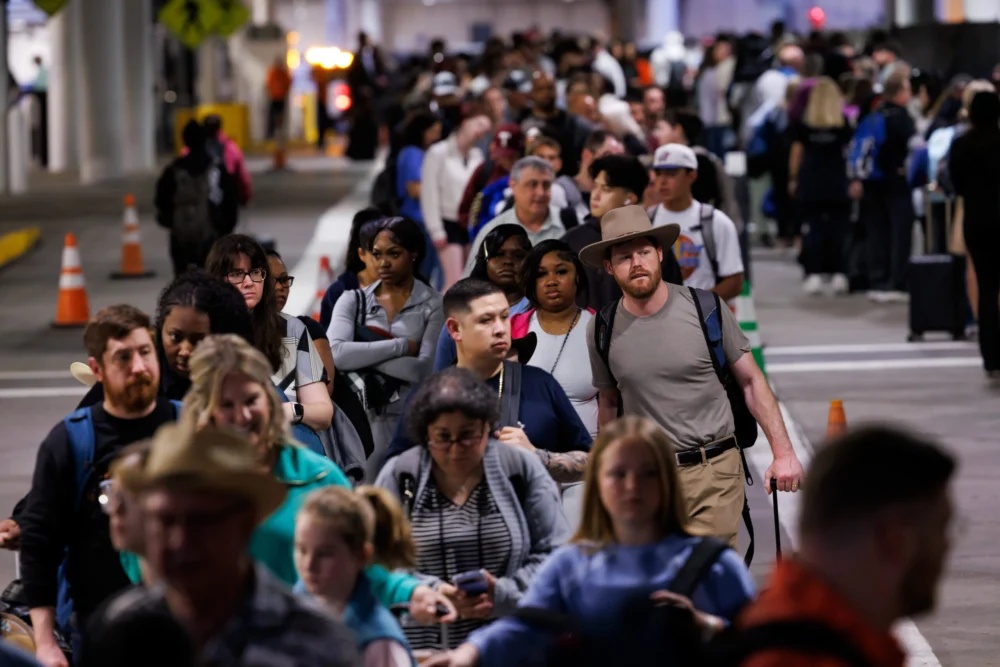
The geopolitical landscape of the early spring of 2026 has been fundamentally reshaped by the military strikes launched by the United States and Israel against Iranian targets nearly two weeks ago, an event that has sent shockwaves through the global energy markets and the aviation industry alike. As travelers navigate increasingly crowded terminals, such as the Transportation Security Administration checkpoints at William P. Hobby Airport in Houston, they are being met with more than just long lines; they are facing the immediate financial repercussions of a conflict that has disrupted one of the world’s most vital energy corridors. The surge in fuel prices initiated by the hostilities on February 28 is already manifesting in higher airfares, and industry analysts warn that the extent of the impact on consumers will be determined by the resilience of travel demand in an increasingly volatile economic environment.
The immediate reaction from the airline sector has been swift and global. Cathay Pacific, a bellwether for Asian aviation, announced on Thursday that it would roughly double its fuel surcharges on tickets starting March 18, a move that signals the end of the relatively stable pricing environment enjoyed during the post-pandemic recovery years. This trend is mirrored across the Southern Hemisphere and Europe. Australia’s national carrier, Qantas, has confirmed it is raising fares across its network to mitigate the ballooning costs of operation. Meanwhile, Scandinavian Airlines (SAS) characterized the recent spike in fuel costs as "unusually rapid and substantial," forcing a revision of its pricing structures. Air New Zealand took an even more cautious stance, withdrawing its financial outlook entirely until "fuel markets and operating conditions stabilize," while simultaneously implementing "initial fare adjustments" to protect its bottom line. The New Zealand carrier warned that if the conflict leads to sustained elevated jet fuel costs, it may be forced to take further pricing actions and drastically adjust its flight schedules and network reach.
The focus of the aviation world is now shifting to Washington, D.C., where U.S. airline CEOs and top executives are scheduled to brief investors at the J.P. Morgan Industrials Conference this coming Tuesday. The sentiment heading into the summit is one of wary preparation. Wall Street analysts are already factoring in a significant hit to earnings, particularly for the first quarter and potentially extending through the first half of 2026. According to a note from UBS analysts Atul Maheswari and Thomas Wadewitz, a negative impact on first-quarter earnings per share appears "almost certain" given the trajectory of fuel prices over the last fourteen days.
United Airlines CEO Scott Kirby, speaking recently at an event at Harvard University, acknowledged the inevitability of fare increases. Kirby noted that the sheer magnitude of the fuel price surge leaves carriers with little choice but to pass costs on to the consumer. However, he remains cautiously optimistic about the underlying strength of the market. Despite the geopolitical uncertainty, Kirby and other senior executives—speaking on the condition of anonymity—report that travel demand has remained robust. This persistent "appetite for travel" provides airlines with a degree of pricing power that they might not have had in a weaker economy. If travelers continue to book flights regardless of the cost, airlines can successfully offload their increased fuel expenses. However, the sustainability of this trend remains tethered to the duration and intensity of the conflict in the Middle East.
The mechanics of airline pricing are often misunderstood by the general public. As Scott Keyes, founder of the flight deal company Going (formerly Scott’s Cheap Flights), aptly noted, "Airlines never met a higher fare they didn’t want." For the consumer, the strategy must be one of proactive booking. Keyes suggests that travelers should book early to lock in current rates, provided they avoid the most restrictive "basic economy" tickets. By purchasing tickets that allow for changes or cancellations, travelers can hedge against future price drops. If a traveler books a summer flight for $500 today and the price falls to $350 in two weeks—perhaps due to a sudden de-escalation of the war—they can often reclaim the $150 difference as a travel credit. In Keyes’ view, this creates a "heads you win; tails the airlines lose" scenario for the savvy passenger.
To understand why a regional conflict has such a profound impact on a domestic flight in the United States, one must look at the sheer scale of fuel consumption in the industry. Jet fuel is typically an airline’s second-largest expense after labor, accounting for at least 20% of total operating costs. For a major carrier like United Airlines, the numbers are staggering. In 2025, United spent approximately $11.4 billion on fuel, with an average price of $2.44 per gallon. By Wednesday, March 11, 2026, the price of U.S. jet fuel had climbed to $3.78 a gallon. This represents a massive budgetary shortfall that cannot be easily absorbed.

The financial impact is most acute in the short term. Sheila Kahyaoglu, an airline analyst at Jefferies, pointed out that the next 30 to 90 days will be the most difficult for carriers. This is because airlines have already sold many of their tickets for near-term flights based on much lower fuel price projections. Since they cannot retroactively charge passengers more for a ticket already purchased, they must eat the cost until new, higher-priced tickets become the majority of their revenue stream. Kahyaoglu noted that Delta Air Lines and United Airlines might be better positioned than their competitors to weather this storm, primarily due to their strong "high-end" or premium demand. Wealthier travelers and corporate clients are generally less sensitive to price hikes than budget-conscious vacationers, who are already feeling the pinch of rising gasoline prices at the pump.
The volatility in jet fuel prices is even more extreme than that of crude oil. Since the initial strikes on February 28, jet fuel prices in some regions have more than doubled. While oil prices hit four-year highs following the attacks, they have swung wildly as traders react to every headline. Jet fuel often rises faster than crude because it carries the added costs of refining and the increasingly complex logistics of transporting fuel from refineries to airports during a period of international tension. For example, on February 27, filling the tanks of a Boeing 737-800 cost approximately $17,000 based on average prices in major U.S. hubs. Just one week later, that same task cost over $27,000. Prices dipped slightly after President Donald Trump suggested the war could end "very soon," bringing the cost down to $23,000, but the market remains on a knife-edge.
Historically, airlines have employed various creative measures to offset fuel spikes. In previous years, these surges led to the introduction of checked bag fees and seating charges. Carriers have also looked toward weight reduction as a long-term solution. United Airlines famously switched to a lighter paper stock for its in-flight magazine in 2018, while American Airlines transitioned to digital manuals for flight crews to save on weight. While these changes seem minor, they can save hundreds of thousands of dollars in fuel costs annually across a large fleet.
However, the current crisis is not just about the price of fuel; it is about capacity. Courtney Miller, founder of Visual Approach Analytics, argues that high fuel prices do not automatically dictate higher fares. Instead, they set an expectation. Airlines price their seats to prevent them from flying empty. If fares rise too high and demand drops, airlines will respond by reducing capacity—cutting the number of flights on certain routes or grounding older, less fuel-efficient aircraft.
The situation in the Middle East has already created a capacity crunch. Airspace closures and the suspension of flights to and from the region have resulted in the cancellation of more than 46,000 flights since the conflict began, according to data from Cirium. These constraints are forcing airlines to take longer, more fuel-intensive routes to avoid conflict zones. Qantas reported that its flagship Perth-to-London route now requires a refueling stop in Singapore, though this has unexpectedly allowed them to pick up more passengers, with flights running at 90% capacity. Finnair has also seen a 15% increase in fares for its Helsinki-to-Asia routes as it navigates the complex web of closed airspaces that have persisted since the 2022 invasion of Ukraine and are now exacerbated by the Middle East crisis.
Adding to the vulnerability of U.S. carriers is the fact that most have abandoned the practice of fuel hedging. Southwest Airlines, once the industry leader in locking in fuel prices to protect against volatility, officially ended its hedging program last year. Without these financial safeguards, domestic airlines are fully exposed to the daily fluctuations of the energy market.
As the industry looks toward the second quarter of 2026, the closure of the Strait of Hormuz remains the greatest "wild card." If this critical shipping channel remains blocked, the global supply of oil will remain restricted, keeping prices at record levels. Rick Joswick of S&P Global Energy emphasizes that the demand for jet fuel is "inelastic." Unlike a commuter who might choose to take the bus if gas prices get too high, an airport cannot simply "dry up." Planes must fly to maintain global commerce and connectivity, and they must pay whatever the market demands for the fuel to do so. For the millions of travelers planning their 2026 journeys, the message is clear: the cost of seeing the world is going up, and the path forward is as turbulent as the skies above the Middle East.
