
 By Isnaini Azizah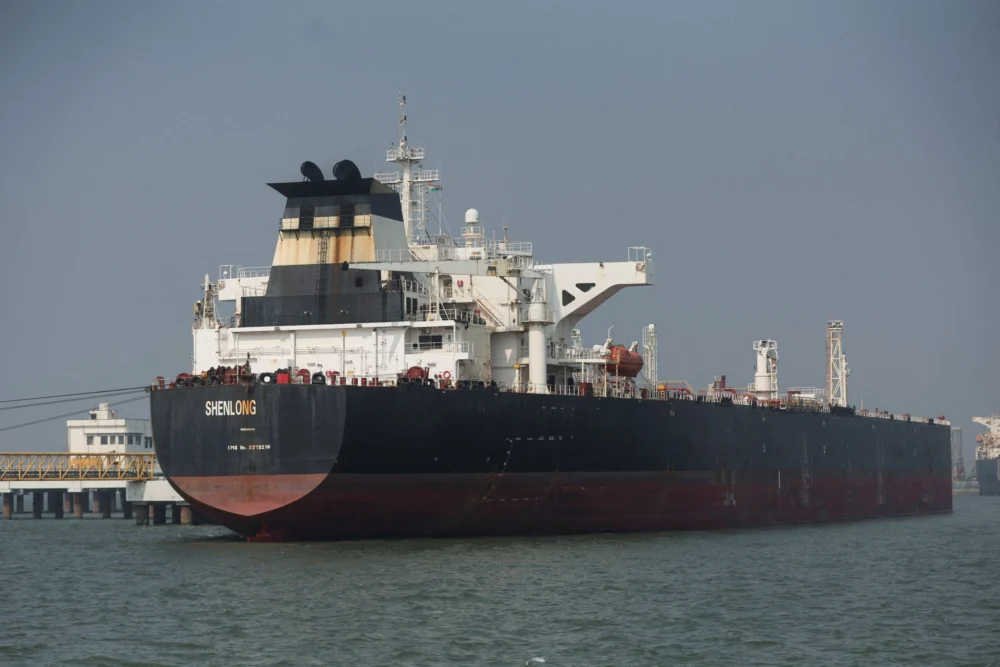
The arrival of the Liberia-flagged tanker Shenlong Suezmax at the Port of Mumbai on March 12, 2026, served as a somber milestone in an escalating global energy crisis. Loaded with millions of barrels of Saudi Arabian crude, the vessel’s successful transit through the Strait of Hormuz was a rare moment of operational completion in a region increasingly defined by volatility. As the ship docked in India, the world’s third-largest oil consumer, the geopolitical backdrop remained fraught with peril. The ongoing conflict between Iran and a U.S.-Israeli coalition has effectively turned one of the world’s most vital maritime arteries into a chokehold, threatening to send shockwaves through global markets and, ultimately, to the price tags found on retail shelves across the globe.
The Strait of Hormuz, a narrow waterway separating the Persian Gulf from the Gulf of Oman, is the world’s most important oil transit point. Historically, approximately 20% of the world’s total oil consumption passes through this passage daily. However, recent weeks have seen a dramatic shift from regional tension to a state of effective closure. This disruption is not merely an energy problem; it is a systemic threat to the global supply chain, affecting the movement of fertilizers, industrial metals, refined fuels, and consumer goods. The implications are clear: the longer the passage remains contested or closed, the more certain it becomes that the "Iran war" will translate into higher costs for everyday consumers.
The political landscape in Tehran has further complicated any hopes for a swift resolution. On Thursday, Mojtaba Khamenei, Iran’s newly appointed Supreme Leader, made his first public address since ascending to power. His rhetoric was uncompromising. Khamenei characterized the closure of the Strait of Hormuz as a strategic "tool to pressure the enemy," signaling that the Iranian regime views maritime disruption as its primary leverage against Western economic interests. This hardline stance suggests that the shipping lanes will remain a primary theater of conflict for the foreseeable future, despite diplomatic efforts to de-escalate.
In Washington, the response has been one of measured confidence, though critics argue it borders on dismissiveness. Defense Secretary Pete Hegseth, speaking at a Pentagon press briefing on Friday, sought to reassure markets and the American public. "We have been dealing with it, and don’t need to worry about it," Hegseth stated, implying that U.S. naval assets and strategic reserves are sufficient to mitigate the immediate fallout. However, logistics experts and economists are far less sanguine. They point out that while the military may be able to protect specific convoys, the sheer volume of global trade cannot be fully insulated from the rising insurance premiums, rerouting costs, and fuel surcharges that accompany such a conflict.
Logistics giant C.H. Robinson underscored this reality in a statement released Friday. The company, which manages billions of dollars in freight, warned shippers to prepare for "continued variability." According to the firm, while some cargo continues to move, carriers are struggling with constrained capacity and are becoming increasingly selective about which shipments they accept. This "selective acceptance" means that smaller retailers or those with lower-margin goods may find themselves priced out of the shipping market entirely. "Carriers are managing fuel-related cost impacts, resulting in pricing volatility and variable service conditions," the statement read, highlighting a "new normal" where reliability is a luxury.
Max Kahn, President of Coresight Research, believes the industry is approaching a breaking point. While retailers spent the previous year diversifying their supply chains to avoid over-reliance on single regions—largely due to shifting tariff policies—the total closure of a primary maritime route like Hormuz presents a different level of challenge. "Retailers have become much better at building flexibility, but the bigger worry is if this continues to last," Kahn told CNBC. He noted that the flexibility built to handle trade wars with China is not necessarily equipped to handle a hot war in the Middle East that doubles the price of jet fuel and maritime diesel.
The impact on consumers is expected to manifest in stages, with the grocery store being the first point of pain. Food supply chains are notoriously "inelastic," meaning they cannot easily be paused or rerouted without significant spoilage or cost increases. Fertilizers, a key export through the region, are essential for global crop yields; a shortage today means higher produce prices six months from now. Conversely, apparel retailers like Inditex (the parent company of Zara) have a different set of problems. While they can theoretically slow down production, they are heavily dependent on air freight to maintain their "fast fashion" model. Recent flight cancellations across the Middle East have already left piles of garments stranded in South Asian hubs, unable to reach European and American storefronts.
Kahn also pointed to a dual-pressure system facing the retail sector: input cost pressure and demand pressure. As it becomes more expensive to manufacture and ship goods (input cost), consumers are simultaneously feeling the pinch at the gas pump, which reduces their overall "discretionary" spending power (demand pressure). This creates a pincer movement for retailers. During the inflationary spikes of 2022 and 2023, many retailers maintained profitability by raising prices—a strategy that consumers, flush with pandemic-era savings, largely accepted. However, in 2026, with savings depleted and interest rates still weighing on households, the ability to pass costs onto the consumer is much more limited.
The economic fallout is expected to be uneven, reinforcing a "K-shaped" economic reality. In this scenario, high-income consumers continue to spend on luxury and specialty items, while lower-income households are forced to make drastic cuts. Analysts from Wolfe Research noted on Sunday that "discretionary-heavy" retailers like Five Below and Target are particularly vulnerable. These stores rely on middle-to-low-income shoppers who are most sensitive to changes in gas prices. When it costs $20 more to fill up a gas tank, that is $20 less spent on home decor, toys, or trendy accessories.
Conversely, some retailers may find opportunity in the chaos. Costco is frequently cited as a potential "winner." As gas prices soar, Costco’s reputation for price leadership at the pump becomes a powerful tool for driving foot traffic. Analysts suggest that consumers will be increasingly willing to wait in long lines for discounted fuel, and once they are at the warehouse, they are likely to complete their grocery and household shopping there as well. Similarly, Ulta Beauty has historically shown resilience during periods of oil inflation, as the "lipstick effect"—the tendency for consumers to purchase small luxuries even during economic downturns—remains a factor for higher-income demographics.
However, for value-driven stores like Dollar General, Dollar Tree, and Ollie’s Bargain Outlet, the outlook is grimmer. While these stores are often seen as "recession-proof," they are actually highly sensitive to the "fixed household expenditures" of their core customers. UBS analysts highlighted in a Monday note that for a shopper living paycheck to paycheck, the rise in oil prices isn’t just a nuisance; it is a "layered and persistent drag on consumer health." When the cost of getting to work and buying basic groceries rises, there is simply nothing left for the "bargain" items that drive sales at dollar stores.
The broader macroeconomic implications are equally concerning. While the February Consumer Price Index (CPI) report came in within expectations, those figures did not fully capture the recent spike in energy costs following the latest escalations in the Gulf. Experts warn that if the Strait of Hormuz remains blocked, the resulting energy "tax" on the global economy will inevitably drag down GDP growth. Uncertainty is the enemy of investment, and as long as the timeline for a resolution in the Middle East remains unknown, corporations are likely to pull back on expansion and hiring.
As the Shenlong Suezmax unloads its cargo in Mumbai, it serves as a reminder that the global economy is a delicate web of interdependencies. A decision made by a Supreme Leader in Tehran or a defensive posture taken by a Secretary in Washington has a direct, measurable impact on the price of a gallon of milk in Ohio or a t-shirt in London. The retail industry, which has spent the last several years navigating the fallout of a pandemic and a trade war, now finds itself in the crosshairs of a geopolitical conflict that shows no signs of abating. For the consumer, the message is clear: the era of cheap, reliable goods is under threat, and the true cost of the Iran war has only just begun to reach the store shelves.
