
 By admin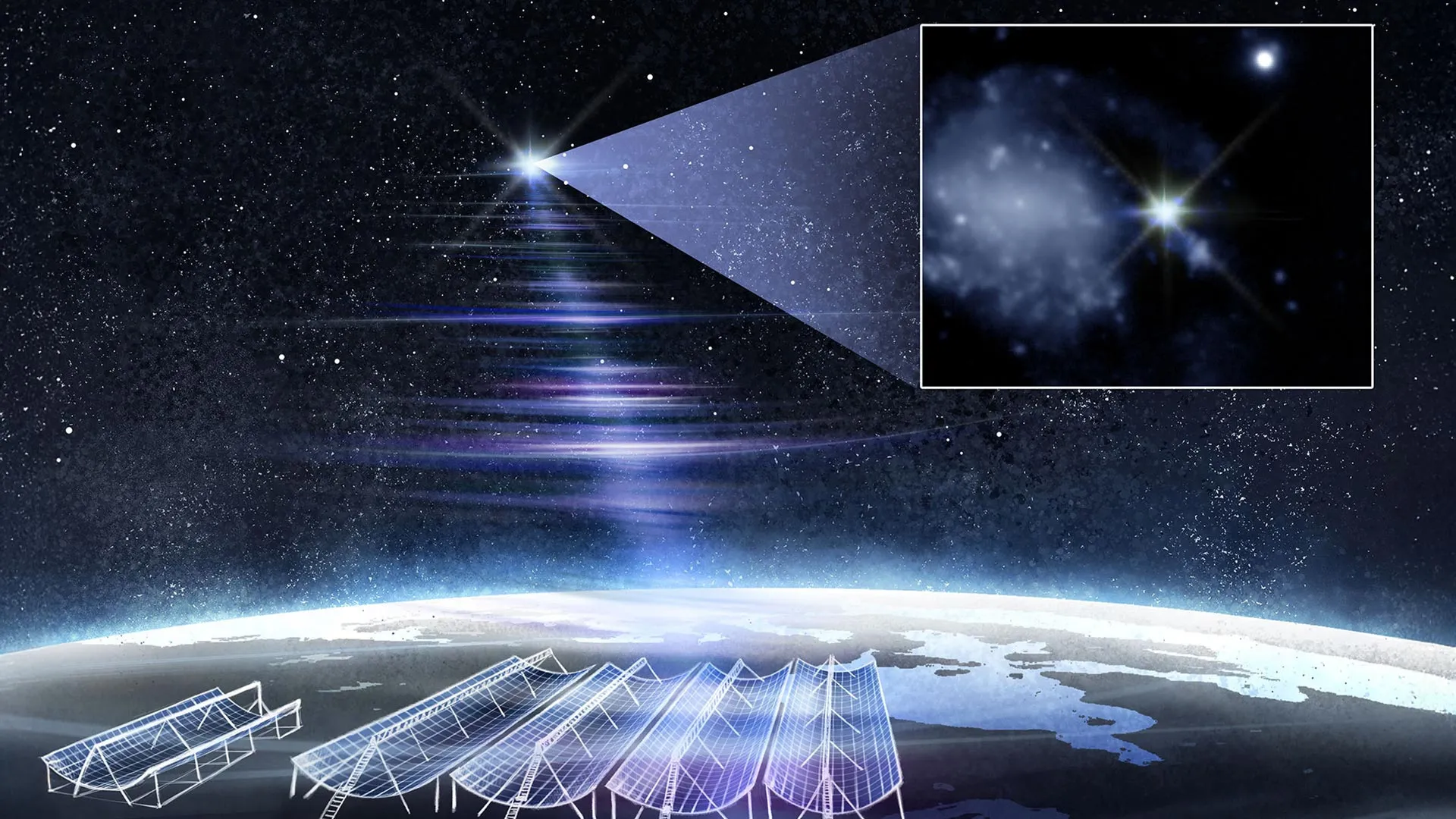
Fast Radio Bursts are characterized by their extreme luminosity, momentarily outshining entire galaxies in radio wavelengths, despite lasting only a few milliseconds to a few seconds. Their discovery in 2007, with the serendipitous detection of the "Lorimer Burst," immediately sparked intense scientific curiosity and speculation. While scientists widely believe they are produced by extreme astrophysical events, the precise mechanisms and types of celestial objects responsible for generating them remain a profound mystery. Leading theories often point to highly magnetized neutron stars known as magnetars, undergoing immense flares or "starquakes," or even cataclysmic events like the merger of two neutron stars or a neutron star and a black hole. The sheer energy involved in these bursts suggests phenomena at the very limits of known physics.
Since its inauguration in 2018, the Canadian Hydrogen-Intensity Mapping Experiment, or CHIME, located in British Columbia, has revolutionized FRB detection. With its unique stationary, cylindrical design and vast field of view, CHIME has proven exceptionally adept at detecting thousands of these bursts, dramatically increasing the known population of FRBs. This prolific rate of discovery, however, brought its own challenge: while CHIME could tell astronomers that an FRB occurred, its single-site nature meant it struggled to determine their exact positions in the sky with the precision needed for detailed follow-up studies. Without an accurate celestial coordinate, it’s akin to hearing a distant thunderclap but having no idea where the lightning struck.
CHIME Outrigger Array Pinpoints the Burst with VLBI
The newly detected signal, officially named FRB 20250316A and affectionately nicknamed RBFLOAT ("Radio Brightest Flash Of All Time") by the research team, represents a monumental leap forward in localization. Its position was pinpointed with remarkable accuracy, an achievement made possible by the CHIME/FRB Outrigger array. This innovative network comprises smaller, purpose-built versions of the main CHIME instrument strategically installed at three geographically distinct locations: British Columbia, Northern California, and West Virginia. By linking these widely separated radio telescopes, astronomers can employ a sophisticated technique known as Very Long Baseline Interferometry (VLBI).
VLBI works by simultaneously observing a radio source with multiple telescopes spread across continents. The slight differences in the arrival times of the radio waves at each telescope are precisely measured and then combined, effectively transforming the entire network into a single "virtual telescope" with a dish diameter equivalent to the maximum separation between the individual dishes. This technique provides unparalleled angular resolution, allowing astronomers to determine an object’s position in the sky with exceptional accuracy – far greater than any single telescope could achieve. In the case of RBFLOAT, this collaborative effort proved instrumental.
"We were ultimately extremely lucky that we were able to pinpoint the precise sky position of this rare event," said Mattias Lazda, a doctoral student at the University of Toronto and a co-author on both seminal papers describing the discovery. His comment underscores the often-precarious nature of astronomical observations. "A few hours after we detected it, we experienced a power outage at one of our telescope sites that played a critical role in telling us where the burst came from. Had the event happened any later that day, we would’ve completely missed our chance." This near-miss highlights the importance of operational readiness and the often-fortuitous timing that can define major scientific breakthroughs. The real-time data processing and immediate response capabilities of the CHIME/FRB team were paramount in capitalizing on this fleeting opportunity.
A Powerful Burst From a Nearby, Ordinary Galaxy
Although Fast Radio Bursts rank among the most intense radio sources known, their ephemeral nature means they appear only briefly. Each burst typically lasts from a few milliseconds to a few seconds, temporarily shining billions of times brighter than the Sun in radio waves, and momentarily outshining every other radio signal in its host galaxy. RBFLOAT, detected on March 16, 2025, exhibited this characteristic transience, lasting about one-fifth of a second – a duration relatively long for an FRB, but still remarkably short for such a powerful event.
One of the primary reasons for RBFLOAT’s exceptional brightness was its relatively close proximity to Earth. "Cosmically speaking, this fast radio burst is just in our neighborhood," says Kiyoshi Masui, associate professor of physics and affiliate of MIT’s Kavli Institute for Astrophysics and Space Research, and a U of T alum. This proximity is a critical advantage for researchers. Being closer means the signal is stronger, allowing for a higher signal-to-noise ratio in observations, which in turn facilitates more precise localization and enables deeper, multi-wavelength follow-up investigations of the host galaxy and its immediate environment. "This means we get this chance to study a pretty normal FRB in exquisite detail," Masui added, implying that RBFLOAT might not be an extreme outlier in terms of intrinsic properties, but rather an example of a common FRB seen up close.
The burst originated near the outer region of the galaxy NGC 4141, a spiral galaxy located approximately 130 million light-years away in the constellation Ursa Major. This distance, while vast by human standards, is considered "nearby" in the cosmic context of FRBs, many of which originate billions of light-years away. The CHIME/FRB Outrigger array’s VLBI capabilities allowed researchers to narrow the signal’s origin down to an astonishingly small region: only 45 light-years across. To put this level of precision into perspective, it is comparable to spotting a guitar pick from a distance of 1,000 kilometers – an analogy that powerfully conveys the technical prowess involved. This tight localization is crucial, as it allows astronomers to search for potential progenitor objects within a confined stellar population, rather than across an entire galaxy.
The rapid response to the detection further underscores the excitement surrounding RBFLOAT. "The discovery was very exciting, because we had our brightest ever event right after all three outriggers were online," said Amanda Cook, a Banting Postdoctoral Researcher at McGill University and a U of T alum who led the paper describing RBFLOAT’s radio detection and localization. "Immediately, even though it was a Sunday afternoon, a bunch of us piled into a zoom room and started hacking away at the research, hoping to get follow-up observations on source as quickly as possible." This anecdote illustrates the highly collaborative and urgent nature of cutting-edge astronomical research, where time is often of the essence to capture fleeting phenomena across different wavelengths.
JWST Observations Reveal a Faint Infrared Signal
The extraordinary precision of the CHIME/FRB Outrigger array localization proved to be a game-changer, enabling a crucial next step: follow-up observations with the mighty James Webb Space Telescope (JWST). JWST, with its unparalleled infrared sensitivity and angular resolution, is designed to peer through cosmic dust and gas, revealing the faint, cool objects and stellar populations that characterize the birth and death of stars.
During these targeted JWST observations, scientists made an unexpected discovery: a faint infrared signal emanating from the exact location where RBFLOAT originated. This finding was particularly surprising because FRBs are primarily radio phenomena, and direct infrared emission from the burst itself is not a standard expectation. Researchers are still diligently exploring the implications of this infrared detection. One intriguing possibility is that the signal comes from a red giant star, an evolved star nearing the end of its life, suggesting that the FRB progenitor might be associated with a specific phase of stellar evolution or a binary system involving such a star. Another compelling idea is that it could be a fading light echo, residual energy from the burst itself interacting with surrounding interstellar material, creating a transient infrared glow.
"The high resolution of JWST allows us to resolve individual stars around an FRB for the first time," said Peter Blanchard, a Harvard postdoctoral fellow and lead author of the companion paper describing the JWST observation. "This opens the door to identifying the kinds of stellar environments that could give rise to such powerful bursts, especially when rare FRBs are captured with this level of detail." This ability to resolve individual stars or small clusters within the immediate vicinity of an FRB is a monumental step, moving beyond simply identifying a host galaxy to characterizing the specific stellar nursery or stellar system where these extreme events occur. This direct link to a stellar environment is critical for refining and testing the various theoretical models for FRB progenitors.
A Burst That Challenges Current Theories
Perhaps one of the most significant and thought-provoking aspects of RBFLOAT is its non-repeating nature. Despite being the brightest FRB ever detected by CHIME and its relatively close proximity, astronomers have not observed any repeat bursts from the same source. To confirm this, scientists meticulously examined hundreds of hours of CHIME data covering the region over more than six years, but found no additional signals originating from NGC 4141.
This observation is crucial because FRB research has, in recent years, gravitated towards a bifurcated understanding: repeating FRBs (like FRB 121102 or FRB 20200120E, often linked to active magnetars that survive the burst event) and seemingly non-repeating FRBs (which were often assumed to be cataclysmic, destructive events like neutron star mergers). However, some recent studies had begun to suggest that all FRBs might repeat, just with vastly different rates and luminosities, implying a common, surviving progenitor for all.
"This burst doesn’t seem to repeat, which makes it different from most well-studied FRBs," said Cook. "That challenges a major idea in the field, that all FRBs repeat, and opens the door to reconsidering more ‘explosive’ origins for at least some of them." RBFLOAT’s steadfast silence, despite its brightness and the extensive monitoring, strongly reasserts the possibility of truly one-off, destructive events as a distinct class of FRB progenitors. This finding prompts astronomers to re-evaluate the universality of magnetar-like origins and to seriously entertain other "explosive" scenarios, such as the complete annihilation of a neutron star in a merger, which would inherently be a non-repeating event. The diverse nature of FRB progenitors, therefore, seems more likely than ever.
The comprehensive findings from this discovery were detailed in two scientific papers published concurrently in the Astrophysical Journal Letters. One paper focused on the original radio detection and the precise localization of the burst using the CHIME/FRB Outrigger array, outlining the technical triumph of VLBI. The companion paper reported the groundbreaking JWST near-infrared observations of the same localized region, offering the first glimpse into the stellar environment of an FRB. Together, these complementary studies provide unprecedented new insights into the multifaceted nature of fast radio bursts. Far from remaining mysterious cosmic oddities, these powerful, fleeting signals are rapidly becoming valuable tools for probing the extreme physics of the universe, offering unique perspectives on stellar evolution, the intergalactic medium, and the most energetic events in the cosmos. This dual approach of radio localization and multi-wavelength follow-up represents a powerful new paradigm for FRB research, promising to unlock even more secrets of these cosmic flashes in the years to come.
