
 By admin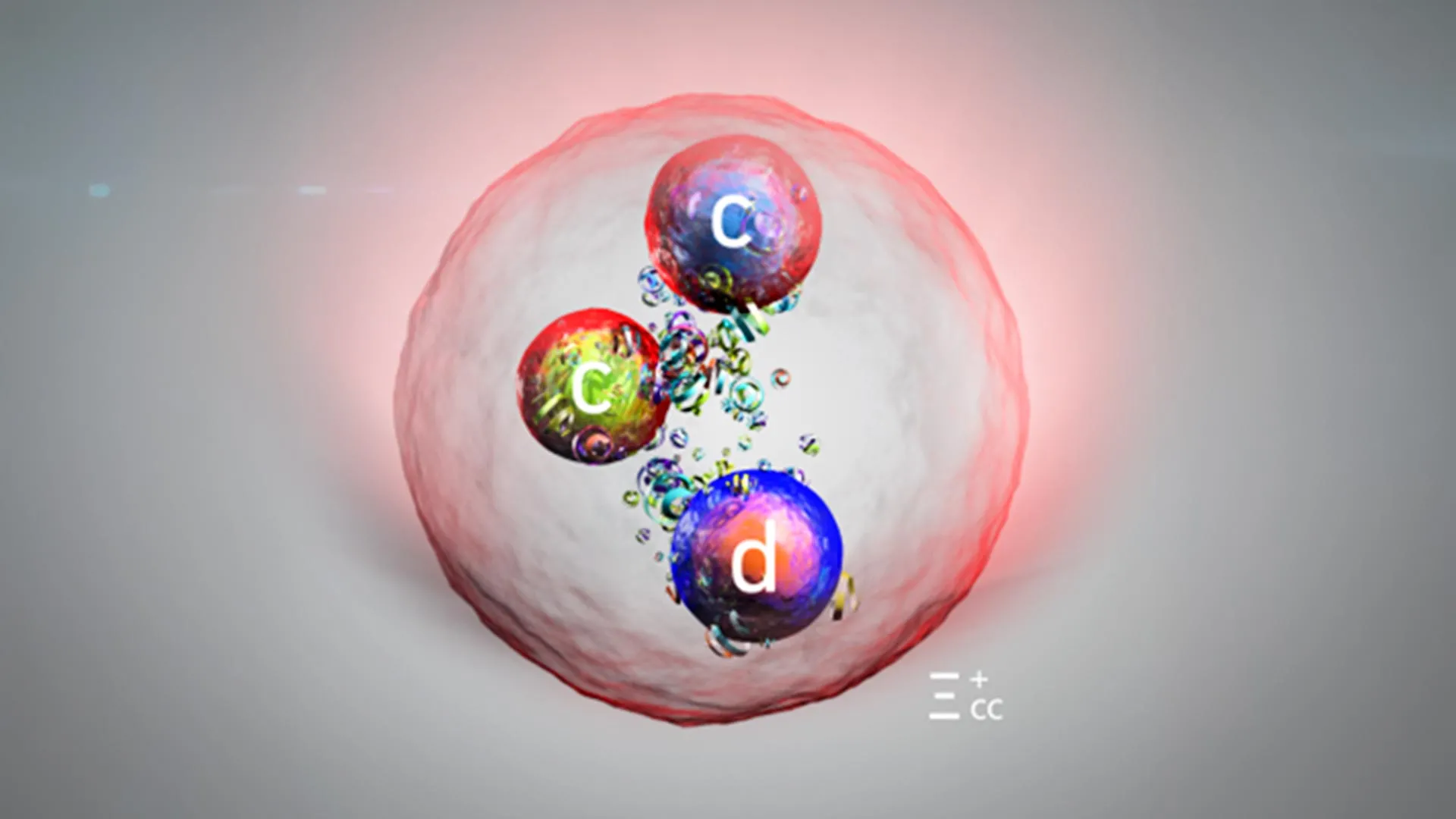
The $Xi_cc^+$ is not just another particle; its identification fills a crucial gap in the Standard Model of particle physics, confirming theoretical predictions about the existence of baryons with double heavy-quark content. Its discovery is the culmination of a vast international undertaking, involving over 1,000 researchers hailing from 20 different countries. Among these nations, the United Kingdom emerged as the foremost contributor, with The University of Manchester playing an exceptionally pivotal role, providing both intellectual leadership and critical technological advancements.
A Heavier, Exotic Relative of the Proton
To truly appreciate the significance of the $Xicc^+$, one must understand its place within the vast family of subatomic particles. It belongs to the baryon family, particles composed of three quarks, like the familiar proton and neutron that make up atomic nuclei. The proton, a cornerstone of matter, was famously identified in Manchester by Ernest Rutherford and his colleagues between 1917 and 1919. A proton consists of two ‘up’ quarks and one ‘down’ quark. The newly discovered $Xicc^+$ shares this fundamental three-quark structure but replaces the lighter ‘up’ quarks with significantly heavier ‘charm’ quarks, resulting in a particle with substantially greater mass.
Quarks are elementary particles that come in six "flavors": up, down, charm, strange, top, and bottom. Each flavor also has an antimatter counterpart. The ‘charm’ quark is the third most massive quark, discovered in 1974, and is about 1,500 times heavier than the ‘up’ quark. This heavier composition is precisely what makes the $Xi_cc^+$ so intriguing. Particles with two heavy quarks (like the two charm quarks here) offer a unique laboratory for studying Quantum Chromodynamics (QCD), the theory describing the strong nuclear force that binds quarks together. Unlike typical baryons where all three quarks are in a complex, relativistic dance, in double-heavy baryons, the two heavy quarks are thought to behave somewhat like a "heavy core" around which the lighter quark orbits, creating a kind of subatomic "solar system" that is easier to model theoretically.
This finding builds upon a profound and enduring legacy of particle physics research at Manchester. Decades before the LHC, in the 1950s, scientists at the university were pioneers in identifying a member of the ‘Xi’ ($Xi$) particle family, a type of baryon containing a strange quark. This early work laid foundational groundwork, establishing a tradition of discovery that directly precedes and informs breakthroughs like the $Xi_cc^+$.
Manchester’s Indispensable Role in the LHCb Detector Upgrade
The successful identification of the $Xi_cc^+$ was made possible by the state-of-the-art capabilities of the upgraded LHCb (Large Hadron Collider beauty) detector. This ambitious upgrade, designed to handle significantly higher data rates and achieve greater precision, saw Professor Chris Parkes, who is the head of The University of Manchester’s Department of Physics and Astronomy, at the helm. He led the international collaboration through the critical phases of the upgraded LHCb detector’s installation and its crucial early operational period. Furthermore, Professor Parkes spearheaded the United Kingdom’s involvement in this monumental project for over a decade, guiding it from its initial conceptual approval through to its successful completion. This long-term leadership underscores Manchester’s commitment and influence within the global particle physics community.
The Manchester LHCb team’s contributions were not limited to leadership; they were deeply embedded in the detector’s physical construction. The team meticulously designed and built essential components of the upgraded tracking system, most notably the advanced silicon pixel detector modules. These intricate modules were precisely assembled in the University’s Schuster Building, a facility renowned for its cutting-edge research. These components are absolutely critical for the detector’s function, enabling the accurate tracking of particle decays and the precise identification of fleeting signals, such as those emanating from the $Xi_cc^+$. The ability to pinpoint the trajectories and decay products of particles with such accuracy is paramount for distinguishing genuine new particle discoveries from background noise.
Reflecting on the historical context and the present achievement, Professor Parkes articulated the profound connection between past and present scientific endeavors: "Rutherford’s gold-foil experiment in a Manchester basement transformed our understanding of matter, and today’s discovery builds on that legacy using state-of-the-art technology at CERN. Both milestones demonstrate just how far curiosity-driven research can take us. This discovery showcases the extraordinary capability of the upgraded LHCb detector and the strength of UK and Manchester contributions to the experiment." His words encapsulate the spirit of scientific inquiry that has driven centuries of progress, highlighting how fundamental research, often without immediate practical applications, invariably leads to profound insights and technological innovation.
Providing further insight into the technological marvel of the detector, Dr. Stefano De Capua, also from The University of Manchester, led the intricate production process of these critical silicon detector modules. He vividly described the detector’s operation using an evocative analogy: "The detector is a form of ‘camera’ that images the particles produced at the LHC and takes photographs 40 million times per second. It utilises a custom-designed silicon chip that also has a variant for use in medical imaging applications." This analogy underscores the detector’s incredible speed and precision, capable of capturing the ephemeral trails of particles created in the LHC’s high-energy collisions. The mention of medical imaging applications for the custom silicon chip highlights a fascinating example of how fundamental research in particle physics can lead to unexpected and beneficial spin-off technologies, improving healthcare diagnostics.
Unraveling the Mystery: How the $Xi_cc^+$ Particle Was Identified
The identification of the $Xicc^+$ particle was a painstaking process, relying on the sophisticated data analysis techniques applied to the massive datasets generated by the LHCb detector. Researchers detected the $Xicc^+$ not directly, as it is an unstable particle that decays almost instantaneously, but by meticulously observing its specific decay signature. They traced its transformation into three lighter, more stable particles: a $Lambda_c^+$ (Lambda-c-plus), a K$^-$ (Kaon-minus), and a $pi^+$ (Pion-plus). Each of these daughter particles then leaves its own characteristic trace in the detector, allowing physicists to reconstruct the original, heavier particle from which they originated.
These critical decay events were recorded during the high-energy proton-proton collisions at the LHC throughout 2024, a landmark year that marked the first full-capacity operational period for the upgraded LHCb experiment. The increased luminosity of the LHC, combined with the enhanced capabilities of the detector, allowed for an unprecedented volume of data to be collected, significantly improving the chances of observing rare phenomena like the $Xi_cc^+$.
Through rigorous analysis of this data, a clear and undeniable signal emerged. Approximately 915 distinct events corresponding to the $Xicc^+$ decay chain were measured, revealing a precise mass of 3619.97 MeV/c$^2$ (Mega-electron Volts divided by the speed of light squared). This unit, MeV/c$^2$, is commonly used in particle physics to express mass, linking it directly to Einstein’s famous energy-mass equivalence, E=mc$^2$. This meticulously measured mass result aligns remarkably well with theoretical predictions, and crucially, it matches expectations based on a previously discovered related particle, the $Xicc^++$ (Xi-cc-plus-plus). The $Xicc^++$ (composed of two charm quarks and one up quark) was discovered in 2017, providing the first definitive evidence for the existence of double-charm baryons, and setting the stage for the search and confirmation of its neutral and singly-charged counterparts like the $Xicc^+$.
Solving a Two-Decade Mystery in Particle Physics
The discovery of the $Xicc^+$ at LHCb carries additional weight due to a long-standing debate within the particle physics community. For more than two decades, the existence of this specific particle had been a subject of contention. In 1999, an experiment at Fermilab, the SELEX collaboration, reported an earlier claim of observing a particle with similar characteristics, albeit with a different mass. However, these initial findings were never independently confirmed by other experiments, leading to considerable skepticism and leaving the question of the $Xicc^+$’s existence unresolved.
The scientific process demands rigorous validation and reproducibility. Without independent verification, even intriguing results remain hypotheses. The new, highly precise measurement from LHCb at CERN definitively resolves this two-decade mystery. The measured mass of 3619.97 MeV/c$^2$ does not match the earlier unconfirmed claim from Fermilab, but it does align perfectly with sophisticated theoretical expectations derived from the Standard Model and the properties of its partner particle, the $Xi_cc^++$. This powerful confirmation underscores the reliability and precision of the LHCb detector and the analytical methods employed by the collaboration.
What Comes Next for CERN and Manchester
The discovery of the $Xicc^+$ is not an endpoint but rather a springboard for further exploration. It reinforces the validity of the Standard Model of particle physics in this exotic sector and provides invaluable data for refining our understanding of Quantum Chromodynamics. The unique configuration of two heavy quarks and one light quark in the $Xicc^+$ allows physicists to probe the strong force in a way that is less complicated by the relativistic dynamics of lighter quarks, potentially revealing new insights into its fundamental nature.
Looking ahead, The University of Manchester is poised to continue its leading role in the next ambitious phase of the LHC program: LHCb Upgrade 2. This upcoming upgrade will capitalize on the unprecedented capabilities of the High-Luminosity LHC (HL-LHC) accelerator, which is designed to deliver significantly more proton-proton collisions. This dramatic increase in data volume will enable scientists to delve even deeper into the properties of known particles, explore extremely rare decay processes, and push the boundaries of discovery in search of physics beyond the Standard Model. Manchester’s ongoing involvement will ensure its continued influence in shaping the future trajectory of particle physics research.
The details of this groundbreaking $Xi_cc^+$ discovery were formally presented at the Rencontres de Moriond Electroweak conference, a prestigious annual gathering of leading particle physicists where the latest results and theoretical advancements in electroweak interactions and beyond are discussed. This presentation marks the formal announcement of a discovery that promises to reshape our understanding of the universe’s most fundamental constituents.
