
 By admin
For those who navigate the world of award travel, the Hilton Aspire Card represents the pinnacle of the Hilton Honors ecosystem. Even for travelers who may only find themselves at a Hilton property a handful of times each year, the card provides an immediate "fast track" to the high life through its automatic, top-tier Hilton Diamond status. This status alone can be a game-changer, offering space-available room upgrades (up to one-bedroom suites), executive lounge access, and a daily food and beverage credit in the United States or complimentary continental breakfast abroad. However, while Diamond status is a passive benefit, the Hilton Aspire resort credit is an active one that requires a strategic approach to fully maximize.

The mechanics of the Hilton Aspire resort credit are designed to encourage regular engagement with the Hilton portfolio. Cardmembers are eligible for up to $200 in statement credits twice per calendar year. The first $200 window runs from January through June, and the second $200 window opens from July through December. This $400 annual total is a significant increase over the previous iteration of the benefit, but it requires the cardmember to visit an eligible resort in both halves of the year—or at least find a way to trigger the credit during those specific windows. When used effectively, this benefit alone covers nearly 73% of the card’s $550 annual fee, leaving the remaining $150 to be easily eclipsed by other perks like the annual Free Night Certificate and the $200 flight credit (distributed as $50 quarterly).
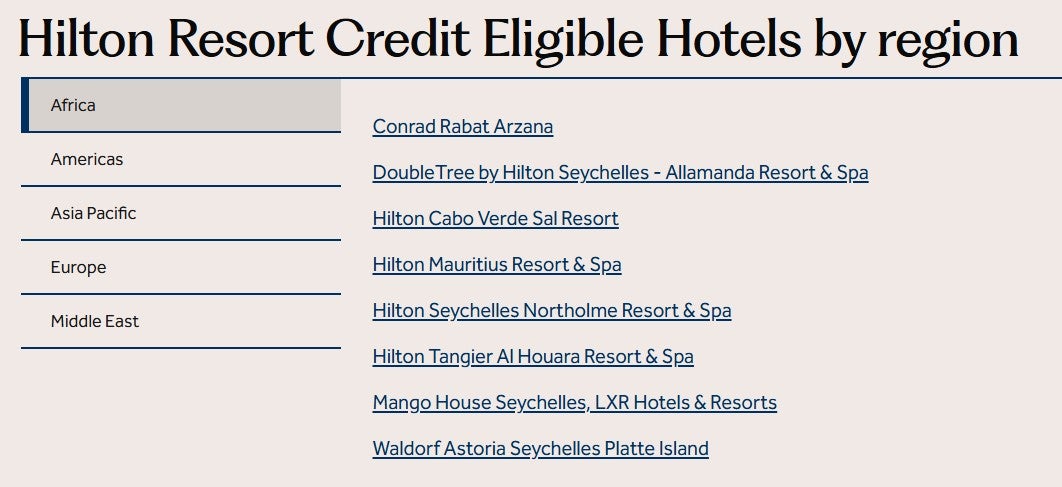
To successfully utilize the resort credit, one must understand the specific definitions and limitations set forth by American Express and Hilton. The credit is only valid at "participating Hilton resorts." This is a crucial distinction, as not every Hilton-branded hotel qualifies. Hilton maintains a dedicated directory of resort properties, which includes high-end brands like Waldorf Astoria, Conrad, and LXR, as well as more accessible options under the Hilton, DoubleTree, and Curio Collection banners. Travelers should always verify their destination against the official Hilton resort list before booking, as a standard "city hotel" in a major metropolitan area—even a high-end one—will likely not trigger the credit unless it is explicitly designated as a resort.

The logistics of triggering the credit are relatively straightforward but contain several "gotchas" that can trap the unwary. To receive the statement credit, the cardmember or an authorized user must use the Hilton Aspire Card to pay for eligible charges directly at the property. This typically includes the room rate, taxes, and incidental charges such as dining at on-site restaurants, spa treatments, or equipment rentals. However, there is a major caveat: nonrefundable "Advance Purchase" rates generally do not qualify. Because these rates are often processed by a central Hilton corporate billing system rather than the individual hotel’s front desk, they may not code correctly as a resort purchase on the American Express statement. To ensure the credit posts, it is best to book "Best Available" or "Member" rates that are paid at checkout, or at least ensure that any deposit is handled directly by the property.
Expert travelers often look for "gray area" ways to utilize the credit if they do not have a resort stay planned during a specific six-month window. While the terms and conditions state that incidental charges must be charged to a room to be eligible, historical data from the traveler community suggests that some on-site restaurants and spas may trigger the credit even without a stay, provided the merchant terminal is owned and operated by the resort itself. Furthermore, some cardmembers have had success calling a resort directly to purchase a gift card or to put down a deposit for a future stay. For instance, a traveler with a stay booked for early 2026 might call the hotel in late 2025 to pay a $200 deposit, thereby capturing the July–December credit for a trip that hasn’t happened yet. While these methods are not guaranteed and fall outside the strict letter of the terms, they represent the kind of creative maneuvering that dedicated points-and-miles hobbyists use to ensure no value is left on the table.

The true power of the Hilton Aspire resort credit is revealed when it is combined with other benefits or "stacked" with multiple cardholders. In households where both partners hold their own Hilton Aspire Card, the potential for savings doubles. A couple could theoretically enjoy $800 in resort credits annually ($400 per person). By asking the front desk to split the bill at checkout, a single luxury stay can be subsidized by multiple credits. This strategy was effectively employed by travelers visiting high-cost destinations like the Waldorf Astoria Maldives Ithaafushi or the Conrad Bora Bora Nui, where daily expenses for food and activities can easily exceed several hundred dollars.
Beyond the resort credit, the Hilton Aspire Card’s Free Night Certificate (FNC) remains one of the most flexible and valuable "uncapped" certificates in the industry. Unlike competitors who limit their free night awards to hotels within a certain point cost or category, the Hilton FNC can be used at almost any property in the global Hilton system, provided there is "Standard Room Reward" availability. This allows cardmembers to redeem their certificate at ultra-luxury properties where cash rates might exceed $1,000 per night, such as the Grand Wailea in Maui or the Waldorf Astoria Amsterdam. When you add the $400 in resort credits to the value of a high-end FNC redemption, the "net cost" of the card’s annual fee often drops into the negative, essentially paying the cardmember to hold the card.

Real-world applications of these benefits highlight the card’s versatility. For example, a traveler visiting the Hilton Alexandria Corniche in Egypt might find that the $200 semi-annual credit covers nearly an entire week-long stay due to lower local currency costs. Conversely, a traveler at the Hilton Cartagena in Colombia might use the credit to offset a significant portion of a three-night stay, including parking and poolside dining. Even at domestic locations, such as the DoubleTree Fallsview Resort & Spa by Hilton Niagara Falls, the credit can turn an expensive weekend getaway into a budget-friendly excursion by covering both the room rate and incidental fees.
The Hilton Aspire Card also serves as a formidable "points-earning machine." When staying at Hilton properties, cardmembers earn 14 Hilton Honors points per dollar spent. When combined with the 100% points bonus that comes with Diamond status (an additional 10 points per dollar) and the base 10 points per dollar earned by all members, Aspire cardholders earn a staggering 34 points per dollar on eligible hotel spend. At a conservative valuation of 0.5 cents per point, this equates to a 17% return on every dollar spent at Hilton, making it the clear choice for any paid stay within the brand.
For those considering adding the Hilton Honors American Express Aspire Card to their wallet, the current market timing is particularly favorable. American Express frequently offers elevated welcome bonuses to attract new users. Currently, new cardmembers can earn 175,000 Hilton Honors bonus points after spending $6,000 on purchases within the first six months of account opening. This influx of points, combined with the immediate issuance of a Free Night Certificate and the first $200 installment of the resort credit, provides a massive "front-loaded" value that can facilitate a dream vacation almost immediately.
In conclusion, the Hilton Honors American Express Aspire Card is a masterclass in premium credit card engineering. While the $550 annual fee may initially cause "sticker shock," a deeper analysis of the $400 resort credit, the $200 flight credit, the uncapped Free Night Certificate, and the industry-leading Diamond status reveals a product that is surprisingly easy to justify. For the traveler who appreciates the comforts of a resort—whether it is a beachfront villa in the Maldives or a family-friendly spa in Niagara Falls—the Aspire Card is not just a payment tool, but a strategic asset that unlocks a higher tier of travel experiences while simultaneously lowering the out-of-pocket cost of luxury. Success with the card simply requires a bit of calendar management and a glance at the resort directory, a small price to pay for the outsized rewards on offer.
