
 By admin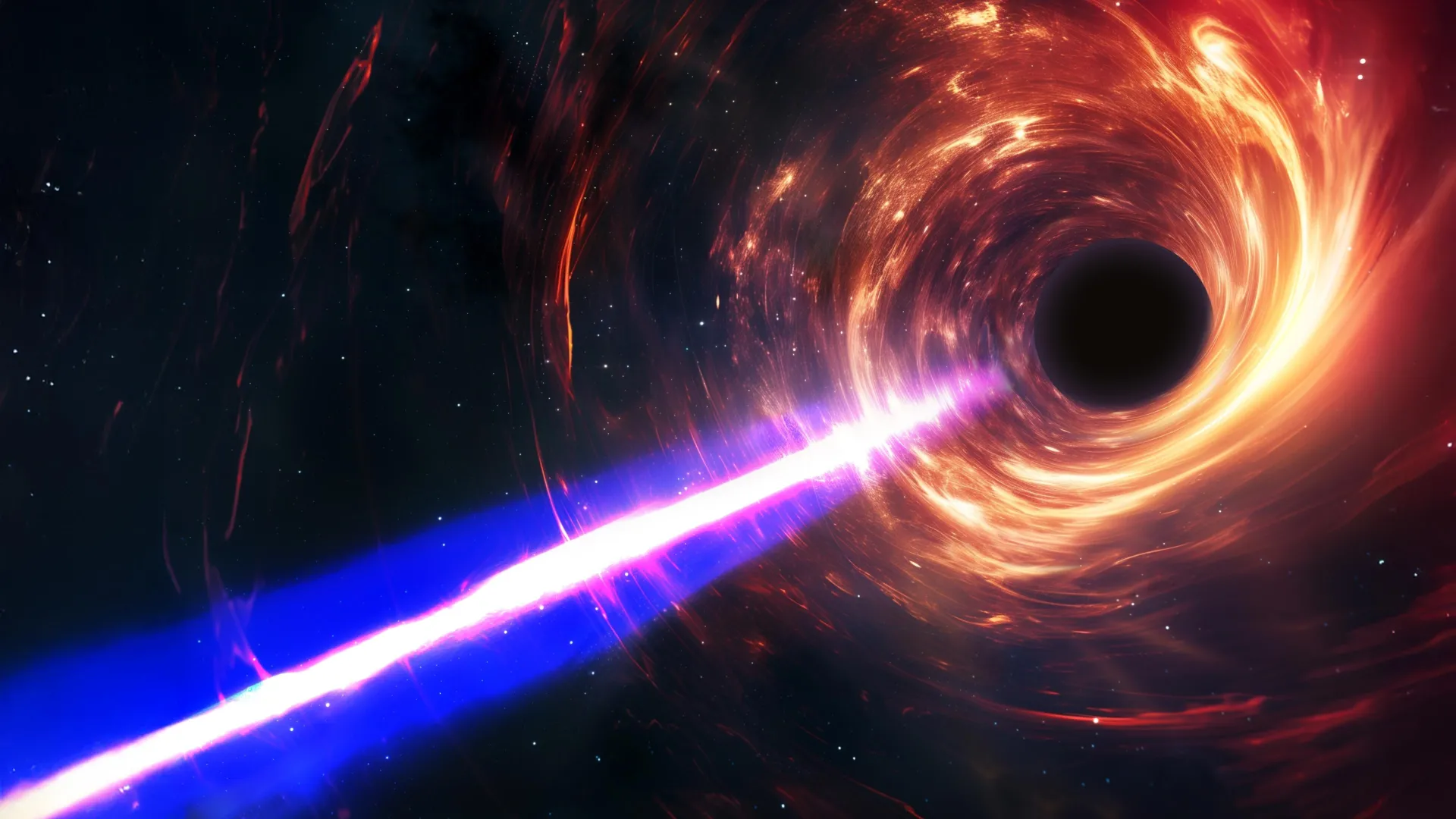
Black holes, enigmatic gravitational behemoths that warp spacetime, are far from inert cosmic vacuums. While their intense gravity prevents anything, even light, from escaping once past their event horizon, the regions immediately surrounding them are sites of spectacular activity. As matter—gas, dust, and even stars—falls towards a black hole, it forms a swirling accretion disk, heating to millions of degrees and emitting prodigious amounts of X-rays and other radiation. Yet, not all infalling matter is consumed. A fraction of it is somehow channeled by powerful magnetic fields into two opposing, tightly collimated beams of plasma, known as relativistic jets, which erupt from the black hole’s poles at incredible speeds. These jets can extend for hundreds of thousands of light-years, carving out vast cavities in the surrounding intergalactic medium and profoundly influencing their host galaxies. Understanding the precise mechanisms that power these jets and quantifying their energy output has been a significant challenge in astrophysics for decades. Previous estimations relied heavily on indirect methods, often averaging over vast timescales, making it difficult to pinpoint the instantaneous energy transfer or to directly correlate jet activity with the dynamics of the accretion disk.
The study, meticulously published in the esteemed journal Nature Astronomy, specifically zeroed in on Cygnus X-1, a celestial icon renowned for its historical significance as the first confirmed black hole candidate. This binary system comprises a stellar-mass black hole, roughly 21 times the mass of our Sun, locked in a tight orbital dance with a massive blue supergiant star, HDE 226868. The proximity of the supergiant star provides a constant stream of stellar wind, a torrent of charged particles continually flowing outwards from its surface. It was this unique cosmic dance and the system’s observable characteristics that presented an unparalleled opportunity for the research team. Through their innovative observational technique, scientists were able to precisely determine that the powerful jets streaming from Cygnus X-1’s black hole carry an astonishing energy output equivalent to approximately 10,000 Suns. To put this into perspective, if the entire energy output of our Sun were converted into a single burst, this black hole’s jets would equal that power 10,000 times over, continuously. This staggering figure underscores the immense power harbored within these cosmic engines.
To achieve this unprecedented measurement, the international team leveraged the extraordinary capabilities of a widely spaced array of radio telescopes operating in unison, effectively creating a virtual telescope the size of Earth. This technique, known as Very Long Baseline Interferometry (VLBI), combines signals from multiple radio dishes across continents—from Europe to Australia and beyond—to achieve angular resolution far superior to any single telescope. This allowed them to capture exquisitely detailed images of the jets, resolving fine structures that would otherwise be blurred. The key to their novel approach lay in observing how these jets were dynamically pushed and distorted by the powerful, dense winds emanating from the nearby supergiant star as the black hole traversed its elliptical orbit. The effect, as eloquently described by the researchers, is strikingly similar to how robust gusts of wind on Earth can visibly bend and reshape a powerful stream of water from a fountain. The interaction provided a measurable ‘cosmic barometer’ for the jets’ inherent strength.
Using Stellar Winds to Reveal Jet Strength: A Cosmic Anemometer
The ingenuity of this method lies in its elegant simplicity and the sophisticated physics employed. By meticulously calculating the strength, density, and velocity of the supergiant star’s prodigious stellar wind—which is many orders of magnitude more intense than our Sun’s comparatively gentle solar wind—and then precisely tracking how much the relativistic jets were deflected and reshaped by this stellar torrent, researchers could deduce the jets’ intrinsic power at a specific moment in time. This marks a pivotal moment in astrophysical research, representing the first instance where scientists have directly measured the instantaneous energy of black hole jets. Prior studies were largely confined to inferring jet power from long-term averages or from the integrated effects of jets over vast cosmological timescales, which often obscured the direct relationship between the black hole’s accretion process and its jet production. This new instantaneous measurement provides a snapshot of the energy balance, offering a clearer picture of the physics at play right at the black hole’s doorstep.
Beyond the sheer power output, the team also made significant strides in measuring the jets’ velocity. They determined that the jets from Cygnus X-1 hurtle through space at roughly half the speed of light, an astounding 150,000 kilometers per second. Pinpointing this precise speed has been a formidable challenge for scientists for many years due to observational complexities and the relativistic nature of these phenomena. Accurately determining both the power and speed of these jets provides critical parameters for refining theoretical models of black hole physics and the processes that accelerate particles to such extreme velocities.
The ambitious project was primarily led by the Curtin Institute of Radio Astronomy (CIRA) and the Curtin node of the International Centre for Radio Astronomy Research (ICRAR), both prominent institutions in Western Australia, with vital contributions from the renowned University of Oxford.
"Dancing Jets" Offer New Insight: Unveiling the Energy Transfer Mechanism
Dr. Steve Prabu, the lead author of the study, who was affiliated with CIRA during the research and is now continuing his pioneering work at the University of Oxford, provided vivid insights into the team’s methodology. He explained that the researchers meticulously utilized a sequence of high-resolution images to track what he poetically described as "dancing jets." This captivating term refers to the observed phenomenon where the jets repeatedly shift their direction and shape as they are dynamically pushed and buffeted by the intense winds emanating from the supergiant companion star, all while the black hole and star execute their intricate orbital ballet around each other. The continuous interaction and visible deflection allowed the team to essentially "weigh" the jets’ momentum.
Dr. Prabu emphasized that these unprecedented observations are instrumental in revealing precisely how much of the immense energy generated in the immediate vicinity of a black hole—as matter spirals inwards and forms the accretion disk—is subsequently transferred into its surrounding environment by these powerful outflows. This energy transfer mechanism, often referred to as "feedback," is a cornerstone of modern astrophysical theory, playing a critical role in regulating galactic ecosystems.
"A key finding from this research is that about 10 per cent of the energy released as matter falls in towards the black hole is carried away by the jets," Dr. Prabu stated. This figure is profoundly significant. For decades, cosmologists and astrophysicists running large-scale simulated models of the Universe have often made the fundamental assumption that roughly 10% of the accretion energy is channeled into relativistic jets. This assumption, while theoretically sound and necessary for their models to align with observed cosmic structures, has been notoriously difficult to confirm through direct observational evidence—until now. "This is what scientists usually assume in large-scale simulated models of the Universe, but it has been hard to confirm by observation until now," Dr. Prabu reiterated, highlighting the study’s crucial role in bridging the gap between theoretical predictions and empirical validation.
Confirming Theories About Black Hole Physics and Shaping the Cosmos
Co-author Professor James Miller-Jones, a distinguished researcher from CIRA and the Curtin node of ICRAR, further elaborated on the transformative implications of this research. He highlighted that earlier techniques for estimating jet power were inherently limited, only capable of providing average power outputs over exceedingly long timescales, often spanning thousands or even millions of years. This temporal averaging posed a significant obstacle, making it exceedingly difficult to directly compare the energy contained within the jets with the simultaneous X-ray emissions generated by the superheated matter spiraling into the black hole. A direct, instantaneous measurement of jet power allows for a much more precise and dynamic understanding of the intricate energy balance within the black hole system.
"And because our theories suggest that the physics around black holes is very similar, we can now use this measurement to anchor our understanding of jets, whether they are from black holes 10 or 10 million times the mass of the Sun," Professor Miller-Jones profoundly stated. This concept of "universality" is a cornerstone of black hole physics. While stellar-mass black holes like Cygnus X-1 are the remnants of collapsed massive stars, and supermassive black holes (millions to billions of solar masses) reside at the centers of most galaxies, the fundamental physical processes governing accretion disks, magnetic field generation, and jet formation are believed to operate under similar principles, scaled by mass. Therefore, a precise measurement from an accessible stellar-mass black hole can serve as a vital benchmark for understanding the more distant and harder-to-resolve supermassive counterparts.
This "anchor point" takes on even greater significance in the context of upcoming astronomical endeavors. "With radio telescope projects such as the Square Kilometre Array Observatory (SKA) currently under construction in Western Australia and South Africa, we expect to detect jets from black holes in millions of distant galaxies, and the anchor point provided by this new measurement will help calibrate their overall power output," Professor Miller-Jones explained. The SKA, poised to become the world’s largest radio telescope, will revolutionize our ability to observe the distant Universe, detecting faint radio emissions from billions of years ago. Having a reliably calibrated fundamental power conversion efficiency from a nearby black hole system like Cygnus X-1 will be indispensable for accurately interpreting the vast amounts of data expected from the SKA, allowing astronomers to confidently infer the energetic impact of black holes throughout cosmic history.
Ultimately, the findings underscore the profound and often counterintuitive role of black holes in the grand cosmic narrative. "Black hole jets provide an important source of feedback to the surrounding environment and are critical to understanding the evolution of galaxies," Professor Miller-Jones concluded. This feedback mechanism is a crucial ingredient in models of galaxy formation and evolution. The powerful jets emanating from central supermassive black holes can heat and expel gas from galaxies, thereby suppressing star formation and regulating the growth of galaxies. Without this feedback, theoretical models predict that galaxies would grow far larger and form stars much more rapidly than what is actually observed. Thus, these seemingly destructive cosmic phenomena are, in fact, integral sculptors, preventing runaway star formation and enriching the intergalactic medium, thereby shaping the very structure and destiny of the Universe we inhabit.
The collaborative spirit of this monumental research extended to several other esteemed institutions, including the University of Barcelona, the University of Wisconsin-Madison, the University of Lethbridge, and the Institute of Space Science, highlighting the global effort required to unravel the deepest mysteries of the cosmos. This direct measurement of black hole jet power not only validates decades of theoretical work but also paves the way for a more precise understanding of the universe’s most powerful engines and their profound influence on galactic evolution, propelling astrophysics into a new era of discovery.
