
 By admin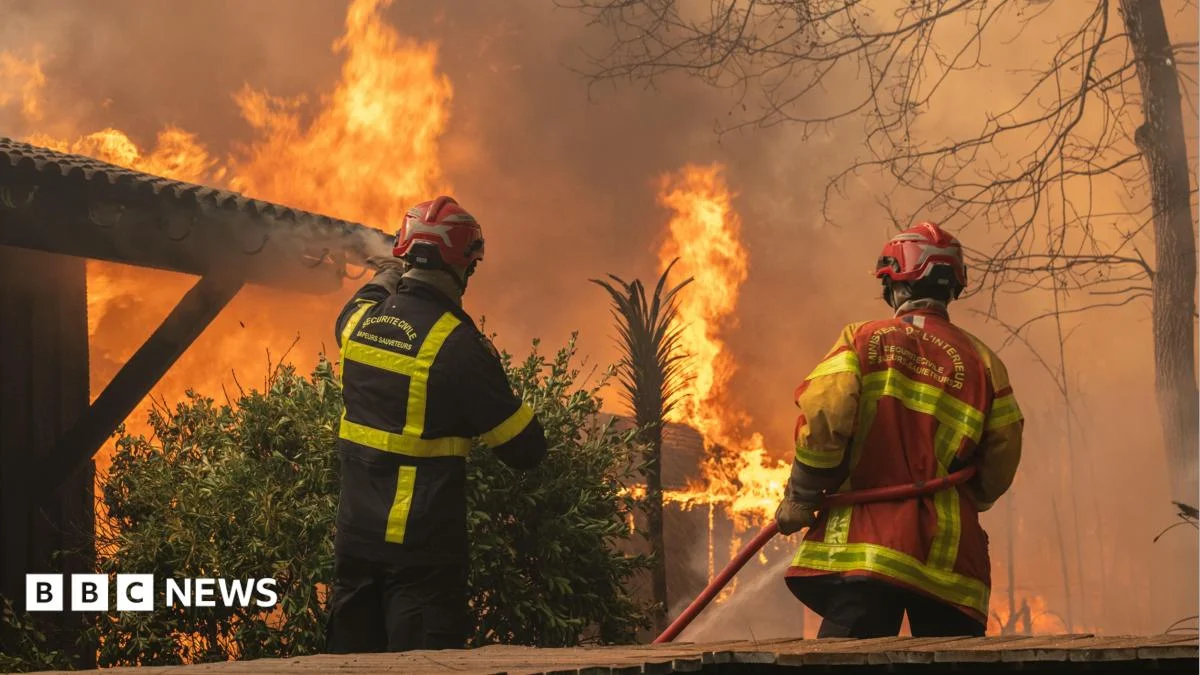
Firefighters are struggling to contain wildfires in south-west France as strong winds push flames towards the city of Bordeaux, with one official saying they "are far from having the fire under control." The situation is dire, with over 300,000 people in France and Spain forced to flee their homes as fires have been raging for days, their containment efforts severely hampered by relentless winds and scorching high temperatures. This widespread inferno marks an alarming escalation in Europe’s struggle against the growing threat of climate change-induced wildfires.
In Spain, where a state of emergency has been declared in the worst-hit regions, a slight change in weather conditions has offered a glimmer of hope to firefighters working tirelessly outside Madrid. However, the overall mood remains somber. Spanish Prime Minister Pedro Sánchez acknowledged the gravity of the situation, admitting that "complex times ahead" are anticipated. The human cost of these infernos has already become tragically apparent. Authorities in the Valencia region confirmed the death of a man in a fire, a stark reminder of the immediate dangers posed by these uncontrolled blazes. The victim, believed to be in his 70s, was discovered deceased in his car by firefighters who were attempting to extinguish a fire in the Salt de l’Aigua ravine in Manises, according to local media reports. This incident underscores the risks faced not only by those directly in the path of the flames but also by the brave emergency responders.
The scale of the evacuations in France is staggering. Late on Saturday, an additional 55,000 residents were ordered to evacuate, bringing the total number of people displaced in the south-western regions of Gironde and Landes to approximately 250,000. The sheer volume of people forced to abandon their homes highlights the pervasive nature of the threat. Firefighter Captain Nicolas Braz provided a chilling account of the conditions on the ground to the AFP news agency. He described how the fire had become so intense that it was creating "its own winds – complete with whirlwinds," rendering the inferno "erratic and unmanageable." Captain Braz grimly predicted that it was set to be another "difficult night," a sentiment that has been echoed by many on the front lines.
In response to the escalating crisis, France has mobilized its military to bolster firefighting efforts. Extra reinforcements from the army have been deployed to assist firefighters in clearing brush and creating crucial fire breaks, essential measures to slow the advance of the flames. President Emmanuel Macron, while addressing the nation, pledged that France would "rebuild" and assured affected communities that his government would "be there for as long as is needed." This commitment signifies the long-term challenges and recovery efforts that will be required in the wake of such devastation.
The human impact of these fires extends beyond those directly evacuated. A British couple holidaying in Bordeaux shared their harrowing experience, describing how they witnessed the flames intensify on Friday night as the fire crept closer to their location. Maisie, speaking to BBC Newsbeat from their holiday rental, recounted how at "about seven o’clock you could smell smoke. We thought someone was having a barbecue." The reality, however, was far more sinister. Her partner, Caleb, described the alarming extent of the smoke and ash, noting that it had covered the swimming pool and turned their feet black when they dared to venture outside. The air quality has become a significant concern, with the couple adding that the smoke "really hits your lungs right away."
The fear and uncertainty are palpable in the affected areas. Nearby, in Saint-Aubin-de-Médoc, residents who were evacuating described the situation as "stressful," with one local unequivocally labeling it a "disaster." The disruption caused by these fires is far-reaching, impacting even major international events. The final leg of the iconic Tour de France, originally scheduled to take place on Sunday, has been significantly shortened. Organizers and police announced that the race would be reduced from 133km (83 miles) to 89km (55 miles) to allow security forces to be redeployed to assist in areas affected by the wildfires. This decision underscores the severity of the crisis, demonstrating how it is demanding resources and attention across all sectors of society.
President Macron is scheduled to convene an emergency meeting with his ministers to address the alarming situation. With approximately 30 or so fires raging across the country, the government has described the current circumstances as "totally unprecedented." This acknowledgment highlights the extreme nature of the current wildfire season and the challenges faced by national authorities.
The current crisis is not an isolated incident but rather a symptom of a broader trend of increasingly severe wildfire seasons in Europe. Belgian Interior Minister Annelies Verlinden, speaking to the BBC, confirmed that fires had started earlier in the year. She recalled that in April, the Netherlands had activated the EU’s civil protection mechanism, a system designed to trigger support and reinforcements from other member states during large-scale emergencies. This early activation of the mechanism was a prescient indicator of the challenges to come.
Minister Verlinden also warned that more outbreaks are likely as the summer progresses. "Forecasters are predicting, unfortunately, another heatwave so we can expect other wildfires," she added, painting a grim picture of the months ahead. The statistics from previous years underscore the escalating threat. Last year, a staggering one million hectares burned across Europe during the summer months, and Minister Verlinden expressed concerns that "we are expecting to face another historical, sad record because the season has started earlier in the year." This prediction suggests that the current fires might be just the beginning of a prolonged and devastating period.
In a testament to international cooperation and solidarity in the face of this crisis, France has activated the EU’s civil protection mechanism. As a result, the country will receive crucial assistance in the form of water bombers, including three Canadair planes from Croatia and two Air Tractors from Portugal. Additionally, Black Hawk helicopters from the Czech Republic and Slovakia, along with 40 members of a Romanian forest fire team, are being dispatched to aid in the containment efforts. The European Union is also playing a significant role in coordinating aid. EU Commission President Ursula von der Leyen confirmed that 11 planes and helicopters have been sent to both France and Spain from the EU’s collective firefighting fleet, demonstrating a unified European response to the escalating threat.
The current wildfire situation in France and Spain is a stark manifestation of the growing impact of climate change. Rising global temperatures, prolonged heatwaves, and changing weather patterns are creating conditions ripe for the ignition and rapid spread of wildfires. The intensity and scale of these blazes serve as a critical warning, emphasizing the urgent need for both immediate action to combat the current infernos and long-term strategies to mitigate the effects of climate change and adapt to a world where such extreme weather events are becoming increasingly common. The resilience of affected communities, the dedication of emergency responders, and the collaborative efforts of international partners will be crucial in navigating this challenging period and working towards a safer future.
