
 By admin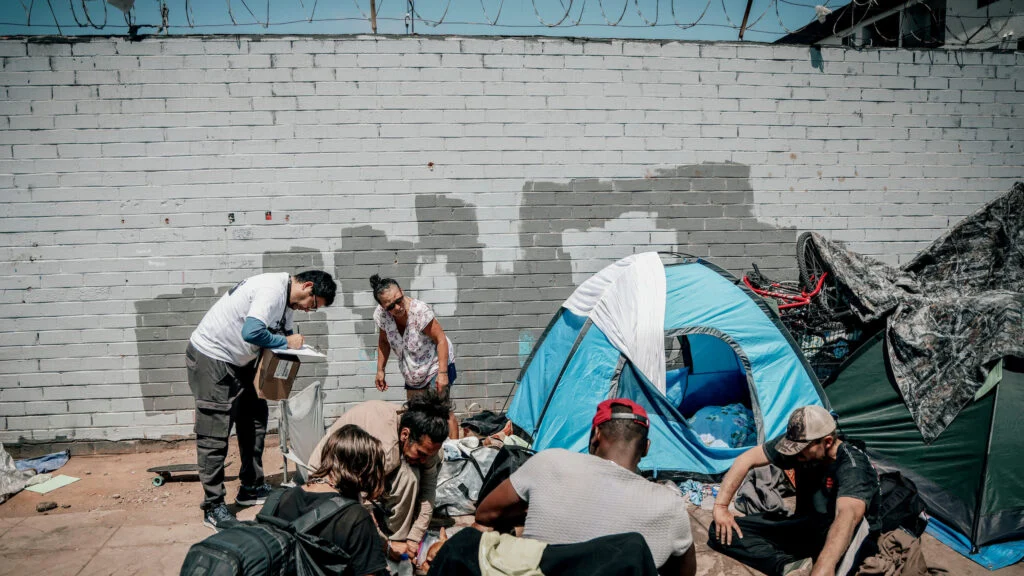
She first came to Park Boulevard for the money and the snacks, a pilgrimage born of necessity and the quiet recommendations of the street. A friend had whispered that there was a place with free fruit gummies, granola bars, and rice crispy treats—a small sanctuary where she could also earn $20 just by answering survey questions. For GB, a 47-year-old woman whose nights were spent crinkling through garbage bags in search of aluminum cans, the offer sounded like a dream. To earn $20 on the street, she had to collect hundreds of empty bottles and cans, lugging them to recycling centers for a meager $1.66 per pound. On Park Boulevard, she was told, all she had to do was show up and speak her truth. One morning in May, she and a friend walked over from the tent city where they lived, trading the exhaust of the freeway for the sterile, frosted-glass calm of a research office.
The office belonged to the University of California, San Diego (UCSD), and it provided more than just snacks and strong coffee. It provided a rare moment of dignity. GB, who had been using methamphetamine since 2021, was a woman defined by her fears and her survival instincts. She was terrified of needles; she snorted her speed and had never touched heroin or any injectable drug. When Carlos Vera, an outreach coordinator for the study, asked if he could draw her blood, her first instinct was to bolt. She thought about feigning a bathroom break and disappearing into the San Diego sun. But she stayed because of Vera. He talked to her like a "real human being," a stark contrast to the way society usually viewed her—as a bug, a nuisance, or something dirty to be swept away during city "cleanups."

She consented to the draw, but the results left her reeling. Vera informed her that her initial screening was positive for syphilis. GB was incredulous. Her boyfriend had died of an overdose in February; she had performed CPR on him until the paramedics arrived, but he was already gone. He had been her only partner for years, and she had no symptoms—no sores, no rashes, no fevers. She didn’t realize that she was part of a burgeoning "silent crisis" that was catching public health officials off guard. Since March, Vera’s team had interviewed 81 people in San Diego; eight of them, or roughly 10%, had active syphilis. Most, like GB, would never have known they were infected without the intervention of the research team.
This localized outbreak is an alarming reversal of what had briefly appeared to be a national success story. After two decades of relentlessly rising syphilis rates across the United States, data from early 2024 had suggested a slight cooling of the epidemic. However, by the time GB was tested, that data was nearly two years old and failed to account for the reality on the ground. In the spring of 2025, Planned Parenthood affiliates in Southern California began warning of a surge in unreported sexually transmitted infections (STIs), particularly among marginalized populations who are alienated from traditional healthcare systems. For these individuals, research studies like the one at UCSD act as a surrogate safety net, identifying cases that would otherwise remain hidden and untreated, continuing the cycle of transmission.
The crisis is further complicated by the unique geography of the San Diego-Tijuana region. GB lives less than 20 miles from the San Ysidro Port of Entry, the busiest border crossing in the Western Hemisphere. According to the Department of Homeland Security, approximately 90,000 people cross this border daily, many of them commuting for work, family, or social reasons. Public health in San Diego is inextricably linked to public health in Tijuana. The study GB joined was originally designed to monitor infectious disease trends on both sides of the border, recognizing that viruses and bacteria do not respect international boundaries. However, political shifts in Washington D.C. have hamstrung these efforts.

In April 2025, the National Institutes of Health (NIH) reversed its stance on international collaborations. Despite previous assurances that the Tijuana component of the UCSD study was acceptable, administrators informed the researchers that "foreign subawards"—grants shared with international partners—were no longer a priority. Citing a need for greater transparency and oversight, the agency effectively halted funding for projects involving Mexican collaborators. For the UCSD team, this meant they had to shutter their Tijuana office, lay off eight dedicated staff members, and abandon years of trust-building in Mexican communities. The epidemiological map was being cut in half, leaving researchers blind to the transmission patterns occurring just a few miles south.
While the funding cuts blinded the researchers, a national drug shortage crippled their ability to provide treatment. When Vera took GB to a county clinic for her free treatment, they encountered a hurdle that neither of them expected. The gold standard for treating syphilis is Bicillin L-A, an intramuscular form of penicillin that dissolves slowly over the course of a week, consistently attacking the corkscrew-shaped Treponema pallidum bacteria. But a nationwide shortage of the drug, exacerbated by a 2025 recall and a manufacturing monopoly, meant that the clinic had to ration its supply for pregnant patients to prevent congenital syphilis.
Instead of a single, effective injection, GB was handed a prescription for oral doxycycline: two pills a day for 30 days. For a woman living in a tent, maintaining a 30-day medication regimen is nearly impossible. "Our study sort of serves as a safety net," said Britt Skaathun, a UCSD epidemiologist. "But when there are police sweeps, they dispose of everyone’s belongings. Medications are included in those belongings." The researchers had seen it happen time and again—life-saving medications for HIV, diabetes, and depression lost in the back of a city trash truck. For GB, losing her pills meant not just a failed cure, but the risk of developing late-stage syphilis, which can attack the heart and nervous system.

The intersection of infectious disease, substance use, and border politics is a "triple whammy" of controversy that researchers like Steffanie Strathdee have navigated for decades. Strathdee, a professor at UCSD, recalls the 1990s when her research on needle exchanges in Vancouver was intentionally misinterpreted by politicians to argue against harm reduction. She warns that today’s data on cross-border transmission could easily be weaponized by isolationists to justify further border restrictions. Yet, her previous work proved that even when the border was closed during the Covid-19 pandemic, HIV clusters continued to grow and move between San Diego and Tijuana. The two cities are epidemiologically intertwined; ignoring one inevitably endangers the other.
As Vera drives his outreach van through the encampments of San Diego’s 17th Street, the human cost of these policy failures is visible on every corner. He distributes naloxone (Narcan) to those living in the shadow of the I-5 freeway, often reviving people from the brink of overdose. He checks on study participants like "Christina," who lives in a makeshift shelter of quilts and shopping carts, and "GB," who struggles to keep track of her 30-day antibiotic count amidst the chaos of recycling runs and police notices. Every tent in the city bears a neon yellow "24-Hour Notice of Cleanup," a constant reminder that stability is an illusion for the people Vera serves.
The federal government has attempted to mitigate the penicillin shortage by importing similar drugs from Europe and testing the efficacy of expired lots, but these are stopgap measures. Meanwhile, critical research that could lead to more efficient treatment—such as clinical trials to see if a single injection is as effective as three—has been delayed by administrative paralysis at the NIH. Following mass layoffs at the Department of Health and Human Services in 2025, grant processing times have ballooned. Researchers like Jeffrey Klausner at the University of Southern California have waited over a year for "overdue" grant approvals that could shift national treatment guidelines and alleviate the drug shortage.

In the end, the fight against syphilis in the borderlands relies not on grand federal proclamations, but on the small, persistent actions of people like Carlos Vera. It relies on a cup of noodles, a granola bar, and the patient building of trust in a population that the rest of the world has largely abandoned. Back at the Park Boulevard office, as the marine layer burns off and the San Diego sun begins to bake the pavement, Vera opens the door for three more men seeking help. One paces nervously, his bandana tied like a bird’s crest; another leans against a liquor store sign. They are here for the snacks, perhaps, or the $20, but they are also here because someone finally asked them how they were doing. As Vera offers them coffee and a place to sit, the "silent crisis" of the border finds a voice, one diagnosis at a time, even as the systems designed to support them continue to fray at the edges.
