
 By admin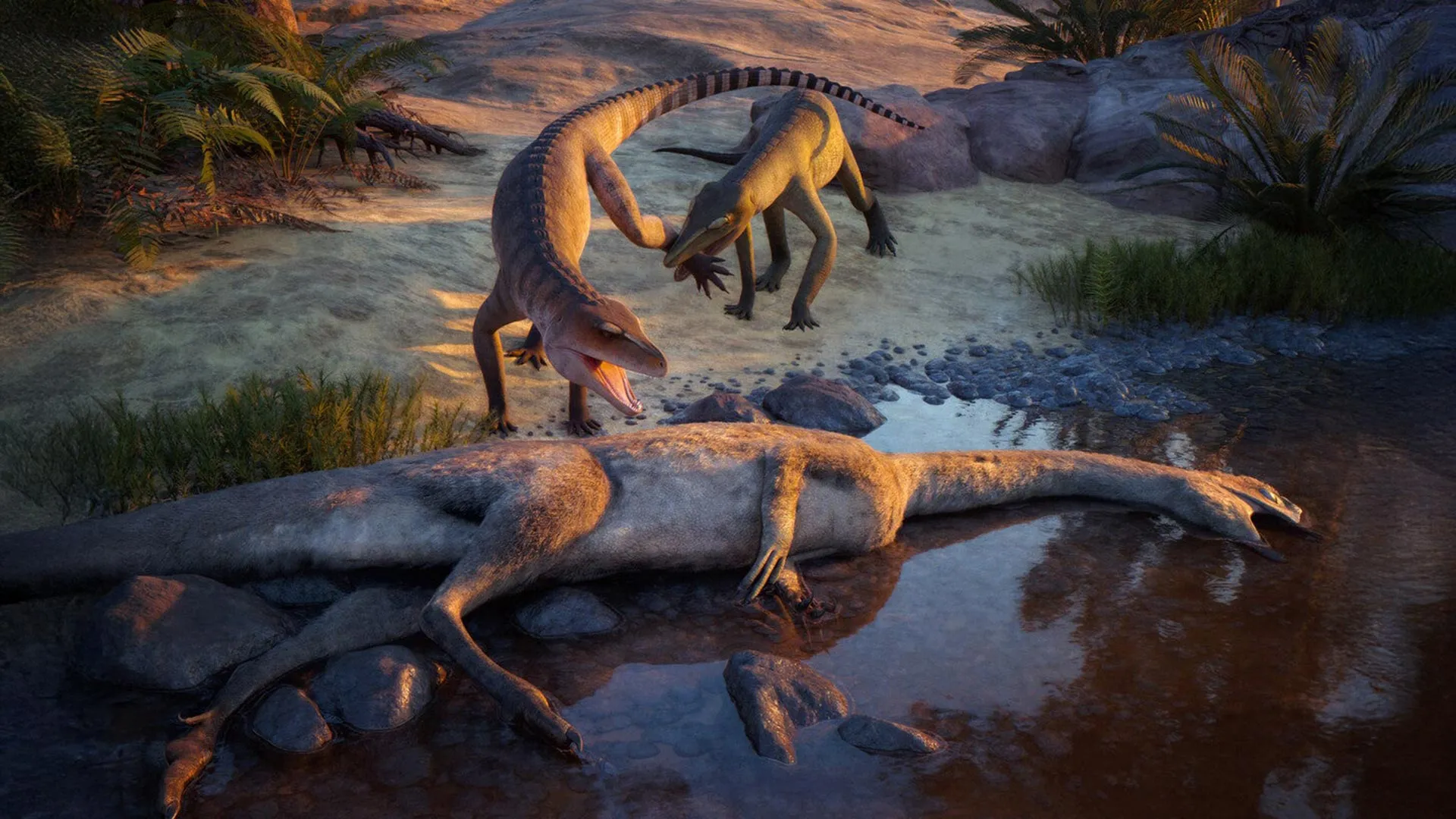
Approximately 210 million years ago, amidst the low ferns of a humid riverbank in what is now northern New Mexico, two early relatives of modern crocodiles stood poised, their forms hinting at distinct hunting strategies. This was the Late Triassic Period, a crucial epoch in Earth’s history when the supercontinent Pangea was a single landmass, and life, having rebounded from the devastating Permian-Triassic extinction, was undergoing rapid diversification. The climate was generally hot and humid, supporting lush vegetation in riverine environments, and setting the stage for the rise of archosaurs – the lineage that would eventually give rise to both crocodiles and dinosaurs.
Each of these ancient predators was roughly the size of a modern jackal, yet their skeletal structures, particularly their cranial anatomy, suggested they were adapted to exploit different ecological niches. One of these animals was Hesperosuchus agilis, a well-known, agile terrestrial predator of the time. Characterized by its long, slender snout, powerful hind limbs built for rapid movement, and comparatively smaller, more delicate front limbs, Hesperosuchus was likely a cursorial hunter, constantly searching for smaller prey along the meandering rivers and streams that crisscrossed the ancient landscape. Its morphology suggests it specialized in quick strikes, possibly preying on insects, small amphibians, lizards, or early mammals.
The second animal, however, possessed a noticeably different cranial architecture. Its snout was considerably shorter and more robust, its skull was heavily reinforced with thicker bone, and its enlarged jaw muscles indicated a much more powerful bite. These features suggest an adaptation for snapping down on larger, perhaps tougher-skinned, or more resistant prey, requiring significant force to subdue. This second creature, whose identity remained a mystery for decades, represented a distinct predatory specialization within the same ancient ecosystem.
Neither of these formidable hunters escaped the sudden, catastrophic event that followed. Researchers believe both animals perished simultaneously, likely caught in a sudden flash flood or a devastating mudslide, common occurrences in the active fluvial systems of the Triassic. Their remains were rapidly buried together, a taphonomic process crucial for their exceptional preservation. Favorable chemical conditions within the burial environment allowed their bones to mineralize and endure through immense spans of geological time – surviving the entire "Age of Reptiles" (the Mesozoic Era), the subsequent rise and diversification of mammals, and their eventual excavation. Today, these invaluable fossil blocks are meticulously housed at the Peabody Museum of Natural History at Yale University, offering a unique window into a pivotal moment in evolutionary history.
A New Species Emerges From an Old Fossil: The Unveiling of Eosphorosuchus lacrimosa
The journey from a buried fossil to a recognized new species is often a long and arduous one, sometimes spanning decades or even centuries. In this case, after years of close scrutiny and the application of cutting-edge technology, paleontologists at Yale University finally determined that the short-snouted animal from the Ghost Ranch fossil bed belonged to a previously unknown species. They formally named it Eosphorosuchus lacrimosa in a groundbreaking new study published in the prestigious journal Proceedings of the Royal Society B.
Bhart-Anjan Bhullar, associate professor of Earth and planetary sciences in Yale’s Faculty of Arts and Sciences (FAS) and associate curator of vertebrate paleontology and vertebrate zoology at the Peabody Museum, served as the senior author of the study. He emphasized the profound significance of this discovery: "This speaks to the diversification of proto-crocs toward the beginning of the ‘Age of Reptiles.’" Bhullar’s statement highlights the early evolutionary experimentation occurring within the archosaur lineage during the Late Triassic, a period marked by intense ecological competition and innovation.
"During this period, the late Triassic, there were two reptile dynasties vying for dominance: the line that would produce crocodiles and alligators on one side, and that which would produce birds, which of course are dinosaurs, on the other," Bhullar further elaborated. This "archosaurian arms race" saw two major groups, the Pseudosuchia (crocodile-line archosaurs) and the Avemetatarsalia (bird-line archosaurs, including dinosaurs and pterosaurs), rapidly diversifying and exploring new ecological roles. At this evolutionary juncture, the early dinosaurs were often slim, delicate animals that walked on two slender legs, akin to modern herons, with prominent examples like Coelophysis bauri – ironically, also famously found at Ghost Ranch. In contrast, the proto-crocodiles of this era, like Hesperosuchus and now Eosphorosuchus, were fast-running, quadrupedal predators, generally low-slung and more heavily built – analogous in their ecological role to a jackal, a large fox, or a dog in modern ecosystems. This discovery underscores that, unlike today’s predominantly aquatic crocodilians, many early crocodile relatives were agile, terrestrial predators, mastering land-based hunting before their lineage largely shifted to semi-aquatic lifestyles.
A Rare Window Into the Late Triassic: The Significance of Ghost Ranch
Reconstructing the intricate tapestry of life in a particular ancient place and time presents formidable challenges for paleontologists. Fossils are often incomplete, fragmented, and disarticulated, making it difficult to definitively determine whether animals found in the same rock layer actually coexisted or were simply deposited together over a long period. This is where exceptionally preserved fossil sites, known as lagerstätten, become invaluable. These rare localities provide much clearer, often contemporaneous, evidence of ancient ecosystems.
Ghost Ranch in northern New Mexico stands as one of the world’s most renowned lagerstätten for the Late Triassic Period. For over a century, scientists have meticulously studied fossils from its Chinle Formation, revealing a vibrant ecosystem teeming with life. Finds from Ghost Ranch include a diverse array of near-crocodiles (pseudosuchians), lizard relatives, various fish, amphibians, early mammal relatives (cynodonts), and a multitude of dinosaurs – most prominently, the carnivorous theropod Coelophysis bauri, often found in large, aggregated bone beds. The unparalleled preservation quality and the sheer abundance of fossils at Ghost Ranch provide a unique, high-resolution snapshot of a Late Triassic fluvial environment. The Yale Peabody Museum is fortunate to house two extensive sections of rock from the famed "Ghost Ranch Bone Bed," with the combined mass of these blocks roughly equivalent to the size of a car, representing an astonishing concentration of ancient life.
The specific fossil block containing the two crocodile relatives was excavated in 1948 by a team from the University of California, Berkeley, and later transferred to Yale. Despite being available to scientists for approximately 75 years, it had never undergone a full, detailed analysis or been formally identified beyond a tentative classification as Hesperosuchus. This scenario is not uncommon in large museum collections, where countless specimens await the right combination of scientific curiosity, expertise, and technological advancement. "I had been staring at this fossil for a while," Bhullar recounted, highlighting the role of persistent observation. "For years, both Ghost Ranch crocs were thought to be examples of Hesperosuchus, but it looked like the Yale animal had a different facial structure." This subtle but critical observation by Bhullar prompted the in-depth investigation that ultimately led to the identification of a new species.
CT Scans Reveal Hidden Anatomy: Unlocking the Secrets Within the Rock
To thoroughly investigate these suspected differences, Miranda Margulis-Ohnuma, a Ph.D. student in Earth and planetary sciences in Yale’s Graduate School of Arts and Sciences (GSAS) and the study’s first author, spearheaded the analysis. Her crucial tool was computed tomography (CT) scanning, a non-destructive imaging technique that has revolutionized paleontology. The scan of the fossil was expertly performed at the Yale Chemical and Biophysical Imaging Center by former Peabody Museum senior preparator Marilyn Fox.
CT imaging allowed Margulis-Ohnuma to peer inside the rock matrix, visualizing structures that remained completely embedded and inaccessible through traditional physical preparation methods. This technology uses X-rays to create detailed cross-sectional images, which are then compiled into a three-dimensional digital model of the fossil. Margulis-Ohnuma could then digitally "disassemble" the fossil, isolating individual bones and examining their intricate morphology without ever touching the delicate original specimen. This virtual dissection uncovered several key anatomical features in the short-snouted animal’s skull and jaws that distinctly differed from all known specimens of Hesperosuchus. These differences, which included variations in bone shape, suture patterns, and muscle attachment points, were substantial enough to support the identification of Eosphorosuchus as a separate genus and species, confirming Bhullar’s initial suspicions.
Naming the Dawn-Bringer of Tears: Eosphorosuchus lacrimosa
The name chosen for the new species, Eosphorosuchus lacrimosa, carries a rich double meaning. Eosphorosuchus combines "Eosphorus," the Greek god known as the "dawn-bringer" (the morning star), with the Greek word "soukhos," meaning crocodile. This part of the name cleverly alludes to its position at the "dawn" of the functional diversification within the crocodilian lineage. The specific epithet "lacrimosa" is Latin for "weeping" or "tearful," a poignant reference to the sudden and tragic circumstances of the animal’s death, buried alongside its relative in a catastrophic event.
As Margulis-Ohnuma, the first author of the new study, stated, "Eosphorosuchus is one of only a handful of well-preserved early crocodile relatives, and its coexistence with Hesperosuchus represents the ‘dawn’ of functional diversification in the lineage that would give rise to modern crocodiles." Her insights underscore the critical evolutionary importance of this fossil. Beyond its unique anatomy and remarkable preservational history, the specimen powerfully demonstrates the untapped potential residing within existing museum collections to continue revealing novel insights into the history of life on Earth, even decades after their initial excavation.
Early Crocodile Relatives Hunted Differently: Evidence of Niche Partitioning
The discovery of Eosphorosuchus lacrimosa is particularly valuable because it provides a rare, clear example of two closely related predatory species coexisting within the same ecosystem at the same moment in time. Their contrasting cranial and dental morphologies offer compelling evidence of "niche partitioning" or "resource partitioning" – an ecological strategy where competing species evolve to use different resources or exploit them in different ways to minimize direct competition.
Hesperosuchus, with its longer, narrower snout, was likely adapted for a diet of smaller, perhaps more agile prey, using quick, scissor-like snaps. Its slender jaws would have been efficient for capturing small vertebrates, insects, or aquatic prey from rivers and streams. In stark contrast, Eosphorosuchus, with its shorter, heavily reinforced skull and powerful jaw muscles, was built for a much stronger, crushing bite. This morphology suggests it specialized in tackling larger, more robust prey, possibly including early synapsids (mammal relatives), other reptiles, or even the juveniles of larger archosaurs. These distinct feeding strategies would have effectively reduced direct competition for food resources between the two proto-crocodiles, allowing both species to thrive in the same environment.
"It’s a time-slice of a single moment 210 million years ago," Bhullar remarked, painting a vivid picture of the ancient world. "These two individuals had to compete and interact with each other. They were quite possibly looking at each other when they died." This poignant image encapsulates the intensity of life and death in the Late Triassic. The study’s co-authors, Alexander Ruebenstahl, a current student at Yale GSAS, and recent Yale graduate Dalton Meyer ’25 Ph.D., now a lecturer at Roanoke College, also contributed significantly to this landmark research.
The discovery of Eosphorosuchus lacrimosa significantly enhances our understanding of early archosaur evolution, particularly the diversification of the pseudosuchian lineage. It provides concrete evidence for the early establishment of complex ecological relationships, including niche partitioning, among predator guilds in the Late Triassic. This period was a crucible for evolutionary innovation, setting the stage for the dinosaur-dominated ecosystems of the Jurassic and Cretaceous. By revealing how early crocodile relatives diversified their feeding strategies, this find offers crucial insights into the broader evolutionary dynamics that shaped the "Age of Reptiles" and the eventual trajectory of modern crocodilians. It stands as a testament to the enduring power of museum collections and advanced imaging techniques to continue unveiling the secrets of our planet’s ancient past.
What Is Eosphorosuchus lacrimosa?
Eosphorosuchus lacrimosa is a newly identified extinct species of proto-crocodile, or pseudosuchian archosaur, discovered by paleontologists at Yale University. Living approximately 210 million years ago during the Late Triassic Period, it was a terrestrial, fast-running predator adapted for hunting near ancient rivers and lakes in what is now northern New Mexico. Its name, meaning "dawn-bringer crocodile of tears," reflects its position at the dawn of crocodilian diversification and the poignant circumstances of its preservation.
Why Is Eosphorosuchus lacrimosa Important?
Eosphorosuchus lacrimosa offers critical evidence for the early functional diversification of crocodile relatives. Its unique skull and jaw morphology, contrasting sharply with its co-existing cousin Hesperosuchus agilis, demonstrates that these early predators were already employing distinct feeding strategies to partition resources. This niche partitioning helped reduce direct competition, allowing for greater biodiversity in the Late Triassic ecosystem. Furthermore, its preservation alongside Hesperosuchus provides a rare "time-slice" snapshot of an ancient environment, illustrating the dynamic interactions and competitive pressures faced by both proto-crocs and early dinosaurs as they vied for ecological dominance at the beginning of the "Age of Reptiles."
