
 By admin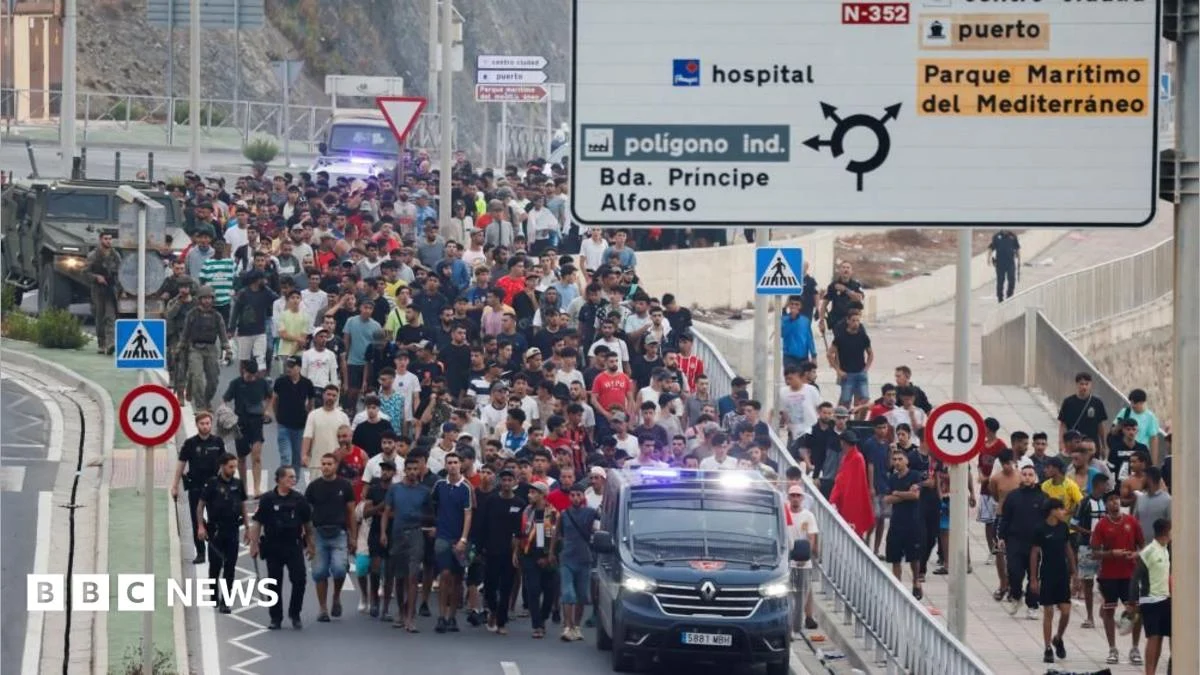
Spain has issued a strong condemnation of what it describes as the "selfish, polarising and unlawful" reactions from several European Union member states following a significant influx of approximately 60,000 migrants from Morocco into the Spanish enclave of Ceuta. The unprecedented surge, which saw border controls in the North African territory falter on July 30th, has triggered a sharp diplomatic fallout across the continent, pitting Spain against key EU partners who have opted for critical stances and even proposed the suspension of border-free travel within the Schengen Area.
Officials in Madrid have reported that the vast majority of those who entered Ceuta during the chaotic events of July 30th have since been repatriated. Spain’s Interior Minister, Fernando Grande-Marlaska, confirmed on Saturday that the death toll associated with the crisis had tragically risen to 67. This grim statistic underscores the human cost of the desperate attempts to reach European shores.
The immediate aftermath of the surge saw Italy, under Prime Minister Giorgia Meloni, take a particularly assertive step by temporarily suspending the EU’s border-free Schengen arrangement with Spain. Meloni characterised the scenes in Ceuta as "shocking" and a direct threat to national security, citing "uncontrolled immigration" as the primary concern. This move was swiftly echoed by Finland and Denmark, with Danish Prime Minister Mette Frederiksen urging the EU to "consider all options, including a suspension of Schengen co-operation." Adding to the pressure, Czech Prime Minister Andrej Babiš publicly called for a temporary suspension of Spain’s Schengen membership, further isolating Madrid in the diplomatic arena.
In response to this wave of criticism and proposed measures, Spanish Prime Minister Pedro Sánchez penned a letter to European Commission President Ursula von der Leyen, expressing his "serious concern" about the attitudes of certain European governments. Sánchez emphatically stated that the Spanish government had successfully restored control over the border and prevented any "unauthorised onward movement towards continental Europe" within a remarkable 48-hour period. He acknowledged that while many EU nations had offered "support and solidarity," others had chosen to "attack Spain," attributing their actions to "prejudice, fake news, ignorance, or political interest." Sánchez also pointed out a crucial technicality: Ceuta itself is not part of the Schengen Area, a fact he felt was being overlooked in the ensuing political debate. He concluded his strong statement by asserting that "The European Union cannot afford this kind of selfish, polarising and unlawful reaction."
The events unfolded with dramatic intensity on Thursday, as border controls in Ceuta, a Spanish territory situated on the North African mainland, appeared to collapse, leading to scenes of chaos. Spanish MEP Juan Fernando López Aguilar provided a more reassuring update on Saturday morning, telling the BBC that the situation was "beginning to get under control" and that the migrants were "returning peacefully." However, while the immediate crisis on the ground was showing signs of easing, the political and diplomatic repercussions were already creating significant ripples across Madrid and other European capitals.
Italy’s Prime Minister Giorgia Meloni, in a social media post on Thursday, articulated her concerns, stating that such "uncontrolled immigration" posed a significant risk to national security. Her subsequent decision to suspend the Schengen zone agreement with Spain for a month marked a significant escalation in the diplomatic tensions. The Schengen Area, a unique arrangement encompassing 29 European countries, has been a cornerstone of free movement within the continent by abolishing internal border controls. Spain, in turn, summoned the Italian ambassador to Madrid, with its foreign minister expressing expectations of "European solidarity and not partisan demagoguery."
Finland’s Interior Minister, Mari Rantanen, declared that preparations were underway to restore internal border checks "if the need arises" and explicitly urged "all European countries" to support Meloni’s initiative. This sentiment was echoed by Danish Prime Minister Mette Frederiksen, who called for the EU to "consider all options, including a suspension of Schengen co-operation." France also took immediate action, tightening checks on its border with Spain and announcing an increase in its police presence. Similarly, Portuguese Prime Minister Luis Montenegro indicated that his government was considering reinforcing border checks.
European Commission President Ursula von der Leyen acknowledged the gravity of the situation, describing the images from Ceuta as "unacceptable." She stressed on social media that "We cannot allow anyone to come to our Union without abiding by our rules." German Chancellor Friedrich Merz expressed his support for Spain’s stance against allowing illegal migrants onto the European continent and issued a direct demand for Morocco to "take back illegal migrants immediately." The international reaction extended beyond Europe, with the US State Department attributing the incident to Spain’s migration policies. Former President Donald Trump went further, labelling the situation a "catastrophe" and likening it to "an invasion of a country by hundreds of thousands of people."
Spain has, however, robustly defended its handling of the migrant surge. In a swift and comprehensive response, Madrid deployed substantial resources to Ceuta, including troops, additional police units, drones, divers, and boats, to bolster border security. The country also reinforced its armed forces in Melilla, another Spanish enclave bordering Morocco, where hundreds of similar crossings were reported. Prime Minister Pedro Sánchez visited Ceuta following the influx and announced his intention to consider reinforcing the border with Morocco, noting that Moroccan authorities were cooperating. He attributed the surge to trafficking gangs, describing the incident as a "violation of Spain’s territorial integrity." Sánchez elaborated that "Trafficking mafias took a self-serving interpretation of a Supreme Court ruling" which then "spread like wildfire."
EU Commissioner Magnus Brunner, after a phone call with Spanish Foreign Minister José Manuel Albares, confirmed that "not a single person has crossed to mainland EU," offering a measure of reassurance regarding the containment of the influx. The background to this crisis is rooted in a ruling by Spain’s Supreme Court in June, which stipulated that migrants intercepted at sea attempting to reach Ceuta or Melilla could not be summarily returned to Morocco without due legal process. This ruling, intended to uphold due process, appears to have been exploited by migrant trafficking networks.
While the scale of this year’s surge is extraordinary, Ceuta has long been a significant focal point for migrants seeking to reach Europe. The summer months typically witness a heightened effort to reach Ceuta, often facilitated and organised through social media platforms. This is not an entirely new phenomenon; in 2021, approximately 8,000 people entered Ceuta over a matter of days, an event that significantly exacerbated Spain’s already complex diplomatic tensions with Morocco. The recent influx, therefore, represents a renewed and intensified challenge to Spain’s border management and its broader relations with North African countries, while also exposing fault lines within the European Union’s approach to migration and border security. The incident highlights the persistent humanitarian challenges at Europe’s southern frontiers and the complex interplay of national interests, EU solidarity, and the fundamental principles of asylum and border control. The political ramifications are likely to continue shaping the discourse on migration policy across the continent for the foreseeable future.
