
 By admin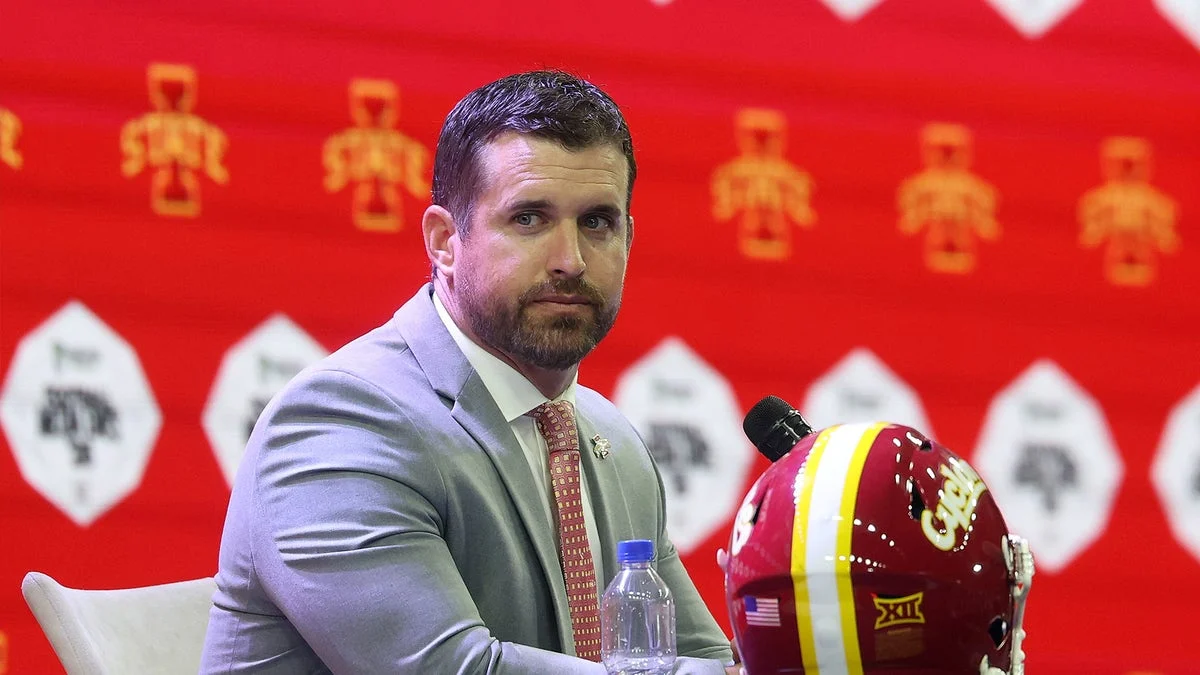
In a bold declaration that has sent ripples through the collegiate football landscape, new Iowa State head coach Jimmy Rogers has publicly asserted his unwavering belief in his team’s potential, even predicting a trip to the Big 12 Championship game in his inaugural season. This audacious claim comes despite the Cyclones being unanimously picked last in the Big 12 preseason media poll, returning no starters from the previous season, and enduring a significant roster upheaval with 55 players entering the transfer portal following Rogers’ hiring. The exodus of talent was notably amplified by the departure of 24 players who followed former head coach Matt Campbell to Penn State, a move that underscored the formidable challenge confronting Rogers in Ames, Iowa.
Rogers, speaking candidly to reporters, revealed that he was the architect of his own team’s low expectations, having anonymously voted the Cyclones to the Big 12 Championship game in an On3.com poll. His rationale was straightforward: "What would you think if I didn’t vote on us? You’d wonder why I’m the head coach at Iowa State," he stated, his confidence palpable. "I was brought in to win. Very self-aware. They didn’t hire me to come here and not be competitive. I wasn’t hired for my disposition. I was hired to create a program that competes and wins and that’s the goal. We’re not signing up for second place." He acknowledged the inherent risk in such a public proclamation, anticipating its widespread dissemination, but reiterated the fundamental importance of player belief. "So I know that’s a bold statement, and they’ll print it everywhere. But the reality is this: the players have to believe in what you say, and you have to act on how you believe. I believe that we can win."
The task before Rogers is monumental, especially when juxtaposed with the legacy of Matt Campbell, the program’s all-time wins leader. Campbell’s tenure at Iowa State was marked by consistent improvement and a period of unprecedented success. In his final season, the Cyclones finished with an 8-4 overall record and a respectable 5-4 mark in Big 12 play. Over his 10 years, Campbell guided Iowa State to seven bowl appearances, a testament to the program’s stability and competitive spirit, although they opted out of a bowl game last season. The pinnacle of Campbell’s coaching achievements at Iowa State was their appearance in the 2020 Big 12 Championship game, a feat that has eluded the program since their last conference title in 1912. This historical context further amplifies the boldness of Rogers’ championship aspirations.
Despite the overwhelming preseason prognostication and the significant player turnover, Rogers’ confidence is not a solitary conviction. Tight end Tyler Fortenberry echoed his coach’s sentiments, stating that Rogers’ prediction comes as no surprise to the current roster. Fortenberry attributed this unwavering belief to Rogers’ past successes as an assistant and head coach at South Dakota State, a prominent program in the Football Championship Subdivision (FCS). During his brief but impactful stint at Washington State, Rogers inherited a team with a substantial influx of 75 new players and managed to guide them to a 6-6 record and a bowl invitation, demonstrating his ability to quickly build a competitive unit.
Fortenberry elaborated on the team’s internal messaging, emphasizing how Rogers actively shields the players from external noise. "Coach Rogers does a good job in team meetings making sure we’re not focused on what Twitter says, what Instagram says or what the media says about what we’re going to finish," Fortenberry explained. "They all have us 16th. If you buy into that and believe what the media has to say, you’re not going to get anywhere in life." This deliberate strategy to foster a self-reliant and internally motivated team culture is crucial for a program facing such significant external doubt.
The narrative surrounding Iowa State’s football program is one of transition and the immense pressure to maintain the progress established under Campbell, while simultaneously forging a new identity under Rogers. The mass exodus of players, while seemingly devastating, can also be viewed as an opportunity for Rogers to mold the team to his specific vision and coaching philosophy. The 55 players who entered the transfer portal represent a substantial rebuilding effort, requiring a meticulous approach to recruitment and player development. Rogers’ background in building successful programs at the FCS level, and his immediate impact at Washington State, suggest he possesses the acumen to navigate such challenges.
His proactive recruitment strategy will be paramount. The incoming freshmen and transfer portal additions will need to be integrated quickly and effectively. Rogers’ emphasis on belief and competitiveness suggests a coaching style that empowers players and fosters a winning mentality. This is particularly important in a conference as demanding as the Big 12, which features perennial powerhouses and consistently competitive teams.
The statistical backdrop of the Big 12 further contextualizes the ambition of Rogers’ goal. Historically, the conference has been dominated by a select few programs, making any team outside of this elite group’s championship aspirations a long shot. However, the landscape of college football is constantly evolving, with upsets and surprise contenders emerging regularly. The parity within the conference, while often favoring established programs, also presents opportunities for teams that can achieve early success and build momentum.
Rogers’ decision to publicly declare his championship ambitions, despite the overwhelming odds, is a calculated risk. It serves as a clear message to recruits, current players, and the fanbase about the high expectations he has for the program. This level of confidence can be a powerful motivator, fostering a sense of urgency and shared purpose. Conversely, if the team falters, such bold statements can attract criticism and scrutiny. However, Rogers appears to embrace this pressure, framing it as a necessary component of his coaching philosophy.
The "anonymous coaches poll" revealing Rogers’ vote for Iowa State to reach the championship game is a particularly insightful detail. It suggests a strategic approach to managing perceptions and creating an "us against the world" mentality. By acknowledging that he was the one who placed his team in such a high-stakes position, he is taking ownership of the challenge and setting a clear benchmark for success. This also subtly challenges the other coaches in the conference, implying that they may be underestimating the potential of his squad.
The departure of Matt Campbell, a beloved and successful figure at Iowa State, created a void that required a coach with a distinct vision and the ability to inspire confidence. Rogers’ background suggests he is not afraid of a challenge and thrives in situations where he can build a program from the ground up. His success at South Dakota State, where he achieved significant victories and developed a reputation for strong coaching, demonstrates his capacity to elevate a team’s performance.
The role of the players in this ambitious endeavor cannot be overstated. As Fortenberry indicated, the team is actively working to insulate themselves from external negativity. This internal focus, coupled with Rogers’ infectious confidence, could create a potent combination. The ability of the new recruits and returning players to gel quickly and adapt to Rogers’ system will be a critical determinant of their success.
Furthermore, the strategic implications of Rogers’ statements extend beyond the immediate playing field. In the highly competitive world of college football recruiting, such bold pronouncements can attract attention and generate interest from highly touted prospects who are drawn to winning programs and confident leadership. This could be a crucial factor in rebuilding the roster and establishing a sustainable culture of success.
The historical context of Iowa State’s football program, particularly their lack of a conference championship since 1912, adds another layer of significance to Rogers’ aspirations. Achieving this goal would not only be a monumental accomplishment for Rogers and his team but would also etch their names in the annals of Iowa State athletics history. The weight of expectation, both internal and external, is considerable, but Rogers appears to be embracing it head-on.
In conclusion, Jimmy Rogers’ confident assertion of Iowa State’s potential to reach the Big 12 Championship game is a bold statement that encapsulates his ambitious vision for the program. Despite the overwhelming preseason predictions of last place and a significant roster overhaul, Rogers has instilled a belief in his team that they can defy expectations and compete for a conference title. His willingness to publicly embrace such a high bar, coupled with his demonstrated ability to build successful programs, suggests that Iowa State football may be on the cusp of a new and exciting era, one defined by unwavering confidence and a relentless pursuit of victory. The coming season will undoubtedly be a rigorous test of his philosophy and the team’s resilience, but Rogers has made it clear that for him, and presumably for his team, second place is simply not an option.
