
 By admin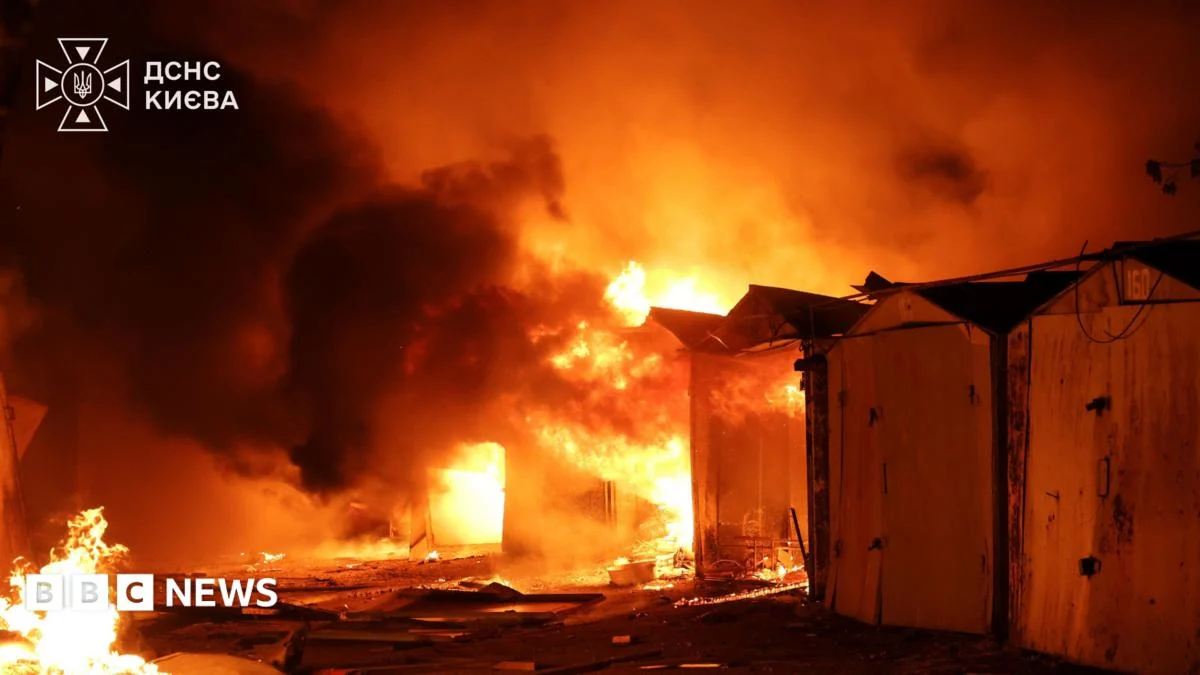
In a grim dawn, overnight Russian missile attacks cast a pall of death and destruction over the region east of Ukraine’s capital, Kyiv. The early hours of Saturday were shattered by the thunderous impact of ballistic missiles, with witnesses reporting powerful explosions that echoed the devastating strikes that had claimed 21 lives across Ukraine just days prior. The relentless barrage left a trail of devastation, with falling debris igniting fires and damaging apartment buildings and vehicles. Timur Tkachenko, the head of the regional military administration, confirmed the tragic toll, stating that at least three individuals, including a young child, had lost their lives. Three other civilians sustained injuries in the relentless ballistic missile strikes, underscoring the indiscriminate nature of the assault.
The inferno spread further within Kyiv, where emergency crews valiantly battled blazes at a building and a fuel tank. Mayor Vitaly Klitchko, reporting on the unfolding crisis via Telegram, provided grim updates on the ongoing firefighting efforts. The State Emergency Service of Ukraine (DSNS) released harrowing photographic evidence, depicting garages, a business establishment, and a residential building engulfed in flames in the capital. Their statement, released alongside the images, indicated that the full extent of casualties was still being assessed, hinting at a potentially higher number of victims.
This latest wave of attacks occurs as President Volodymyr Zelensky embarks on a crucial diplomatic mission to the Serbian capital, Belgrade. This marks his first visit to the Balkan nation, a trip undertaken against a backdrop of grave concerns over Ukraine’s dwindling interceptor missile stockpiles, which severely hamper its capacity to effectively fend off Russian aerial assaults. President Zelensky’s primary objective is to galvanize broader international support for Ukraine’s defense efforts. However, his diplomatic endeavors face a significant hurdle in Serbian President Aleksandar Vučić, who has steadfastly refused to impose sanctions on Russia, a stance that complicates efforts to isolate Moscow economically and politically.
Serbia, a nation aspiring to membership in the European Union, has walked a delicate diplomatic tightrope. While it has provided humanitarian aid to Ukraine and pledged assistance in the nation’s post-war reconstruction, it has simultaneously maintained its historical ties with Russia, including its refusal to join Western sanctions. The agenda for the meeting between Zelensky and Vučić in Belgrade was slated to encompass vital discussions on economic cooperation, the trajectory of Serbia’s EU accession, and pressing security matters, including the implications of the ongoing conflict for regional stability.
Earlier in the week, President Zelensky had articulated his profound distress over the escalating human cost of the conflict, directly linking the "horrific casualties and destruction" to the delays in receiving crucial anti-ballistic missile systems from Ukraine’s international partners. He emphatically stated that a more robust interceptor capability could have been a life-saving bulwark against the recent deadly assaults. The President further elaborated on the dire situation, revealing that the supply of interceptors from allies had been "significantly reduced" over the course of the current year, a stark indicator of the growing strain on Ukraine’s air defense network.
These chilling pronouncements followed a strategic Ukrainian offensive that targeted two oil refineries deep within Russian territory, as well as Moscow-linked vessels in the Black Sea. President Zelensky framed these operations as a deliberate measure to curtail Russia’s oil revenues, a critical financial lifeline that fuels its ongoing war machine in Ukraine. The intensified strikes from both sides reflect a dangerous escalation, occurring in the wake of faltering mediation talks aimed at de-escalating the conflict, leaving the prospect of a peaceful resolution increasingly remote.
The strategic implications of the current air defense situation for Ukraine are profound. The country’s air defense system, heavily reliant on Soviet-era technology, has been augmented by Western-supplied systems. However, the sheer volume and sophistication of Russian missile and drone attacks often overwhelm these defenses. The continuous barrages necessitate a constant supply of interceptor missiles, a resource that Ukraine’s allies are struggling to provide at the required pace. The United States, a leading supplier of military aid, has itself faced domestic political challenges in approving further funding packages, creating uncertainty about the future flow of critical weaponry.
The impact of these attacks extends beyond the immediate casualties and destruction. The psychological toll on the Ukrainian population is immense, with regular air raid sirens and the constant threat of aerial bombardment becoming a grim reality of daily life. The attacks on infrastructure, including energy facilities and residential areas, also have far-reaching economic consequences, disrupting supply chains, hindering agricultural production, and exacerbating the humanitarian crisis.
Analysts have pointed to a potential shift in Russian military strategy, with a renewed focus on targeting Ukraine’s military-industrial complex and its ability to sustain its defense efforts. The strikes on oil refineries, while aimed at crippling Russia’s war financing, also highlight Ukraine’s increasing capacity to strike deep within Russian territory, a development that Moscow has vowed to retaliate against.
The diplomatic front remains as complex as the battlefield. President Zelensky’s quest for international solidarity faces a fragmented global landscape, where national interests often supersede collective action. While many nations have condemned Russia’s aggression and provided substantial aid to Ukraine, others, like Serbia, maintain a more cautious approach, often influenced by historical ties, economic dependencies, or geopolitical considerations. The war in Ukraine has exposed deep divisions within the international community, with Russia leveraging its influence in various regions to counter Western efforts to isolate it.
The ongoing conflict also has significant implications for global energy markets and food security. Disruptions to Ukrainian grain exports, a vital component of global food supplies, have contributed to rising food prices worldwide. Similarly, fluctuations in oil prices, influenced by geopolitical tensions and sanctions, have had a ripple effect on economies across the globe.
The protracted nature of the war, coupled with the recent escalation of attacks, raises concerns about the potential for a prolonged and devastating conflict. The lack of a clear diplomatic off-ramp and the continued reliance on military solutions by both sides suggest that the road ahead will be arduous. The international community faces the daunting challenge of finding ways to de-escalate the conflict, provide sustained humanitarian assistance, and ultimately work towards a lasting peace settlement that respects Ukraine’s sovereignty and territorial integrity.
The tragedy unfolding near Kyiv serves as a stark reminder of the human cost of this war. The loss of innocent lives, particularly that of a child, underscores the urgent need for a renewed push towards de-escalation and a peaceful resolution. President Zelensky’s diplomatic efforts, while facing significant obstacles, remain critical in his fight to secure the resources and support necessary to defend his nation. The world watches, hoping for a turning point that will bring an end to the bloodshed and suffering.
