
 By Lina Irawan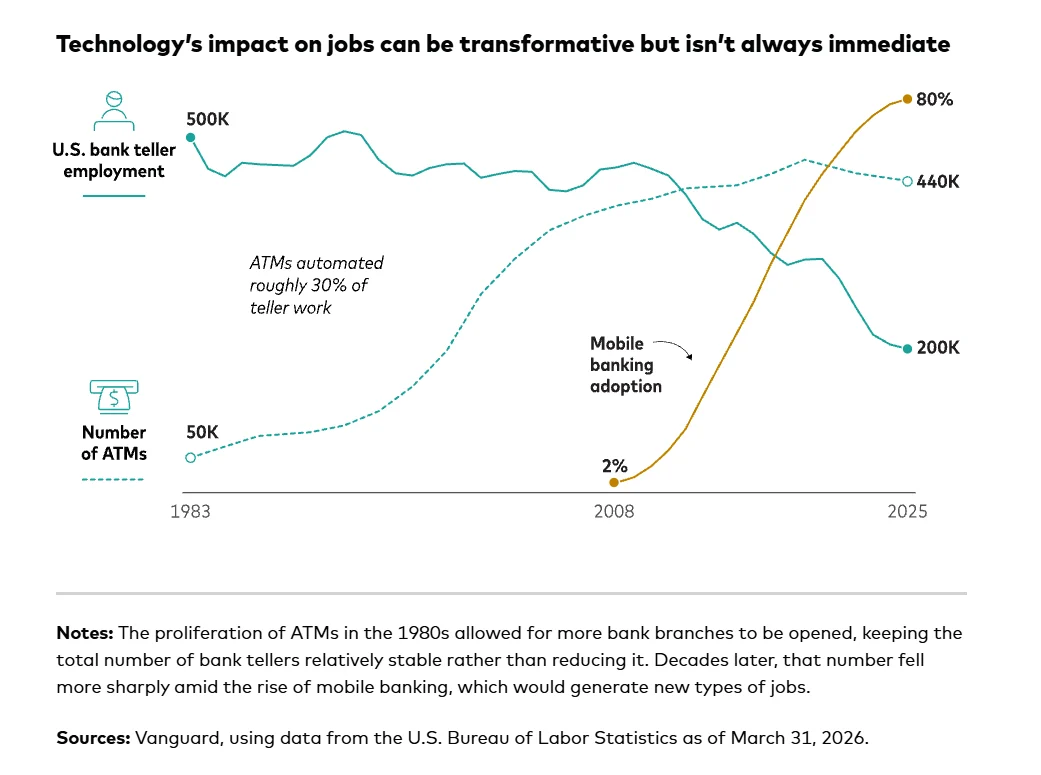
When ATMs first became widespread in the 1980s, the financial industry, economists, and the general public braced for a drastic decline in bank teller positions. The logic seemed irrefutable: these machines could dispense cash, accept deposits, and provide balance inquiries – tasks that constituted a significant portion of a teller’s daily work. The consensus was that human tellers would soon become an anachronism, a relic of a bygone era. However, this widely held assumption proved to be only partially correct, highlighting a critical distinction between task automation and job elimination.
Indeed, the number of tellers required at individual bank branches did decline to some degree as ATMs efficiently automated these routine, transactional tasks. A single machine could handle dozens, if not hundreds, of basic customer interactions without breaks, benefits, or human error. This efficiency gain was undeniable. Yet, the broader employment outcome for bank tellers was far less stark than the doomsayers predicted. Instead of leading to a mass exodus from the profession, ATMs inadvertently catalyzed a significant strategic shift within the banking sector. By dramatically lowering the operating costs associated with routine transactions, ATMs made it economically viable for banks to open more branches. This expansion, particularly into previously underserved suburban and exurban areas, created new demand for physical locations and, consequently, for human staff.
As a result of this dynamic interplay between automation and expansion, total U.S. bank teller employment remained broadly stable, even slightly increasing, from 1980 through 2010. For a mid-career teller working in the 1980s, the ATM posed far less of a threat to their employment security than many contemporary forecasts suggested. Their roles evolved, shifting away from repetitive cash handling towards more complex customer service, problem-solving, and sales-oriented tasks. Tellers became ambassadors for their banks, cross-selling new products like mortgages, credit cards, and investment accounts, and handling more intricate transactions that still required human judgment and interaction. The technology augmented their capabilities and reshaped their duties rather than rendering them obsolete.
New Demand for More Occupations and the Skill-Value Chain Ascent
In fact, just as we anticipate artificial intelligence to transform the labor market today, the expansion of retail banking facilitated by ATMs created demand for a wider range of occupations within the financial sector. The strategic shift meant that banks needed more than just transaction processors; they required individuals capable of cultivating deeper customer relationships and managing increasingly complex financial portfolios. This led to a significant uptick in the hiring of loan officers, who advised on mortgages and business loans; credit analysts, who assessed risk and eligibility; personal bankers, who managed high-value client accounts; and fraud and risk specialists, who became critical as financial transactions grew in volume and complexity.
The work performed inside a bank branch fundamentally moved up the "skill-value chain." Branches became less about the mechanical processing of transactions and more about fostering human connections, providing personalized financial advice, and managing intricate customer relationships. This transformation required tellers and other bank staff to develop new competencies in communication, sales, financial literacy, and problem-solving, skills that ATMs could not replicate. The initial technological wave, rather than destroying jobs, led to a re-evaluation and elevation of human roles within the banking ecosystem.
However, this period of relative stability for tellers was not to last indefinitely. The real disruption came later, triggered by a different technological wave entirely. Beginning around 2010, the advent and widespread adoption of mobile banking applications fundamentally changed the equation. Unlike the ATM, which automated a specific task (a transaction), mobile banking largely automated the entire trip to a bank branch. Customers could now deposit checks by taking a photo, transfer funds with a few taps, pay bills, and manage their accounts from anywhere, at any time, without ever needing to step foot inside a physical bank.
This shift was profound and rapid. The convenience and accessibility of mobile banking quickly rendered many everyday banking activities that once required a branch visit entirely superfluous. The data starkly illustrates this seismic change: by 2025, only a projected 9% of bank customers considered branches their primary banking channel, a dramatic decline from 36% in 2007. This steep drop in branch foot traffic directly translated into a significant reduction in the demand for human tellers. Consequently, bank teller employment began to fall accordingly, marking a true inflection point in the profession’s history.
Importantly, this profound transformation was not driven by technology alone. It was a potent combination of technological innovation, evolving consumer behavior, and critical institutional changes. The Electronic Signatures in Global and National Commerce Act (ESIGN Act) of 2000 played a pivotal, though often overlooked, role. This landmark legislation granted electronic signatures the same legal standing as traditional ink signatures, effectively removing a major legal barrier to fully digital banking experiences. This legislative change enabled secure, legally binding transactions to occur entirely online, accelerating the shift away from in-person, paper-based processes and paving the way for the mobile banking revolution. Without the ESIGN Act, the widespread adoption of digital banking would have been significantly hampered, underscoring how policy and regulation can either enable or constrain technological disruption.
The lesson from the ATM and mobile banking saga is clear and compelling: isolated task automation rarely results in large-scale job losses, except in occupations built around a very narrow, highly repetitive set of activities that can be entirely subsumed by a machine. The fate of switchboard operators, for instance, serves as a stark example; their job was almost exclusively to connect calls, a task that was fully automated by digital switching systems, leading to near-total occupational obsolescence. More often, meaningful and widespread disruption to employment occurs when new technologies are combined with new workflows, innovative business models, and significant institutional or regulatory changes that fundamentally alter how work is organized, how services are delivered, and how customers interact with an industry.
Moreover, this disruption, while eliminating some jobs, simultaneously created entirely new forms of employment that were unimaginable just a few years prior. The rise of mobile banking necessitated a new cohort of specialized professionals: cybersecurity analysts became essential to protect digital transactions and customer data from sophisticated threats; digital product managers were needed to design intuitive and engaging mobile applications; payment-platform engineers built and maintained the complex infrastructure underpinning digital money transfers; and data-platform operators and analysts emerged to manage and derive insights from the vast amounts of customer data generated by online interactions. These new roles often required advanced technical skills, underscoring a shift in the labor market towards higher-skilled, digitally-focused occupations.
This rich history offers a particularly useful lens for understanding today’s fervent debate around artificial intelligence. If AI, particularly generative AI, continues its trajectory to become a general-purpose technology (GPT) like electricity, the internal combustion engine, and the personal computer before it – as recent developments increasingly suggest – then its long-term impact on employment will likely follow a similar pattern of augmentation, transformation, and net job creation, rather than widespread destruction. GPTs, by their very nature, enable the creation of entirely new products, services, and industries that we have not yet even envisioned, fundamentally expanding the economic pie. In short, fears of widespread, catastrophic job loss due to AI are likely overblown when viewed through a historical and systemic perspective.
The Myth of Large-Scale White-Collar Job Loss
Since the public arrival of ChatGPT in late 2022, a narrative has taken hold that AI will quickly eliminate large numbers of white-collar jobs, particularly those involving information processing, writing, and analytical tasks. The initial shockwave of its capabilities led many to predict an imminent "AI winter" for knowledge workers. However, nearly four years later, the labor market tells a different story.
Occupations with the greatest theoretical exposure to AI – those whose tasks are most amenable to automation or augmentation by large language models (LLMs) – have not experienced widespread employment declines. On the contrary, employment growth in these highly exposed occupations has generally kept pace with, or in many cases, even exceeded that of less exposed occupations. Layoff rates across the economy remain low, and while hiring has slowed in certain sectors, this slowdown has been broad-based rather than concentrated specifically in AI-intensive fields. This current reality suggests that for most white-collar professions, AI is primarily functioning as a powerful augmentation tool, making workers more productive and efficient, rather than a direct replacement. It handles the mundane, repetitive, and time-consuming aspects of knowledge work, freeing up human professionals to focus on higher-order tasks requiring creativity, critical thinking, strategic planning, emotional intelligence, and complex interpersonal skills.
Today’s large language models may be reminiscent of the ATMs of the 1980s – powerful tools that automate certain tasks (like drafting emails, summarizing reports, or generating basic code snippets) but augment many more, making workers more productive and leaving the broader structure of work largely intact. They are transforming how work is done, but not necessarily who does it, or if it needs to be done at all.
More significant labor market disruption, akin to the shift from ATMs to mobile banking, would likely require something deeper than mere task automation. It would necessitate a profound reconfiguration of business processes, organizational structures, and customer interactions that fundamentally reshapes the role of workers rather than simply removing them from the equation. This could involve, for example, AI systems not just assisting but independently managing entire projects, conducting complex negotiations, or making high-stakes strategic decisions without human oversight, a scenario that remains largely in the realm of future development. Such a future would likely be enabled by further technological breakthroughs, combined with significant societal and regulatory acceptance, and the development of entirely new business models that leverage these advanced capabilities.
The history of technological change consistently suggests that capabilities alone rarely determine employment outcomes. What matters more is how organizations strategically redesign work around those capabilities, how policy adapts, and how society integrates new technologies. AI may ultimately transform the labor market, just as mobile banking transformed retail banking. But the evidence today suggests we remain closer to the "ATM phase" – where AI augments and enhances human work – than the "mobile banking phase," where it fundamentally re-architects entire industries and significantly reduces the demand for human intermediaries. The challenge and opportunity lie in understanding this progression and proactively shaping the future of work to leverage AI for human flourishing.
The opinions expressed in Fortune.com commentary pieces are solely the views of their authors and do not necessarily reflect the opinions and beliefs of Fortune.
