
 By Titik Puspa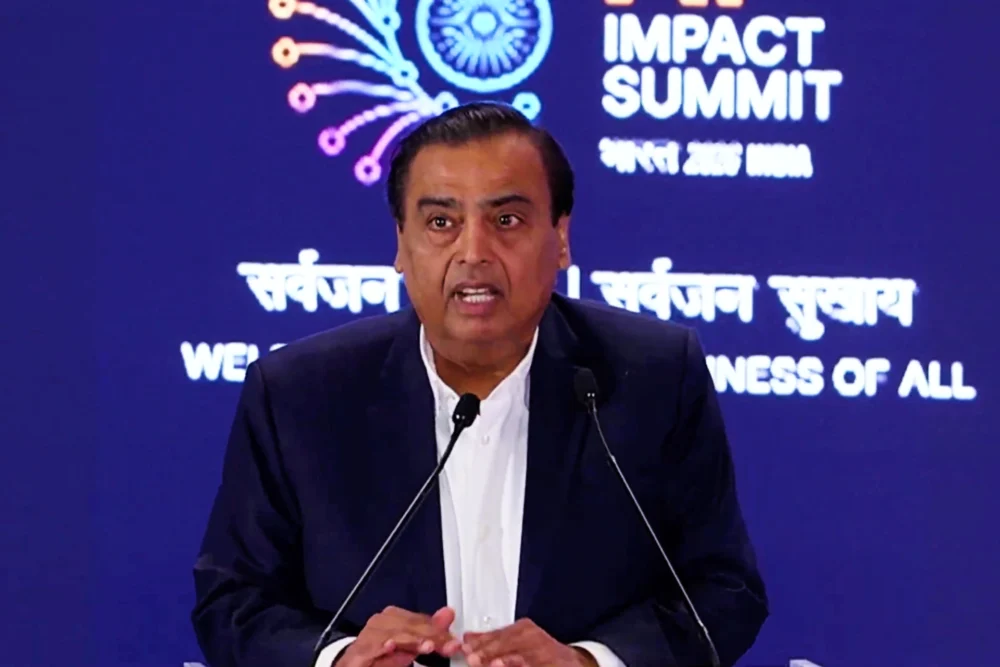
In a landmark announcement that signals India’s burgeoning ambition in the artificial intelligence landscape, Mukesh Ambani, the visionary chairperson of the Indian conglomerate Reliance Industries, revealed an audacious plan to invest a staggering $110 billion (approximately ₹10 trillion) over the next seven years to build comprehensive AI computing infrastructure within the country. This monumental commitment, unveiled at the India AI Impact Summit in New Delhi on Thursday, underscores a strategic imperative for India to achieve technological self-reliance and capitalize on the transformative potential of AI.
The colossal investment will be directed towards establishing gigawatt-scale data centers, a nationwide edge computing network, and the seamless integration of new AI services with Reliance’s ubiquitous Jio telecom platform. This multifaceted approach aims to address what Ambani identified as the primary bottleneck in AI advancement: the scarcity and prohibitive cost of computational power. "The biggest constraint in AI today is not talent or imagination," Ambani declared at the summit, emphasizing that "it is scarcity and high cost of compute." He articulated a clear vision: to democratize AI access by drastically reducing its cost, mirroring Reliance’s past success in making mobile data affordable for millions across India.
Reliance has already laid the groundwork for this ambitious undertaking. Construction is underway for multi-gigawatt data centers in Jamnagar, Gujarat, a strategic location poised to become a hub for AI processing. More than 120 megawatts of capacity from these facilities are anticipated to become operational in the latter half of 2026, marking a significant initial step in realizing the larger seven-year plan. This proactive development demonstrates Reliance’s commitment to not just planning, but actively building the foundational elements of India’s AI future.
Ambani’s pledge arrives at a pivotal moment, as India witnesses an unprecedented surge in AI-related investments. The nation is rapidly positioning itself as a global AI powerhouse, attracting substantial commitments from both domestic and international players. Earlier this week, the Adani Group, another Indian industrial giant, announced its intention to invest approximately $100 billion in building AI data centers across the country. This competitive landscape further intensifies, with the Indian government projecting an impressive inflow of over $200 billion in AI infrastructure spending within the next two years alone. This collective investment signals a unified national drive towards AI leadership.
The global technology sector is also recognizing India’s potential. Major international firms are forging strategic alliances to tap into the country’s growing AI ecosystem. Notably, OpenAI has partnered with the Tata Group to develop approximately 100 megawatts of AI capacity, with plans to scale up to a gigawatt in the future. This collaboration highlights the international recognition of India’s capacity to host and develop cutting-edge AI capabilities. The government’s proactive stance in attracting such investments underscores its ambition to make India a central node in the global AI supply chain.
Ambani’s vision extends beyond mere infrastructure development; it is deeply rooted in fostering India’s technological sovereignty. His assertion that the country "cannot afford to rent intelligence" is a powerful call for indigenous innovation and self-sufficiency. By building domestic AI capabilities, India aims to reduce its reliance on foreign technologies and foster a vibrant ecosystem that can cater to its unique needs and challenges. This philosophy aligns with the broader national agenda of "Atmanirbhar Bharat" (self-reliant India).
The sustainability of such large-scale data center operations is a critical consideration, and Reliance is addressing this through its significant green energy capacity. The company possesses a remarkable 10 gigawatts of surplus power generated from solar projects in Gujarat and Andhra Pradesh. This clean energy surplus will be instrumental in powering the energy-intensive AI infrastructure, ensuring that India’s AI revolution is built on a foundation of environmental responsibility. This integration of renewable energy with AI infrastructure is a forward-thinking approach that positions India as a leader in sustainable technological development.
Reliance’s strategy involves a deeply collaborative approach, fostering partnerships with a wide spectrum of Indian entities. The conglomerate plans to work closely with domestic enterprises, agile startups, and esteemed academic institutions. The objective is to embed AI solutions across a diverse range of industries, transforming sectors critical to India’s economic growth and social welfare. This includes manufacturing and logistics, where AI can optimize supply chains and production; agriculture, where it can enhance crop yields and resource management; healthcare, where it can improve diagnostics and patient care; and financial services, where it can drive innovation and efficiency.
The synergy between Reliance’s telecom arm, Jio, and its AI initiatives is a key element of this strategy. Jio’s vast subscriber base and extensive network provide a natural platform for deploying and scaling AI-powered services. This integration is not merely theoretical; Jio has already secured significant partnerships. Last year, it struck a deal with Google, enabling millions of Jio users in India to access Gemini AI Pro for free. This move not only democratizes access to advanced AI tools but also accelerates the adoption and understanding of AI among the Indian populace.
Furthermore, Reliance is committed to developing AI capabilities tailored to the linguistic diversity of India. The plan includes developing AI models that can understand and operate in several Indian languages. This localization effort is crucial for driving widespread adoption of AI technologies, ensuring that its benefits reach beyond English-speaking urban centers and are accessible to a broader segment of the population. By bridging the language barrier, Reliance aims to unlock the full potential of AI for every Indian.
The aggressive push by Reliance, alongside other major conglomerates like Adani Group, signifies a critical race among India’s largest businesses to secure a dominant position in what is widely anticipated to be one of the country’s most significant future technology opportunities. The convergence of massive investment, strategic partnerships, and a clear national vision is creating an unparalleled ecosystem for AI innovation and deployment in India.
The implications of this $110 billion investment extend far beyond the technological realm. It represents a significant bet on India’s future as a global AI leader. By investing in indigenous infrastructure, India can foster a new generation of AI talent, create high-skilled jobs, and drive economic growth. The focus on self-reliance in intelligence could position India as a provider of AI solutions and services to the global market, rather than just a consumer.
The scale of the planned data centers, measured in gigawatts, signifies a commitment to processing power on par with global standards. This will enable India to host complex AI models, conduct large-scale research, and support the development of advanced AI applications without relying on overseas cloud infrastructure. The nationwide edge computing network will bring AI capabilities closer to end-users, reducing latency and enabling real-time AI applications in areas such as autonomous vehicles, smart cities, and industrial automation.
The partnership with academic institutions is crucial for nurturing the next generation of AI researchers and developers. By collaborating with universities and research centers, Reliance can ensure that its AI initiatives are aligned with cutting-edge research and that India develops a strong pipeline of AI talent. This will be vital for sustaining the long-term growth of the AI sector.
The focus on integrating AI with essential services like healthcare and agriculture holds immense promise for addressing some of India’s most pressing societal challenges. AI-powered diagnostic tools can improve healthcare access in rural areas, while AI-driven agricultural solutions can enhance food security and farmer livelihoods. The financial services sector can leverage AI for fraud detection, personalized banking, and risk management, further strengthening the Indian economy.
Ambani’s declaration that "we cannot afford to rent intelligence" is a powerful statement of intent. It reflects a desire to move beyond simply consuming foreign AI technologies and to become a creator and exporter of AI solutions. This ambition, backed by substantial investment and strategic partnerships, has the potential to fundamentally reshape India’s technological landscape and solidify its position as a global AI powerhouse. The next seven years will be a transformative period for India, as it embarks on this ambitious journey to build its AI future from the ground up. The nation’s ability to execute this plan will be closely watched by the global technology community, as it could serve as a blueprint for other developing nations aspiring to lead in the AI era. The convergence of corporate ambition, governmental support, and a vast pool of talent positions India to not just participate in, but to actively shape, the future of artificial intelligence on a global scale.
