
 By Titik Puspa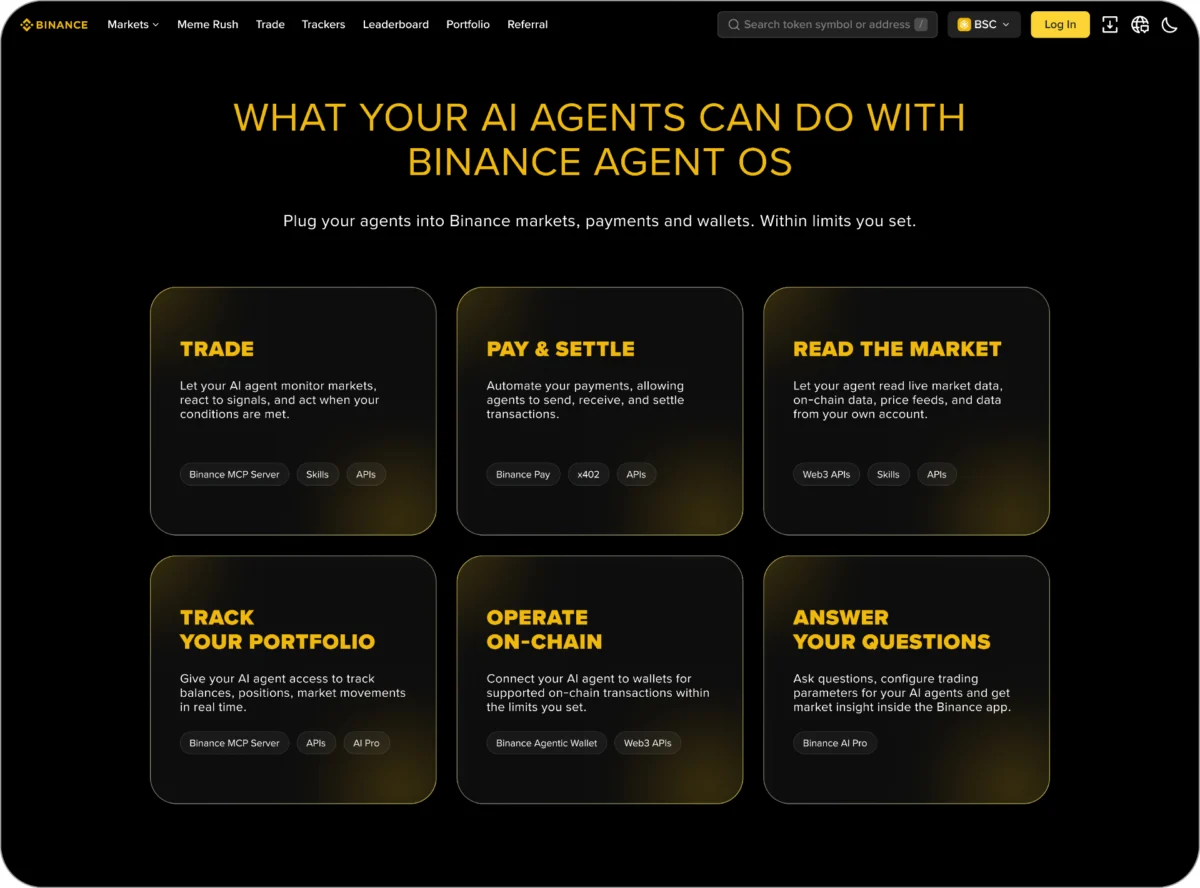
In a groundbreaking move that signifies a pivotal shift in how artificial intelligence interacts with financial markets, Binance, the world’s largest cryptocurrency exchange boasting a user base exceeding 300 million, has officially unveiled "Agent OS." This innovative platform, launched on Thursday, empowers AI agents to autonomously analyze market trends and execute trades directly on behalf of users, effectively ushering in an era where AI actively manages real capital within the complex landscape of digital assets.
Agent OS, accessible via https://binance.com/agent-os, serves as a sophisticated bridge, allowing developers to seamlessly connect their AI applications and agents to Binance’s robust financial infrastructure. This integration unlocks a comprehensive suite of Binance’s existing tools and services, including its powerful Application Programming Interfaces (APIs), the Binance Wallet Agentic Hub, the Binance x402 transaction verification and payment facilitator API, and the Binance Skill Hub. Crucially, the platform also introduces support for Binance’s newly developed Model Context Protocol (MCP), a framework designed to facilitate richer interactions between AI models and financial data. Beyond Binance’s proprietary offerings, Agent OS is designed for interoperability, working harmoniously with leading AI tools such as OpenAI’s ChatGPT and Codex, Anthropic’s Claude Code, and Cursor. This broad compatibility empowers users to grant authorized AI agents access to real-time market data, view their account information, and crucially, execute trades, all within a controlled environment.
The advent of Agent OS marks a significant evolution in the AI landscape, moving beyond the realm of conversational chatbots that merely answer questions to sophisticated agents capable of taking concrete actions. However, as this new frontier of autonomous AI decision-making unfolds, Binance is placing a substantial emphasis on user responsibility, empowering individuals to retain granular control over their agents’ activities. Users are ultimately tasked with determining what data agents can access, which markets they can trade in, and setting specific limitations on their operational scope.
Jeff Li, vice president of product at Binance, articulated this philosophy in a recent interview, stating, "Instead of total freedom, we put the power in users’ hands to give them the granular access control of what they can do through the agent. We put [the control] at the account level to protect the users’ funds.” This user-centric approach is primarily facilitated through a dedicated system of "sub-accounts." Users can assign these sub-accounts to specific AI agents, configuring them for distinct trading activities such as spot trading or futures trading. To further enhance security, withdrawals from these designated sub-accounts are blocked by default, creating a secure sandbox that effectively isolates the agent’s operational activities and safeguards the user’s primary funds.
Binance also offers users the flexibility to dictate the level of autonomy granted to their AI agents. A Binance representative explained that users can choose whether an AI agent must seek explicit approval for every individual trade or if it can execute trades autonomously once its predefined permissions and configurations are set. It is important to note that Binance does not impose a separate, platform-wide cap on the trading volume or potential losses an AI agent can incur. Consequently, the amount of capital a user transfers into a specific sub-account effectively serves as the ultimate financial limit for that agent’s trading activities, underscoring the critical role of user-defined capital allocation in risk management.
When questioned about Binance’s visibility into the decision-making process that leads an AI agent to execute a particular trade, Li clarified that the reasoning and logic behind these actions occur outside of Binance’s core systems. This logic resides either on the user’s local computer or within the chosen AI application the user has integrated. "We really cannot see the reasoning of what the user’s action is," Li stated. This implies that while Binance can meticulously monitor the resulting trading activity of an AI agent, its visibility into the underlying influences – such as whether a decision was swayed by faulty information, biased data, or potential manipulation – is inherently limited.
In scenarios where an AI agent might be compromised, such as through a prompt-injection attack or other security breaches, Li reiterated that the sub-account system serves as the primary line of defense. Furthermore, Binance has confirmed that its existing robust security protocols, comprehensive risk-control measures, and stringent anti-money-laundering (AML) policies, which are already applied to its subaccount APIs, will also be extended to Agent OS from its launch. This layered security approach aims to provide users with confidence in the platform’s integrity.
While trading is positioned as one of the initial and most prominent use cases for Agent OS, Li highlighted the broader potential applications of AI agents within the cryptocurrency ecosystem. These include real-time market monitoring, in-depth research and risk analysis, rapid reaction to market signals, and the autonomous placement of orders. Moreover, agents can be programmed to execute complex trading strategies such as arbitrage, leveraging price discrepancies across different markets.
Beyond traditional trading, Agent OS is architected to facilitate seamless integration with payment systems and on-chain activities. Through Binance’s x402 integration, AI agents can be empowered to send and settle payments, streamlining financial transactions. Additionally, the platform’s Agentic Wallet provides agents with the capability to interact directly with various tokens and decentralized finance (DeFi) protocols, opening up a vast array of possibilities for automated participation in the burgeoning DeFi space.

It is noteworthy that while Binance does not impose separate trading volume or loss caps for AI agents operating within sub-accounts for exchange trading, transactions facilitated through the Agentic Wallet are subject to specific daily limits set by Binance. These limits are designed to manage risk associated with direct interaction with DeFi and payment systems. For instance, regular token swaps are capped at $50,000 per day, DeFi transactions have a default daily limit of $100,000, and x402 payments are restricted to $20 per day, according to company disclosures. These tiered limits reflect the varying risk profiles associated with different types of on-chain interactions.
Li emphasized that Agent OS represents Binance’s "first step" in a larger strategic vision to provide developers with a comprehensive platform for building sophisticated AI-powered applications. This platform is intended to extend its capabilities beyond the confines of the cryptocurrency market, with aspirations to eventually encompass traditional financial markets as well.
Binance’s foray into empowering AI agents is not an isolated development within the cryptocurrency exchange sector. Competitors have been steadily moving in a similar direction, recognizing the transformative potential of AI in financial markets. These exchanges are increasingly leveraging protocols like MCP and other developer-centric tools to grant AI applications direct and programmatic access to market data feeds and their proprietary trading systems.
In March of this year, Kraken, another prominent cryptocurrency exchange, launched an open-source command-line tool that included a built-in MCP server. This initiative enabled AI agents to execute a range of actions, including spot and futures trades, directly on its platform. Following suit, Coinbase announced in June its "Coinbase for Agents" initiative, a platform designed to connect AI agents directly to user accounts. This allows agents to perform tasks such as trading, making payments, and executing other financial workflows, all within the user-defined operational limits. Earlier this year, OKX also embraced agentic trading by integrating an open-source MCP toolkit into its platform, thereby enabling AI-driven trading capabilities for its users. This synchronized push by major exchanges underscores a collective industry recognition of AI’s imminent role in shaping the future of digital asset management and trading.
