
 By Lina Irawan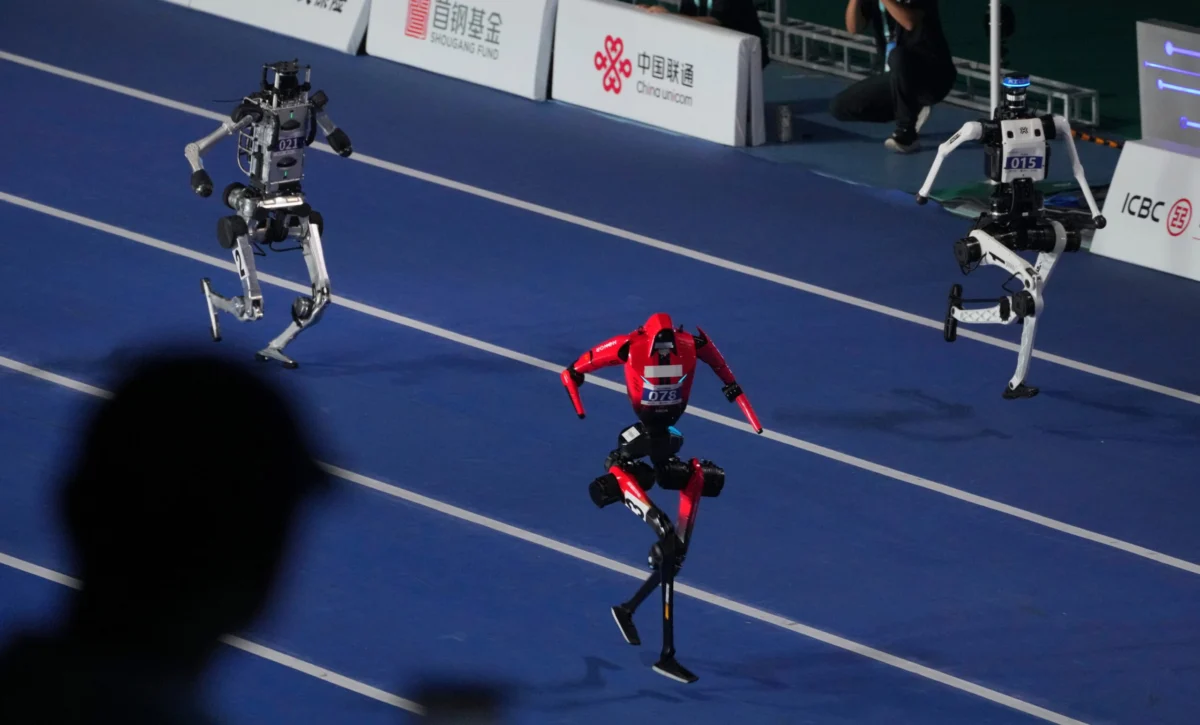
The five-day event, strategically positioned to coincide with Beijing’s hosting of the 2026 World Robot Conference, featured an expansive program of 51 events and more than 1,000 individual competitions. From precision-demanding tasks like table tennis and soccer to raw power challenges such as running, weightlifting, and tug-of-war, the games were designed to push the boundaries of current robotic capabilities. The sheer scale and ambition of the World Humanoid Robot Games underscore China’s commitment to establishing itself as a global leader in advanced robotics, a sector increasingly central to the intensifying technology race with the United States and other global powers.
The most electrifying moments of the opening day were undoubtedly the record-shattering athletic performances. In a stunning demonstration of speed and agility, a humanoid robot from Beijing-based X-Humanoid company completed the 100-meter sprint in a blistering 9.39 seconds. This performance not only outstripped the previous humanoid best but also decisively surpassed the long-standing human world record of 9.58 seconds set by Jamaican sprint legend Usain Bolt in 2009. The achievement was particularly remarkable considering a trial run by a humanoid robot from Chinese smartphone company Honor had already clocked an even faster 9.32 seconds, reaching a peak speed of 14.5 meters per second, prior to the official opening. Such speeds for bipedal robots signify monumental leaps in motor control, balance algorithms, and actuator design, moving beyond mere locomotion to highly optimized athletic movement.
Equally impressive was the humanoid robot’s performance in the standing high jump. Another X-Humanoid creation soared to an astonishing 2.88 meters, dwarfing the previous humanoid best of 0.95 meters achieved in last year’s inaugural games. More significantly, it comfortably cleared the human world record of 2.45 meters set by Cuba’s Javier Sotomayor in 1993. This feat showcases not only enhanced power delivery and mechanical efficiency but also sophisticated dynamic control systems that allow for precise takeoff and landing, pushing the limits of what was once thought possible for bipedal machines. The rapid improvement from the first edition of the games to the second highlights the exponential pace of development in this cutting-edge field.
The context surrounding these games is crucial to understanding their global significance. China currently produces the vast majority of the world’s humanoid robots, a position it has cultivated through significant government investment, ambitious national strategies like "Made in China 2025," and a robust ecosystem of research institutions and tech companies. Beijing views robotics, particularly humanoid forms, as a cornerstone of its future industrial strength, economic growth, and strategic autonomy. These robots are envisioned to revolutionize manufacturing, logistics, healthcare, and even defense, offering solutions to labor shortages, hazardous tasks, and complex automation challenges.
However, this rapid ascent has not gone unnoticed by global competitors. The United States, in particular, has ramped up its scrutiny of Chinese robotics, citing national security concerns. Just last month, the U.S. Federal Communications Commission (FCC) announced a ban on imports of new foreign-made humanoid robots, a move widely interpreted as directly targeting China. This regulatory action reflects a broader geopolitical contest for technological supremacy, where advanced robotics is considered a critical domain. Further escalating tensions, the Pentagon recently added Unitree, one of China’s leading humanoid robot manufacturers, to its list of companies deemed to have ties with the Chinese military. Beijing has vehemently refuted these accusations, characterizing the U.S. actions as protectionist and an attempt to stifle China’s legitimate technological progress. This escalating tech war poses significant challenges to global supply chains, international collaboration, and the open exchange of scientific knowledge, potentially fragmenting the development landscape of advanced robotics.
Despite the awe-inspiring demonstrations in Beijing, experts caution that humanoid robots are still predominantly utilized for research, performance, and exhibition purposes. While the capabilities showcased at the games are groundbreaking, the transition to mass real-world deployment remains a significant hurdle. Challenges abound, including the high cost of production, complex maintenance requirements, considerable energy consumption, and the difficulty of navigating unstructured, dynamic human environments. Furthermore, robust human-robot interaction interfaces, ensuring safety, and addressing ethical considerations related to autonomy and potential job displacement are areas requiring extensive development.
Nonetheless, the future potential is immense. Humanoid robots are expected to eventually play transformative roles in various sectors, from assisting the elderly and performing intricate surgeries to handling dangerous tasks in disaster zones and even contributing to space exploration. The integration of advanced artificial intelligence, particularly breakthroughs in generative AI and reinforcement learning, is accelerating this trajectory, allowing robots to learn, adapt, and perform complex tasks with unprecedented dexterity and intelligence.
The World Humanoid Robot Games also served as a powerful public relations exercise, shaping societal perceptions of AI and robotics. Spectators at the National Speed Skating Oval expressed a mix of excitement, wonder, and evolving understanding. Li Yanfeng, an education worker and Beijing resident, articulated a common sentiment: "Humanoid robots are evolving rapidly. At first, I wasn’t very accepting of artificial intelligence. I was even a bit resistant to it, because of the possibility that it might replace or displace humans. But now that I see this development is unstoppable, I decided to come and take a look." Her journey from apprehension to acceptance reflects a broader societal shift as advanced AI becomes more visible and capable. Another spectator, Yang Shangzheng, simply stated, "These sports are perfectly normal for humans, but now robots can do them. I find it amazing." Liu Tao, attending with his son, epitomized the aspirations of many, hoping to witness "the best robots China currently has to offer."
The enthusiasm from the public underscores the critical role such events play in demystifying complex technologies and fostering a sense of shared progress. While concerns about the ethical implications and societal impact of advanced AI and robotics are valid and ongoing, the games offer a glimpse into a future where humans and highly capable machines coexist and collaborate in increasingly sophisticated ways.
With 16 countries, including Germany, Japan, and the U.S., participating in this year’s robot games, the event transcends national boundaries, even amidst geopolitical tensions. It serves as a global benchmark for humanoid robotics development, encouraging competition and innovation across different technological ecosystems. The inclusion of diverse events, ranging from the athletic to the practical, ensures a comprehensive assessment of current capabilities and highlights areas for future research and development.
In conclusion, the World Humanoid Robot Games in Beijing represent a significant milestone in the journey of humanoid robotics. The record-breaking performances in speed and agility are not merely athletic achievements but profound indicators of China’s rapid technological maturation in AI and robotics. While the path to widespread real-world deployment is still fraught with technical and ethical challenges, the event undeniably solidified China’s position at the forefront of this critical technological frontier. As the global tech race continues to intensify, these "Olympics of the future" offer a compelling vision of what advanced robotics can achieve, shaping public perception and inspiring the next generation of innovators in a world increasingly defined by the capabilities of intelligent machines.
