
 By admin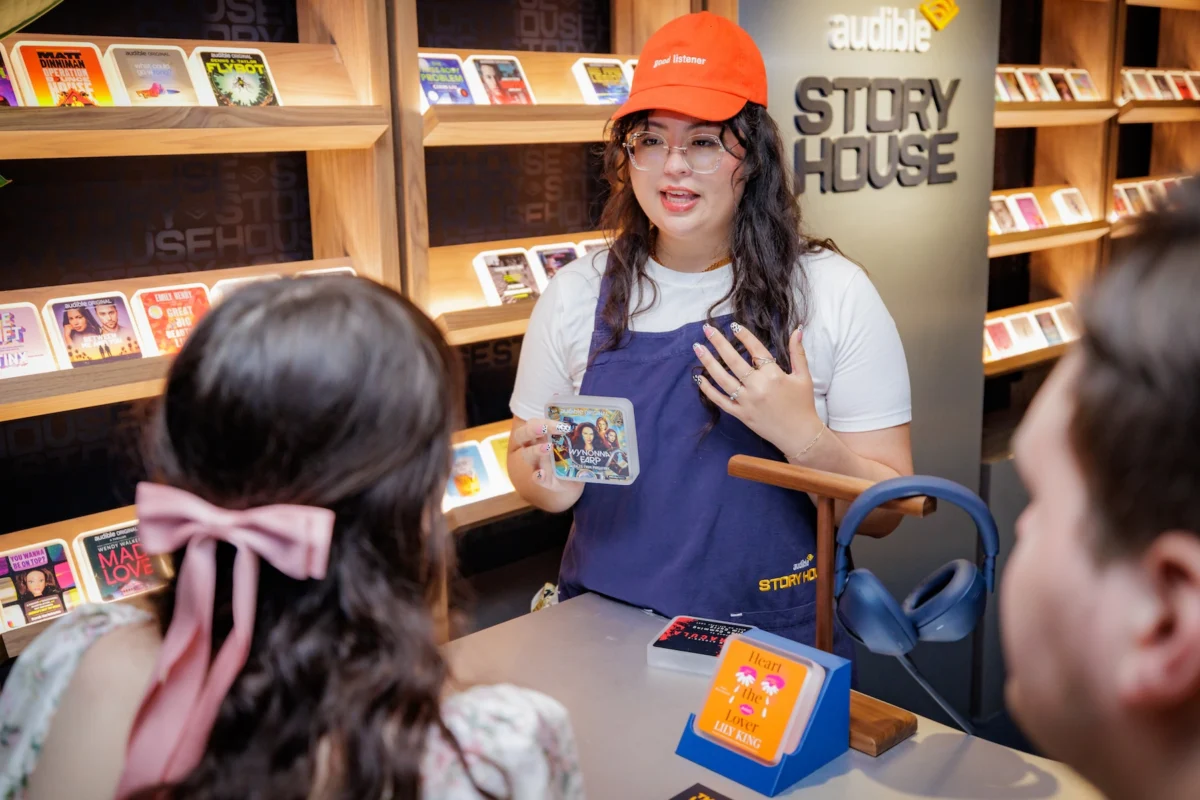
In an era where over half of Americans aged 18 and older, an estimated 157 million individuals, have embraced the world of audiobooks according to the Audio Publishers Association, Audible has taken a bold step to redefine the listening experience. In May, the Amazon-owned audiobook giant launched its innovative "Story House" initiative, a concept boldly proclaimed as the first-ever "bookless bookstore." This immersive pop-up experience, following its debut at BookCon in New York City, operated for a full month in lower Manhattan, attracting over 7,000 unique visitors and providing Audible with invaluable insights into consumer engagement with audio content in a physical space.
The Audible Story House, strategically located at 260 Bowery, transformed a three-floor space into a haven for audiobook enthusiasts. Eschewing traditional book displays, the venue featured "Story Tiles" – physical blocks embedded with RFID chips. These tiles served as interactive gateways, allowing visitors to instantly sample audiobooks through integrated speakers, personal headphones, or their own mobile devices. The space was meticulously designed to cater to diverse listening preferences, boasting seven distinct listening zones. A highlight was the immersive listening theater, equipped with state-of-the-art Dolby Atmos surround sound, offering a truly cinematic auditory journey. Complementing this was a "Listening Bar," staffed by dedicated "Story Tenders" who provided personalized recommendations and guided visitors through the curated selection. Beyond the core listening experience, the Story House buzzed with activity, hosting creator programming and panels, book club meetups, hands-on crafting sessions, and a pop-up café operated by Brooklyn’s Land to Sea. Merchandise related to popular titles and the Audible brand was also readily available, further enhancing the attendee experience.

James Finn, Audible’s global head of brand content marketing, articulated the strategic importance of the Story House. "What I was excited about was the opportunity to learn a lot more about customers and their experiences in that space," Finn told Variety. "And oftentimes, I don’t have a sample size like that, and I don’t have a situation where we show up for an entire month in a city like New York and really learn more about our existing customers and new listeners." This sentiment underscores the experimental nature of the project, aiming to bridge the gap between the digital convenience of audiobooks and the tangible, social aspects of a physical retail environment.
The temporary nature of the Story House, which concluded its run in June, was met with disappointment by many attendees. "It was very hard when we closed the doors, I will be honest," Finn admitted. "And a lot of people assumed that it was going to be there permanently, which was a nice compliment to the team that built the space." This reaction speaks to the success of the experience in creating a memorable and desirable destination for audiobook lovers.
The operational data from the Story House provided a wealth of information about listening habits and preferences. Out of the 301 titles available for sampling, an impressive 98% were listened to "to any degree" over the month. This statistic highlights the breadth of interest and the effectiveness of the "Story Tile" system in encouraging exploration across the entire catalog. Among the most popular titles that resonated with visitors were Andy Weir’s "Project Hail Mary," "The Hive: A Thriller," George Orwell’s classic "1984," the romance novel "Just Kiss Already," and Audible’s acclaimed full-cast recording of "Harry Potter and the Sorcerer’s Stone."

A particularly noteworthy observation was the fervent engagement with Matt Dinniman’s "Dungeon Crawler Carl" LitRPG series. The release of its new installment, "A Parade of Horribles," on May 12th, coincided with the Story House’s operational period, leading to significant interest. "People were coming in, and they had already listened to it, and the eighth book had only come out a couple days ahead of time, and they were still tapping it, and they still were excited about that," Finn remarked, illustrating the passionate community surrounding this niche genre.
Beyond individual title popularity, Audible measured over 15,000 "deep engagement" experiences among visitors. This metric signified more than just a casual browse; it represented a sustained interaction within the space, indicating a genuine connection with the content and the environment. "People weren’t just coming in and then leaving, or coming in and listening to a sample and leaving," Finn elaborated. "They genuinely were staying around, going to the different areas, or coming to the community sessions where we had different activities, or going up to the cafe and buying an AudiBuddy, and that was really interesting." This deep engagement suggests that the Story House successfully fostered a sense of community and provided a multi-faceted experience that extended beyond mere audio sampling.
The learnings gleaned from the Story House are already influencing Audible’s digital strategy. "The Audible team has also been looking at ‘what are the learnings from the actual experience in New York that we can adapt to the experience within the app and within the service’," Finn stated. The overarching takeaway is the imperative of "removing friction and allowing more engagement and allowing more of an opportunity for personalization, so that they have the opportunity to go to what is interesting to them, but to sample and to try." This indicates a strategic focus on enhancing the user experience within the Audible app, making it more intuitive, engaging, and tailored to individual preferences, mirroring the personalized discovery elements of the physical space.

The innovative "Story Tiles" themselves represent a significant technological achievement. With 13,000 leftover tiles, Audible is exploring future applications for these tangible representations of audio content. "We created that technology and that item. It didn’t exist," Finn emphasized. "The ambition was, how do we take something invisible and make it tangible? So the RFID component with it, we were able to see what people were listening to, and it was fantastic because everybody has different tastes and we saw such an interesting read across the entire slate of content there." The ability to track listener engagement with specific titles via the RFID technology provided unprecedented data on content appeal and discovery patterns.
Looking ahead, the success of the Story House has paved the way for future experiential initiatives. While the New York pop-up was a temporary endeavor, its core principles are being carried forward. "But after the fact, what we’ve been doing is assessing what does Audible Story House look like in our plans for ‘27," Finn revealed. "Right now, what we’re doing is similar to what you saw at BookCon. We’re going to bring a version of that with the core fundamentals to Guadalajara Book Festival, and then Frankfurt Book Fair." This indicates a global strategy to replicate the successful elements of the Story House at major literary events, further solidifying Audible’s commitment to innovative consumer engagement.
The Audible Story House stands as a testament to the evolving landscape of media consumption and the increasing importance of experiential marketing. By creating a physical manifestation of the audio world, Audible not only attracted a significant number of visitors but also gathered crucial data and insights that will undoubtedly shape the future of audiobook discovery and engagement, both online and offline. The experiment proved that even in the digital age, there is a strong desire for tactile interaction, curated discovery, and community building around shared interests, even for content that is inherently intangible. The "bookless bookstore" concept, therefore, represents a forward-thinking approach that acknowledges the power of listening while embracing the human need for connection and tangible experiences. The 7,000+ visitors and the 15,000+ "deep engagement" experiences are strong indicators that this model holds significant promise for the audiobook industry. The careful analysis of visitor behavior, from the titles they sampled to the time they spent in various zones, provides a rich dataset for Audible to refine its platform and marketing strategies. The successful implementation of the Story House at international book fairs further demonstrates Audible’s ambition to explore global markets and adapt its experiential approach to diverse cultural contexts. The ongoing exploration of the "Story Tile" technology also suggests a commitment to innovation in how audio content is presented and interacted with. As the audiobook market continues its robust growth, Audible’s foray into immersive, physical experiences like the Story House signals a potential blueprint for other media companies seeking to connect with their audiences in more profound and memorable ways. The emphasis on removing friction and enhancing personalization, directly inspired by the physical space, will likely translate into a more user-friendly and engaging digital platform for millions of Audible listeners worldwide.
