
 By admin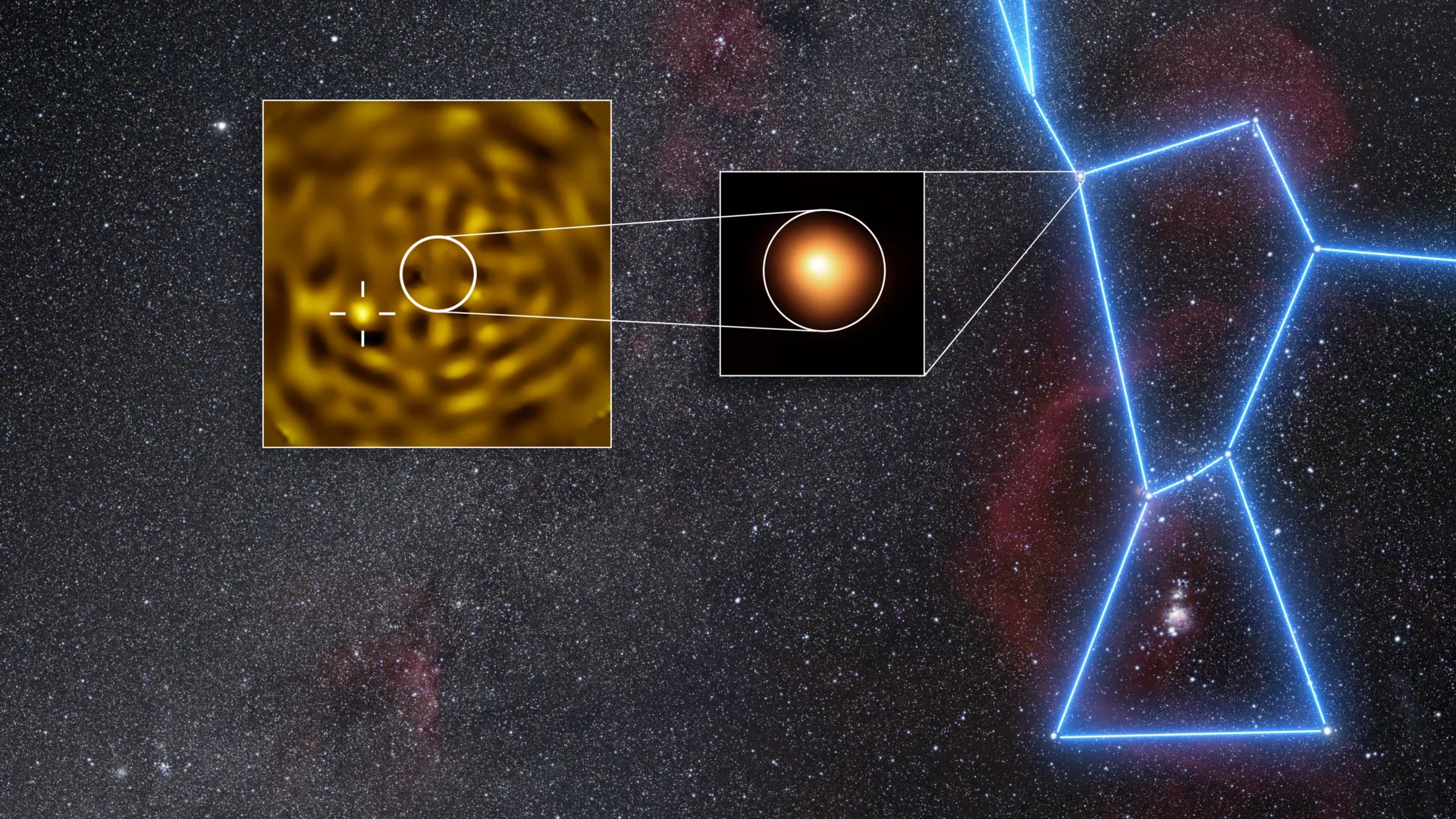
This groundbreaking discovery marks the culmination of a century-long astronomical quest, providing unprecedented insight into the life and potential future of the famous red supergiant. A team led by French astronomer Miguel Montargès, from the Observatoire de Paris — PSL, utilized the formidable capabilities of the European Southern Observatory’s Very Large Telescope (ESO’s VLT) to capture the clearest image to date of what is confidently believed to be Betelgeuse B, a star locked in orbit around its colossal primary. This observation not only confirms a long-held hypothesis but also unveils unexpected characteristics of the companion, reshaping our understanding of this iconic star system.
"This is the conclusion of a century-long quest," declared a visibly thrilled Montargès, whose excitement was palpable. The study, which has been published in the esteemed journal Astronomy & Astrophysics, definitively states, "We have shown that Betelgeuse is not single, it is accompanied by a faint stellar companion." This revelation challenges prevailing models that often treat such massive stars in isolation, underscoring the profound influence a binary partner can have on a star’s evolutionary path.
Betelgeuse, a luminous reddish star nestled in the shoulder of the Orion constellation, has captivated human observers for millennia. Its easy visibility with the naked eye and its intriguing variability in brightness have made it a subject of fascination across cultures and scientific eras. Despite centuries of meticulous scientific observation, including its dramatic dimming event a few years ago, Betelgeuse continues to present astronomers with surprising new facets, proving itself to be a cosmic enigma that guards its secrets closely.
A Century-Long Search for Betelgeuse B: From Hypothesis to Confirmation
The journey to confirm Betelgeuse B began nearly a hundred years ago. The possibility of a companion star was initially proposed as a compelling explanation for some of Betelgeuse’s perplexing changes in brightness, which deviated from typical pulsating star behavior. Early spectroscopic studies occasionally hinted at a secondary presence, but the immense luminosity and sheer size of Betelgeuse, coupled with its relatively close proximity to Earth (estimated at around 640 light-years), made direct detection an extraordinary challenge. The glare from the primary star effectively drowned out any light from a fainter companion, much like trying to spot a firefly next to a lighthouse.
"I jumped from my chair when I saw the processed images," Montargès vividly recounted, recalling the moment of epiphany that followed months of painstaking data analysis. This visceral reaction speaks volumes about the difficulty and the unexpected nature of the discovery. Decades of attempts by astronomers, employing various observational techniques, had failed to yield a clear, unambiguous detection of such a star, reinforcing the notion that Betelgeuse might indeed be a solitary giant.
The tide began to turn with the publication of two pivotal studies in 2024. These theoretical works, leveraging advanced computational models and refined stellar physics, made strong predictions regarding the companion’s likely orbital parameters and position. Crucially, they indicated that Betelgeuse B would reach its greatest apparent separation from Betelgeuse in December 2024. This alignment presented astronomers with a rare and optimal window of opportunity to finally resolve the elusive companion.
Seizing this moment, Montargès and his international team turned ESO’s VLT, located in Chile’s Atacama Desert, towards Betelgeuse that December. The VLT, a leading facility for ground-based astronomy, is equipped with state-of-the-art instruments designed for high-resolution imaging. Following the observations, the team embarked on several months of rigorous data processing and analysis, employing sophisticated algorithms to tease out the faint signal of Betelgeuse B from the overwhelming glare of its primary.
"Honestly, I thought we did not have the sensitivity to detect Betelgeuse B as it was predicted," Montargès admitted, highlighting the inherent skepticism that often accompanies such challenging observations. The initial predictions for Betelgeuse B’s mass and brightness suggested it would be an exceedingly faint target. However, the subsequent analysis revealed a critical difference: "Because it is more massive than predicted, we see it!" This unexpected revelation was a significant factor in the success of the detection.
Previous estimates had posited that the companion would possess roughly the same mass as our Sun. The new observations, however, painted a different picture, suggesting that Betelgeuse B is considerably more substantial, weighing in at approximately two to three times the Sun’s mass. This increased mass directly translates to greater luminosity, making it brighter and thus detectable by the VLT’s instruments, even from behind the intense light of Betelgeuse.
"The fact that we can still discover a nearby companion, more massive and brighter than the Sun, around such a well-studied star is remarkable," Montargès emphasized. "These are among the best moments in science: seeing something new, unexpected." This sentiment encapsulates the thrill of astronomical discovery, where even the most familiar celestial objects can still hold profound surprises.
The Clearest Image Yet of Betelgeuse’s Companion: A Triumph of High-Contrast Imaging
The researchers achieved a direct image of Betelgeuse B, meaning they captured light emanating directly from the companion star itself, rather than inferring its presence through indirect methods like gravitational wobbles or eclipses. This feat was accomplished using the SPHERE instrument (Spectro-Polarimetric High-contrast Exoplanet Research) on ESO’s VLT. SPHERE is specifically designed for high-contrast imaging, utilizing advanced adaptive optics to correct for atmospheric distortions and a coronagraph to block out the overwhelming light from the central star. These technologies, originally developed for the challenging task of finding exoplanets, proved equally adept at resolving a faint stellar companion in close proximity to a bright supergiant.
While the VLT observations provide the strongest and clearest evidence, previous observations had offered tantalizing clues. Notably, a "possible direct detection" was made with the Gemini North Telescope in Hawaiʻi, USA. However, the VLT’s SPHERE instrument, with its superior angular resolution and advanced post-processing capabilities, was able to produce an image of unparalleled clarity and confirm the presence of Betelgeuse B with a higher degree of certainty. The combination of cutting-edge hardware and sophisticated software algorithms, including techniques for speckle suppression and deconvolution, was instrumental in isolating the faint signal of the companion.
Co-author Anthony Boccaletti, also an astronomer at the Observatoire de Paris, underscored the versatility of the observational toolkit: "It is remarkable to see how SPHERE and advanced post-processing techniques, originally developed to find exoplanets, also excel at detecting a companion around a massive, evolved star like Betelgeuse." This cross-application of technology highlights the interconnectedness of astronomical research and the power of innovative instrumentation.
Despite the compelling evidence, the scientific community maintains a rigorous standard of proof. The case is not yet considered entirely closed, as astronomers seek further confirmation. "To be certain that the companion is really there, we still need to observe it in one year on the other side of the star, but there is very little space left for doubt," Montargès added. This crucial step involves tracking Betelgeuse B’s orbital motion to ensure it follows the predicted trajectory, thereby definitively ruling out any potential artifacts or background objects. Such an observation would provide the ultimate validation of its status as a bound companion.
Betelgeuse’s Famous Dimming Event and the New Binary Context
Betelgeuse garnered unprecedented worldwide attention several years ago, specifically during the "Great Dimming" event of late 2019 and early 2020. Its brightness noticeably dropped by roughly two-thirds, a dramatic and visually striking change for such a prominent star. Given that Betelgeuse is an evolved red supergiant nearing the end of its life, which is expected to culminate in a spectacular supernova explosion, the dramatic dimming immediately prompted widespread speculation that the star might be preparing for its grand finale. Public interest surged, with media outlets globally reporting on the possibility of an imminent cosmic fireworks display.
However, subsequent research, once again spearheaded by a team led by Montargès and utilizing ESO’s VLT, provided an alternative and less dramatic explanation. Their studies revealed that the dimming was not a prelude to a supernova but rather the result of a colossal cloud of dust ejected from the star’s outer atmosphere. This dust cloud, formed from material shed by Betelgeuse, temporarily blocked a significant portion of the star’s light as seen from Earth. The mechanism involved a combination of a cooling patch on Betelgeuse’s surface (a large convection cell) and a subsequent mass ejection, leading to the condensation of silicate dust grains.
Now, the likely discovery of Betelgeuse B introduces a new and critical factor that astronomers must incorporate into their models when studying the star’s ongoing evolution. The presence of a companion can profoundly influence a star’s life cycle, from its formation to its eventual demise. Binary interactions can lead to mass transfer, tidal forces, and altered rotational dynamics, all of which can significantly deviate a star’s evolution from that of a solitary counterpart.
Could the Companion Affect Betelgeuse’s Supernova?
The most profound implications of Betelgeuse B’s discovery lie in its potential influence on the future evolution of the red supergiant, including the timing and characteristics of its eventual supernova explosion. Stellar evolution in binary systems is notoriously complex and often diverges significantly from single-star models.
Researchers will now meticulously investigate several key questions:
- Mass Transfer History: Could Betelgeuse B have engaged in mass transfer with Betelgeuse in the past? While Betelgeuse is currently a red supergiant, during earlier stages of its evolution (e.g., as a blue giant), it might have exchanged material with its companion. Such mass transfer could significantly alter the chemical composition and internal structure of both stars, impacting their subsequent evolution.
- Orbital Dynamics and Tidal Interactions: The gravitational pull of Betelgeuse B could exert tidal forces on Betelgeuse, potentially affecting its rotation rate, convection patterns, and mass loss mechanisms. These interactions might influence the frequency and intensity of future dimming events, or even trigger more significant mass ejections.
- Supernova Type and Timing: While Betelgeuse is expected to end its life as a Type II supernova (the collapse of its core), the companion could subtly influence this process. For instance, if significant mass transfer occurred, it could alter the core mass or angular momentum of Betelgeuse, potentially affecting the precise timing or even the observable properties of its supernova. Conversely, if Betelgeuse B was a white dwarf (unlikely given its estimated mass, but for theoretical exploration), mass accretion from Betelgeuse could trigger a Type Ia supernova. However, given Betelgeuse B’s mass, it is likely a main-sequence star, or perhaps an earlier-stage giant itself.
"The question is truly opened whether this companion is going to have an impact on the evolution of the red supergiant," concludes Montargès. This sentiment encapsulates the excitement and the immense scope of future research that this discovery has unlocked. Understanding the intricate dance between Betelgeuse and its newly confirmed companion will not only shed light on this specific system but will also contribute significantly to our broader understanding of massive star evolution and supernova progenitors throughout the cosmos.
The research detailing this monumental discovery was presented in a paper titled "VLT/SPHERE images the candidate companion of Betelgeuse" and is set to appear in the highly respected journal Astronomy & Astrophysics. The international collaborative team behind this work includes: M. Montargès (LIRA, Observatoire de Paris, Université PSL, Sorbonne Université, Université Paris Cité, CY Cergy Paris Université, CNRS, France), A. Boccaletti (LIRA), O. Flasseur (Universite Claude Bernard Lyon 1, Centre de Recherche Astrophysique de Lyon UMR5574, ENS de Lyon, CNRS, France), A. de Koter (University of Amsterdam, Anton Pannekoek Institute for Astronomy, The Netherlands), J. Milli (Univ. Grenoble Alpes, CNRS, IPAG, France), P. Kervella (French-Chilean Laboratory for Astronomy, IRL 3386, CNRS and U. de Chile, Chile and LIRA), S. Ridgway (National Optical Astronomy Observatory, USA), E. Bordier (I. Physikalisches Institut der Universität zu Köln, Germany), E. Lagadec (Université Côte dAzur, Observatoire de la Côte dAzur, CNRS, Laboratoire Lagrange, France), A. K. Dupree (Center for Astrophysics-Harvard & Smithsonian, USA), F. Backs (Institute of Astronomy, KU Leuven, Belgium), T. Calderwood (American Association of Variable Star Observers, USA [AAVSO]), and P. Morgan (AAVSO). Their combined expertise and tireless efforts have opened a new chapter in the study of one of the night sky’s most celebrated stars.
