
 By admin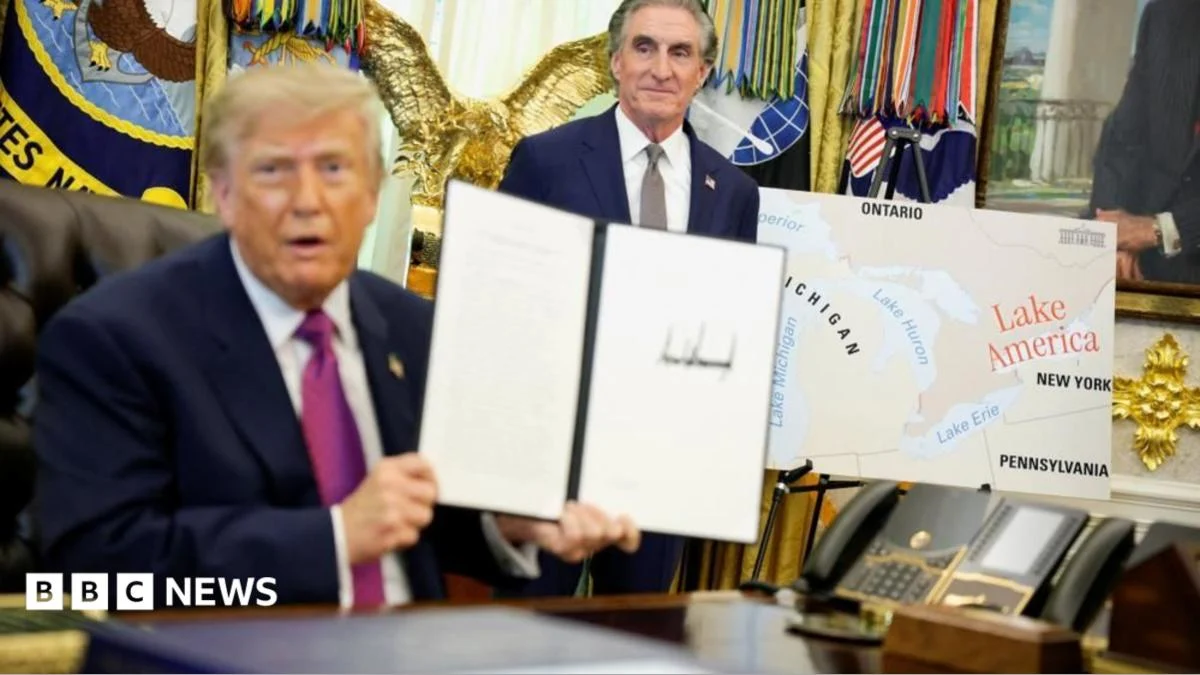
In a move that has sent shockwaves through diplomatic and environmental circles, U.S. President Donald Trump has signed an executive order seeking to unilaterally rename Lake Ontario, one of the five Great Lakes, to "Lake America." This dramatic action follows the collapse of trade talks between the United States and Canada late last week, a breakdown that has precipitated the imposition of new 50% tariffs by the U.S. on $20 billion (C$28 billion) worth of Canadian goods. Canada has vowed retaliation, announcing "dollar for dollar" counter-tariffs set to be implemented next month, escalating a trade dispute that is increasingly spilling over into symbolic and potentially destabilizing territorial claims.
President Trump, who has a well-documented history of using social media to air grievances and issue pronouncements, had repeatedly hinted at such a drastic measure on his social media platforms amidst the deepening trade friction. On Thursday, he declared the renaming "official, effective immediately," asserting that his administration had "filed all the necessary papers, documents" to formalize the change. The executive order mandates that the U.S. Department of the Interior has a 30-day window to update the new name within the Geographic Names Information Service (GNIS), the official repository for domestic geographic names in the United States.
The historical and cultural significance of Lake Ontario, a vital shared waterway for both nations, has been underscored by Canadian officials in their staunch rejection of the U.S. president’s decree. Canadian Prime Minister Mark Carney pointed out that the name "Lake Ontario" boasts a lineage exceeding 400 years, predating both the formation of the Canadian Confederation and the U.S. Declaration of Independence. In a pointed social media post that preceded Trump’s official announcement, Carney declared, "We know that the United States is changing. Their trade relations, their foreign policy, their national monuments, their hydronyms. Canadian women and men also know that things must be called by their name, and this lake is called Lake Ontario – today and forever."
This is not the first instance of President Trump attempting to unilaterally alter the names of internationally recognized geographical features. Upon entering the White House in 2025, he signed a similar executive order that sought to rename the Gulf of Mexico to the "Gulf of America." This prior action was met with outright rejection by Mexico, which argued that a single nation cannot unilaterally rename a shared body of international water. The dispute escalated into a legal battle involving tech giant Google, which ultimately navigated the situation by displaying differing names for the gulf within its maps application based on user location. Google Maps users in the U.S. saw "Gulf of America," while those in Mexico continued to see "Gulf of Mexico." Users in other countries received a dual designation: "Gulf of Mexico (Gulf of America)." The White House at that time also took punitive measures against the Associated Press, blocking its reporters from presidential events due to the news agency’s refusal to adopt the "Gulf of America" nomenclature. This led to a lawsuit by the AP against the Trump administration, a legal challenge that remains ongoing.
The renaming of Lake Ontario raises significant questions about international law and the recognition of geographical names. There is no universally recognized international body with the authority to dictate the names of international waters. While a U.S. president possesses considerable discretion over how his country officially recognizes domestic landmarks, other nations are not legally bound to adopt such changes, particularly when shared territories are involved. Canada has made it unequivocally clear that it has no intention of recognizing the U.S. president’s decree.
The response from Canadian provincial leaders has been equally firm and dismissive. Ontario Premier Doug Ford unequivocally stated, "It’s Lake Ontario to Canadians and the rest of the world. Now and forever." Nova Scotia Premier Tim Houston echoed this sentiment, remarking, "We’re into some real foolishness now. It’s Lake Ontario, buddy." Industry Minister Melanie Joly confirmed the Canadian government’s stance, saying, "We’ll always call it Lake Ontario."
The historical origins of the Great Lakes’ names are deeply rooted in indigenous languages and historical context. Four of the five Great Lakes – Ontario, Huron, Michigan, and Erie – derive their names from indigenous words, reflecting the rich cultural heritage of the North American continent. Lake Superior’s name, on the other hand, originates from an anglicized French term. Lake Ontario, the smallest of the Great Lakes by volume and surface area, holds particular significance as it directly borders the Canadian province of Ontario and the U.S. state of New York, making its shared identity a crucial element of regional cooperation.
During the signing of the executive order in the Oval Office, President Trump framed the move not as a direct provocation to Canada, but rather as a consequence of what he perceives as long-standing trade exploitation by America’s northern neighbor. He reiterated his long-held contemplation of renaming the lake. "So if you think about it, we have a gulf and we have a lake," Trump stated, alluding to the previous renaming of the Gulf of Mexico. "Now, all we need is an ocean. So maybe we’ll have to change the name of the Atlantic and or the Pacific. Maybe we’ll change them both." This statement suggests a broader, more ambitious agenda of renaming international bodies of water to reflect American dominance, a concept that is likely to ignite further international friction.
The timing of this renaming initiative, amidst an intensifying trade dispute, has pushed U.S.-Canada relations to one of their lowest points in recent history, marked by sharp exchanges and mutual accusations between the Trump administration and Canadian officials over the past week. However, a glimmer of hope for de-escalation emerged on Thursday when Canadian U.S. trade minister, Dominic LeBlanc, posted on X that the U.S. had withdrawn some demands concerning French-language labeling requirements. LeBlanc stated that the U.S. had confirmed that "measures to promote French language and Canadian culture will not be subject to future U.S. trade actions." He added, "We look forward to further constructive U.S. clarifications on their other positions, which would create the possibility of a mutually beneficial trade agreement that respects Canadian sovereignty." This indicates that while the trade talks collapsed at the last minute, with both sides accusing the other of last-minute changes to a tentative agreement, there might still be a path forward for renewed negotiations.
The unilateral renaming of Lake Ontario has also drawn sharp criticism from within the United States. Democratic lawmaker Debbie Dingell, whose Michigan district borders four of the five Great Lakes, announced her intention to introduce a bill in Congress to nullify the executive order, labeling Trump’s action "idiotic." She emphasized the shared heritage of the Great Lakes, stating, "The Great Lakes are a shared treasure that generations of Americans and Canadians have worked together to protect." Other Democratic lawmakers have also voiced their disapproval on social media, urging the Trump administration to refocus its efforts on negotiating a trade deal rather than engaging in symbolic gestures. Some have even joined in a playful mockery of the president’s actions, proposing their own humorous name changes for other landmarks.
Wisconsin’s governor, for instance, jokingly posted a video of himself signing a napkin with "Lake Wisconsin" written on it, stating, "See, I can sign napkins that say things, too." New York Governor Kathy Hochul, whose state is the sole U.S. state bordering Lake Ontario, declared that her state "won’t be calling it" Lake America, reinforcing the widespread opposition to the renaming.
In contrast to the widespread criticism, President Trump’s Secretary of the Interior, Doug Burgum, enthusiastically applauded the move. He responded to the president with "We’re on it, Mr. President!" and elaborated, "The places and waters that border our nation and support our economy should reflect the greatness of the United States." Burgum further stated that the U.S. Geological Survey, which is responsible for mapping the country, would "proudly implement" the executive order to rename the lake. This endorsement from a key cabinet member highlights the internal support within the administration for such symbolic assertions of national identity and power, even at the expense of international cooperation and historical precedent. The renaming of Lake Ontario to Lake America signifies a new, potentially contentious chapter in U.S.-Canada relations, one where geopolitical and economic disputes are increasingly being fought on the symbolic battleground of shared geography.
