
 By admin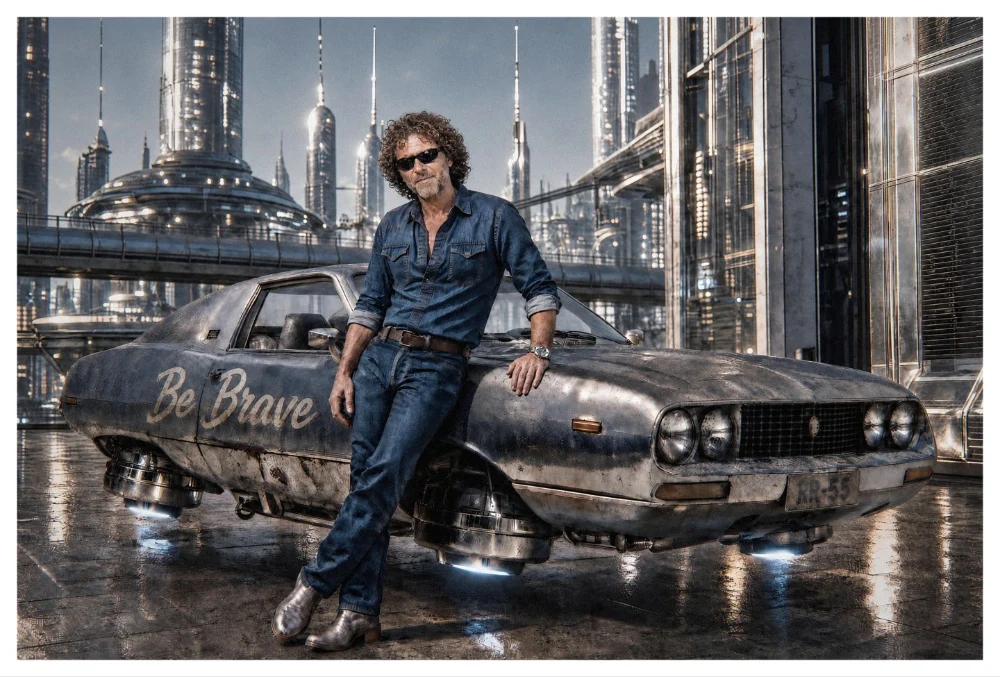
New York-based Italian director Francesco Carrozzini is set to make waves at the prestigious Venice Film Festival with "Be Brave," an ambitious 85-minute documentary that delves into the life of Renzo Rosso, the visionary founder of the iconic Diesel fashion brand. What distinguishes this film is its pioneering use of Artificial Intelligence, a technological integration that Carrozzini emphasizes was meticulously crafted to "still live within a space of emotion and storytelling." This groundbreaking approach positions "Be Brave" as one of the first full-length features to emerge from a top-tier film festival leveraging AI in such a profound manner, signaling a potential paradigm shift in documentary filmmaking.
"Be Brave" paints a compelling portrait of Renzo Rosso as a quintessential visionary underdog. The narrative traces his remarkable journey from humble beginnings, rising from poverty to establish a global fashion empire that redefined casual wear. In a truly revolutionary filmmaking decision, Carrozzini opted not to shoot a single frame of the contemporary Rosso. Instead, the film masterfully recreates Rosso at various stages of his life through sophisticated AI technology. This choice underscores the film’s central theme of innovation and forward-thinking, mirroring the entrepreneurial spirit of its subject.
Venice Film Festival director Alberto Barbera, in announcing the film’s inclusion, highlighted its significance, stating, "I want to put this [film] forward as an invitation for everyone to think about how AI as a tool can open up new creative possibilities for filmmakers." This endorsement from one of cinema’s most influential festivals signifies a powerful validation of Carrozzini’s experimental approach, suggesting that AI, when wielded with artistic intent, can transcend mere technological novelty to become a potent tool for narrative and emotional resonance.
This marks Carrozzini’s return to the Venice Lido, a place familiar to him from previous acclaimed projects. His debut at the festival was with "Franca: Chaos and Creation," an intimate documentary about his late mother, Franca Sozzani, the formidable and influential editor of Italian Vogue. This earlier work showcased Carrozzini’s ability to capture complex personal histories with sensitivity and artistic flair. He further solidified his presence in Venice in 2022 with his foray into feature filmmaking, "The Hanging Sun," a thriller that demonstrated his versatility as a director.
The creation of "Be Brave" was a dynamic and evolving process, mirroring the rapid advancements in AI itself. Carrozzini recounts that over the year and a half spent in production, the AI landscape transformed so drastically that initial work had to be re-done multiple times. "AI has changed to a point where what we were doing in the beginning had to be redone," he explains. "And the moment we will be in the theater it will probably be old already." This inherent ephemerality of the technology presents a unique challenge, yet Carrozzini embraces it. "Working with a medium that is transforming at this pace is also really exciting," he notes, finding exhilaration in the cutting edge of his craft.
The film is produced by Lorenzo Mieli, Mario Gianani, and Gabriele Immirzi at Rome-based Our Films, a Mediawan company, known for its commitment to bold and innovative storytelling.
In an exclusive conversation with Variety ahead of the Venice premiere, Carrozzini elaborated on the intricate challenges and profound implications of bringing "Be Brave" to life, offering insights into his vision for AI’s role in filmmaking.
The Genesis of an AI-Driven Narrative:
Carrozzini revealed that the initial impetus for "Be Brave" came from producer Lorenzo Mieli, who proposed a film about Renzo Rosso. Initially hesitant, having stepped away from the fashion world he grew up in to pursue narrative film and television, Carrozzini was persuaded by Mieli’s conviction. The core idea was to create something innovative and experimental with AI, though the precise application was initially undefined. "In the very beginning, it was really about necessity," Carrozzini stated. While ample archival footage of Rosso existed, including television appearances, there was a notable lack of compelling interviews or intimate moments. This scarcity of raw material became the catalyst for exploring AI. "So the idea became: first of all, we can recreate those from scratch; though we were worried about them not being believable." This seed of an idea evolved into a more ambitious concept: "From the seed of that idea, then came the idea of: Well, let’s take AI and make it sort of the theme of the film and also make it the challenge towards something bigger than ourselves."
A Scripted Documentary: The Narrative Framework:
Contrary to some documentary filmmaking approaches, "Be Brave" is a fully scripted endeavor. Carrozzini explained the narrative conceit: "We wrote a script. This film is fully scripted. We started toying with the idea of me finding Renzo; a rather well-known device in documentary filmmaking. But at the same time putting together the puzzle of who he is, just as he was running away from me because he was trying to trick me." This meta-narrative, where the filmmaker actively seeks his subject while the subject evades, became more than just a storytelling device; it evolved into the film’s thematic core. Carrozzini clarified, "This film is not a thesis on AI. The only thing that is said towards the end – which I think is really important – is that the human has to come first. This is a reflection on AI in storytelling and entertainment. It’s not a reflection on AI tout court." This distinction is crucial, emphasizing the film’s focus on the human element within technological innovation, rather than a purely technical exploration of AI.
Navigating the AI Workflow: A Technical Odyssey:
The practicalities of creating "Be Brave" were undeniably complex, as Carrozzini described the workflow as "a nightmare, especially in the beginning, until we found the workflow." He elaborated on the inherent unpredictability of AI: "Because it’s trial and error. As you know, AI will never give you exactly what you’re asking. It will always give you a version of what you’re asking." This constant iteration and refinement were central to the production.
Bringing Renzo Rosso to Life Through AI:
The process of rendering Renzo Rosso on screen involved meticulous attention to detail. "We used pictures of Renzo from the time [in which his scenes and interviews are set]," Carrozzini explained. The challenge then became imbuing these digital likenesses with authentic performance. "And then you have to have him speak. And you have to have him say what you want. And do it in the voice that you want. He also has to be dressed the way you want." The painstaking nature of this process, from vocal synchronization to sartorial accuracy, was immense. Furthermore, the film aimed to capture the evolution of Rosso’s voice across different ages, striving for maximum verisimilitude. "The first task is getting what you want."

Beyond the visual and auditory replication, capturing Rosso’s authentic behavior proved to be the most formidable hurdle. "Trying to capture not only his physical age, but his behavior," Carrozzini emphasized. "For people who don’t know this process, behavior is really, I would say, the hardest thing. You can get the voice perfect. You can get the image right. But it’s the behavior that was really challenging in creating quite a lot of footage of Renzo." This pursuit of nuanced, lifelike behavior is what elevates the AI-generated performances beyond mere mimicry.
The Director’s Self-Portrait: A Unique Challenge:
Carrozzini also shared his personal experience of directing himself using AI. As he appears in the film, the process was particularly unnerving. "Well, it’s all based on my pictures, and because it’s me, it’s the part that scared me the most." The director’s intimate knowledge of his own appearance made him acutely aware of even the slightest AI-generated discrepancies. "With Renzo sometimes I would think I saw a tiny discrepancy. But with me, I was like: ‘Oh my god, that’s real!’" This heightened self-awareness underscores the uncanny nature of AI-generated likenesses and the director’s commitment to achieving absolute authenticity.
The Technical Backbone: Collaboration and Ingenuity:
The intricate workflow involved significant technical infrastructure and specialized expertise. "All this becomes a workflow problem, labeling all this material as if it was footage, and making it accessible to the editor," Carrozzini noted. He credited Blackstone, one of the companies involved in the project, for their significant contribution to this technical backbone. Crucially, he highlighted the role of "genius, Roberto Beragnoli who was the AI artist, [who] did the heavy lifting." The development of this workflow was a months-long endeavor, focused on acquiring the desired material in the precise sequence.
Carrozzini likened the production effort to that of a major CGI feature film. "It looks like just a documentary. But the work that went into it is like the work of a big, heavy CGI feature film." The quality assurance aspect presented a substantial challenge, as the team utilized a multitude of software tools. "In AI you work at very low quality, and you have to upscale it. It’s very technical. I don’t want to get too nerdy, but the whole process is quite nerdy." This technical depth underscores the advanced nature of the film’s production.
Crafting Immersive Environments:
Beyond individual characters, the film also tackles the creation of environments populated by people. "That was really a very exciting filmmaking endeavor because with anything I do that is scripted, I have to come up with, you know, the same exact number of [visual] ideas," Carrozzini explained. When a scene requires, for instance, "Off Broadway theater. Morning. Ten people waiting in line," the director must meticulously envision every aspect of these individuals. "I have to decide how do those ten people look? How are they dressed? Where exactly are they?" The traditional filmmaking process of casting, scouting, and collaborating with costume designers is here replaced by AI. "In the beginning it was very frustrating because instead of casting and scouting and talking to a costume designer, you do it with AI." This shift demands a new set of creative problem-solving skills.
The Viewer’s Perception: Intentional Ambiguity:
When asked whether it’s important for viewers to distinguish between AI-generated and real footage, Carrozzini expressed a nuanced perspective. "I want to say no," he stated. "This film tells a story of a man who lived, who is real, and whose adventures are all quite true. And so, if we are able to entertain you, make you laugh and empathize with this character, then that’s what counts." His primary concern is the film’s emotional impact and narrative efficacy, rather than its technical transparency. "What interests me is not whether they’re able to discern it or not, but whether the film has an effect."
Addressing the Empathy Deficit:
Carrozzini acknowledged the widespread concern that AI in filmmaking could erode the empathic connection viewers forge with human actors. He addressed this by framing his approach within the documentary genre. "That’s why I was interested in approaching AI through the medium of documentary, which is very different from fiction, although ours is a fictionalized documentary, because it’s written and created. It still has the form of the documentary, it has that filter that you put on when you watch it." He contrasted this with a purely fictional narrative, where the illusion of reality is paramount. "If this was that beautiful documentary ‘Free Solo’ [which captured rock climber Alex Honnold’s hair-raising ascent of Yosemite National Park’s 3,000-foot El Capitan rock formation] that would be a very different thing because we would be pretending that something that never happened had happened."
The Future of AI in Fiction Filmmaking:
Reflecting on the potential of AI in fiction films, Carrozzini expressed caution. "I think something similar is happening with scripted material in fiction. With TV shows and movies. We haven’t overcome that yet. And I’m not sure that we want to." He emphasized the unique quality of human emotion as conveyed by human performers. "The empathy you talk about, it’s generated by real people doing things that, despite being more or less made up, are still human. That emotion is human. That cry is human. That laughter is human." He believes that the current limitations of AI, while not always explicitly stated, often prevent viewers from fully connecting. "Once you know that it’s not human – and right now we can tell, even if we’re not told – the moment you start watching, after five minutes you know that you’re not going to get on board exactly because that empathy is lacking." Despite these reservations, Carrozzini remains optimistic about AI’s potential when applied thoughtfully. "Again, I’m not saying that we fully succeeded. People will tell us [whether we did or not]. But we tried to apply a form of AI that can still live within a space of emotion and storytelling, I think. Because you can’t discern it, it still works for its purpose." However, for now, he would hesitate to undertake a historical or contemporary fiction film that completely eschews human actors.
The interview was edited and condensed for clarity, allowing the depth of Carrozzini’s insights into this groundbreaking cinematic endeavor to shine through. "Be Brave" promises to be a significant talking point at the Venice Film Festival, not only for its compelling subject matter but also for its bold exploration of AI’s transformative potential in the art of filmmaking.
