
 By admin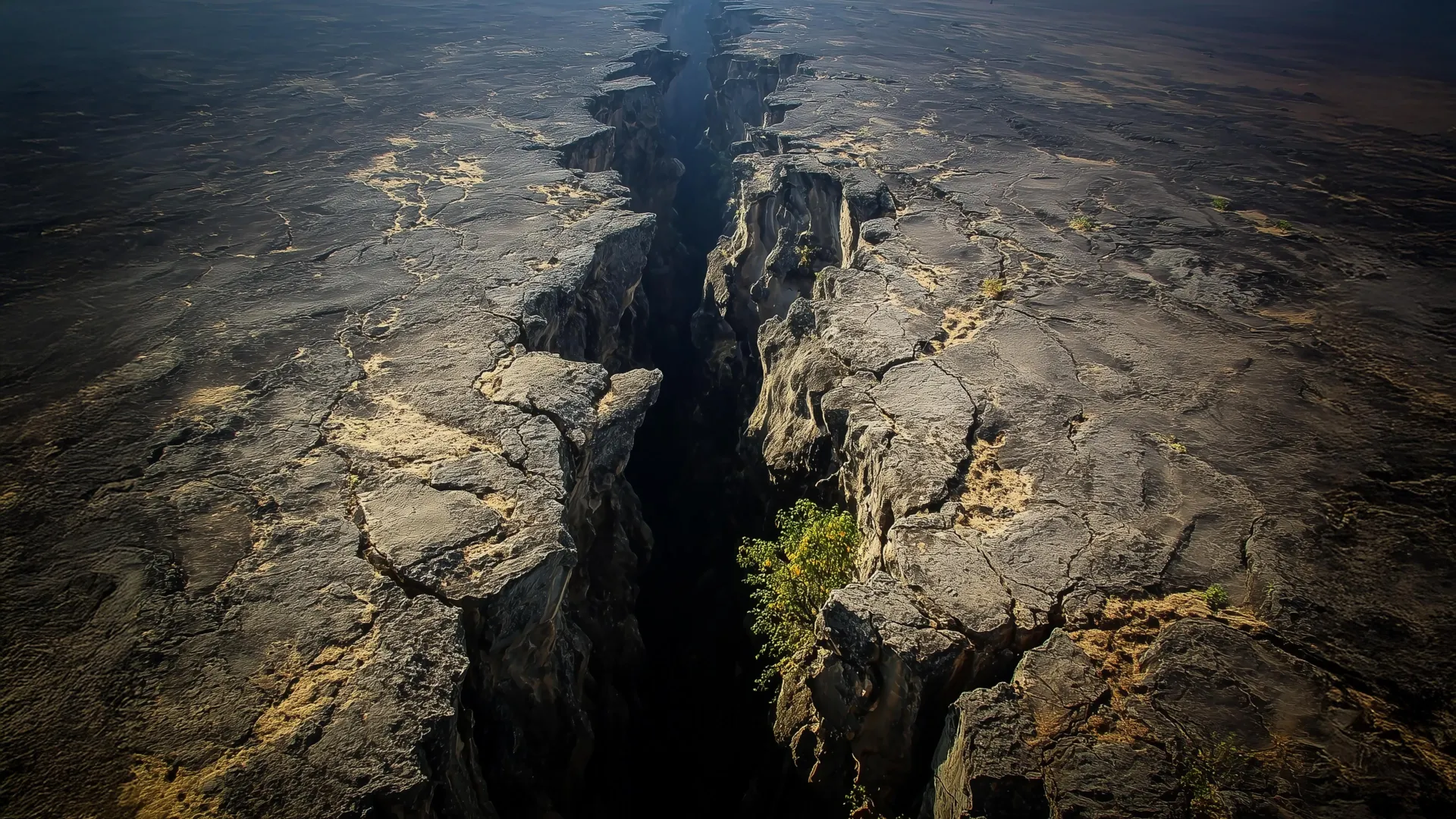
Continental rifting, the process by which Earth’s rigid outer shell, known as the lithosphere, begins to stretch and thin, represents a fundamental stage in the planet’s tectonic cycle, ultimately leading to the formation of new ocean basins. The lithosphere encompasses the Earth’s crust and the uppermost, brittle part of the mantle. As this outer shell is subjected to immense tensile stress, its behavior can vary dramatically depending on factors such as the rate at which the stress is applied and the depth within the lithosphere. Near the surface, where temperatures are lower and rocks are more brittle, the lithosphere tends to fracture, producing visible faults and generating earthquakes. Deeper down, however, where temperatures are higher and pressures are greater, the material becomes more ductile and can deform more gradually, flowing rather than breaking.
Geophysicist D. Sarah Stamps, an associate professor in the Department of Geosciences at Virginia Tech, eloquently likens these contrasting behaviors to the properties of Silly Putty. "If you hit Silly Putty with a hammer, it can actually crack and break," Stamps explains, illustrating brittle failure. "But if you slowly pull it apart, the Silly Putty stretches." This analogy perfectly captures how Earth’s lithosphere, on different time scales and under varying conditions, can exhibit both brittle and ductile deformation. Understanding these rheological properties is crucial for deciphering the mechanics of continental rifting.
In the vast majority of continental rifts observed globally, the pattern of deformation tends to follow a relatively predictable trajectory. The strongest and most pronounced movement typically occurs perpendicular to the rift axis, reflecting the primary direction in which the crust is being pulled apart. This "rift-perpendicular" extension is the expected signature of tensional forces. However, the East African Rift System (EARS), which stands as the largest continental rift system on Earth and a unparalleled natural laboratory for studying continental breakup, presents a more intricate picture. While the EARS certainly exhibits the anticipated rift-perpendicular deformation, Stamps, through over 12 years of meticulous GPS measurements, uncovered an additional, perplexing phenomenon: significant parts of the region were also deforming in a direction parallel to the rift itself. This unexpected, "rift-parallel" motion became a central and enduring mystery for her team at the Geodesy and Tectonophysics Lab.
A Giant Superplume Beneath Africa: The Deep Earth Connection
To unravel this enigma, the research team embarked on an intensive investigation, culminating in a study published in the prestigious Journal of Geophysical Research. The core of their approach involved the application of sophisticated 3D thermomechanical models, designed to simulate the complex interactions within Earth’s interior and their surface expressions. The development of this cutting-edge modeling framework was spearheaded by first author Tahiry Rajaonarison, currently a postdoctoral researcher at New Mexico Tech, who completed his Ph.D. at Virginia Tech under Stamps’ guidance.
The simulations yielded compelling results, indicating a direct linkage between the observed rift-parallel motion and the northward flow of mantle material associated with the colossal African Superplume. The African Superplume is not merely a localized hot spot; it is an enormous, deep-seated zone of rising mantle material that originates from the deepest reaches of the lower mantle, near the core-mantle boundary, beneath southwest Africa. From this profound depth, it ascends and extends northeastward across the African continent, progressively becoming shallower as it travels beneath the surface. This immense upwelling profoundly influences the thermal and mechanical state of the overlying lithosphere. According to the intricate models developed by Rajaonarison and Stamps, this deep mantle flow provides a robust explanation for the anomalous deformation that deviates from the simpler pattern expected solely from a continent being passively stretched apart.
Two Forces May Be Shaping the Rift: A Long-Standing Debate Refined
These new findings also inject crucial evidence into a long-running and vigorous scientific debate concerning the fundamental driving forces behind the East African Rift System. For decades, scientists have generally focused on two primary, and often competing, hypotheses: lithospheric buoyancy forces, mantle traction forces, or, more recently, some intricate combination of the two.
Lithospheric buoyancy forces are phenomena that act relatively close to the Earth’s surface, within the lithosphere itself. They are primarily influenced by differences in elevation and density within the crust and uppermost mantle. A prominent example in East Africa is the African Superswell, a vast region characterized by unusually high topography and elevated heat flow, which creates significant gravitational potential energy differences. These differences can induce lateral forces that drive extension and uplift.
In contrast, mantle traction forces originate much deeper within Earth’s interior. These forces are the direct result of the convective movement of hot, viscous mantle material beneath the lithosphere. As the mantle flows, it exerts a "drag" or "traction" on the rigid tectonic plate above it, effectively pulling or pushing the plate along. The African Superplume, with its immense northward flow, is a prime candidate for generating significant mantle traction forces beneath the EARS.
Stamps’ journey to document the unusual rift-parallel motion began early in her career as a postdoctoral researcher. Her methodology relied on a network of high-precision GPS stations, which continuously receive signals from a constellation of over 30 satellites orbiting Earth at an altitude of approximately 25,000 kilometers. These sophisticated measurements provided an astonishing level of accuracy, capable of tracking surface motion at the millimeter scale over years. Her meticulous observations significantly complicated the prevailing understanding of the EARS, primarily because while shallow buoyancy forces could adequately explain much of the expected perpendicular motion across the rift, they utterly failed to account for the mysterious movement running parallel to it. This discrepancy highlighted the need for a deeper, more comprehensive explanation.
Earlier Models Pointed to a Combination: Building on Previous Work
The scientific process is often iterative, with new discoveries building upon previous insights. In a 2021 study, the same research team had utilized 3D computational simulations to explore how the two sets of forces – lithospheric buoyancy and mantle traction – might interact. Those earlier models suggested that both types of forces could indeed be important in shaping the EARS. Specifically, the models indicated that lithospheric buoyancy forces appeared to be the dominant mechanism responsible for the more familiar deformation occurring perpendicular to the rift. However, crucially, these models were unable to reproduce the anomalous deformation that Stamps had precisely measured running parallel to the rift. This left researchers with a clear mandate: to search for an additional, as-yet-unidentified mechanism capable of explaining the parallel motion.
This is where Rajaonarison’s newer study, building directly on the foundations laid by the previous work, made its pivotal contribution. This time, his 3D thermomechanical modeling was meticulously focused on isolating and explaining the previously unaccounted-for rift-parallel deformation. The results were striking: the models demonstrated unequivocally that the northward mantle flow directly associated with the African Superplume could generate precisely the observed anomalous motion. Furthermore, the models successfully reproduced another critical independent observation beneath the rift: a distinct pattern of rift-parallel seismic anisotropy.
What Seismic Anisotropy Reveals: A Crucial Independent Verification
Seismic anisotropy is a fundamental geophysical phenomenon where seismic waves, generated by earthquakes or controlled sources, travel at different speeds depending on the direction they propagate through rock. This directional dependence arises when minerals and rock structures within the Earth’s interior become preferentially aligned. Such alignment can be produced by various geological processes, including the ductile flow of mantle material, the presence of aligned pockets of melt, or the inheritance of older structural fabrics within the lithosphere.
In the context of the East African Rift, the observed orientation of the anisotropic rock structures beneath the rift directly matches the predicted direction of the African Superplume’s northward mantle flow. This remarkable agreement between independent observations (surface deformation, seismic wave propagation) and theoretical modeling provides an exceptionally strong piece of evidence. It robustly corroborates the hypothesis that deep mantle movement, specifically the northward surge of the African Superplume, is exerting a profound influence on the unusual deformation observed at the surface.
As Rajaonarison articulates, "We are saying that the mantle flow is not driving the east-west, rift-perpendicular direction of some of the deformations, but that it may be causing the anomalous northward deformation parallel to the rift." He further emphasizes, "We confirmed previous ideas that lithospheric buoyancy forces are driving the rift, but we’re bringing new insight that anomalous deformation can happen in East Africa." This statement succinctly captures the dual-mechanism model proposed by the research.
A More Complex Picture of Continental Breakup: Global Implications
When taken together, these comprehensive studies paint a more intricate and sophisticated picture of continental breakup, suggesting that no single force is solely responsible for the myriad geological processes unfolding within the East African Rift System. Shallower lithospheric buoyancy forces appear to play a dominant role in the more typical, perpendicular stretching of the rift, driven by gravitational potential energy. Concurrently, deeper mantle flow associated with the African Superplume is identified as the primary culprit for the unusual northward deformation, and its distinctive seismic signature beneath the surface.
Understanding how these distinct yet interconnected forces interact is of paramount importance, not just for regional geology but for the broader field of Earth sciences. The East African Rift System serves as an unparalleled natural laboratory, offering scientists a unique opportunity to directly observe and study the incipient stages of how continents begin to tear apart. Researchers have dedicated decades to meticulously unraveling the full chain of processes involved in continental rifting, from the deep-seated motions within the mantle to the visible cracking and seismic activity at the Earth’s surface.
"We’re excited about this result from Dr. Rajaonarison’s numerical modeling because it provides new information about the complex processes that shape the Earth’s surface through continental rifting," Stamps concludes, underscoring the significance of this work. This research not only resolves a long-standing mystery within the EARS but also refines our fundamental understanding of plate tectonics, offering critical insights into the dynamic forces that continuously reshape our planet’s continents and ocean basins. The revelation of the African Superplume’s direct influence on surface deformation highlights the profound connections between Earth’s deep interior and its dynamic, ever-changing surface.
