
 By admin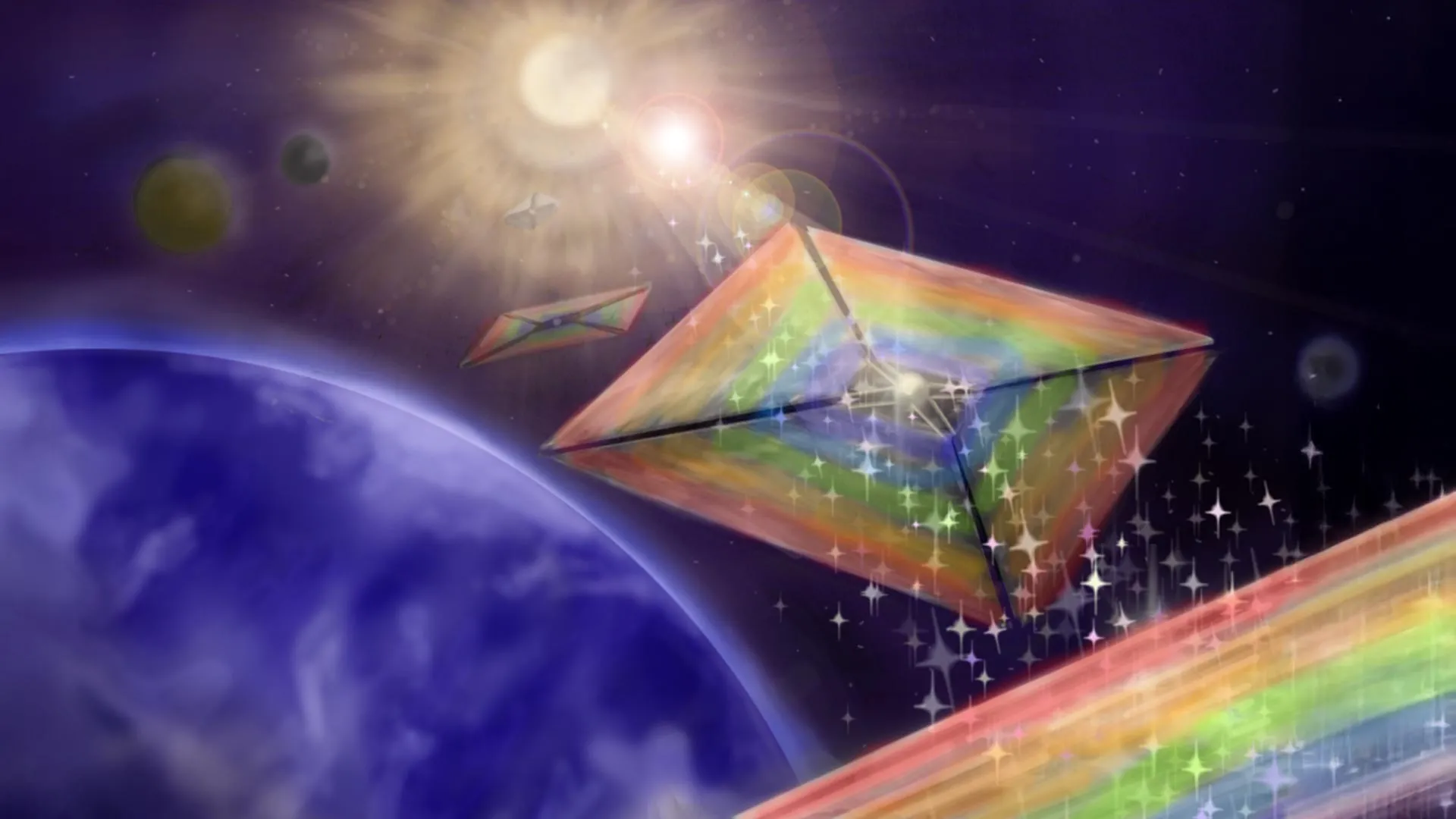
One of the most promising and widely discussed solutions to this propulsion paradox is the solar sail, or more specifically, the lightsail. This concept involves a large, ultrathin, and highly reflective structure designed to be pushed by light, leveraging the minuscule but constant momentum imparted by photons. While the Sun’s light pressure is sufficient for interplanetary travel (as demonstrated by missions like IKAROS and LightSail 2), achieving interstellar velocities – speeds approaching a significant fraction of the speed of light – demands an external, much more powerful source of photons. This is where the concept of laser-driven lightsails emerges as a leading contender, famously championed by initiatives like Breakthrough Starshot, which envisions fleets of gram-scale probes accelerated by ground-based laser arrays. If extremely powerful lasers, potentially operating in the terawatt to petawatt range, are precisely aimed at such a sail, they could theoretically accelerate it to speeds well beyond what current chemical or even advanced ion propulsion systems can achieve, making a journey to Alpha Centauri feasible within decades rather than millennia.
However, the journey to the stars is fraught with unforeseen complexities, and even the elegant simplicity of light propulsion may harbor hidden obstacles. A recent paper, published on arXiv by researchers Chao Shen and Jiaze Li of the Harbin Institute of Technology, introduces a profound and unexpected challenge: the very light designed to propel a lightsail could, at relativistic velocities, begin to produce a drag effect. This groundbreaking theoretical work delves into the intricate relativistic dynamics of light-sail interaction, revealing limitations that could significantly impact the design and operational parameters of future interstellar probes.
How Light Pushes a Solar Sail: A Deeper Dive
To understand Shen and Li’s findings, it’s crucial to first grasp the fundamental mechanisms by which light exerts force on a sail. The researchers meticulously categorize the forces produced by photons striking a solar sail into three distinct contributions, each with varying degrees of efficiency in imparting forward momentum.
-
Incident Light (Raw Momentum Transfer): This is the most direct and dominant form of propulsion. When photons from the laser beam directly strike the sail, they transfer their momentum. Each photon carries momentum, $p = h/lambda$, where $h$ is Planck’s constant and $lambda$ is its wavelength. Upon impact, this momentum is transferred to the sail, pushing it forward. For a perfectly absorbing surface, the force is proportional to the incident power divided by the speed of light ($P/c$). This represents the initial "kick" received by the sail.
-
Specular Reflection (Efficient Momentum Doubling): This is where the efficiency of a highly reflective sail truly shines. When photons bounce perfectly off the sail’s surface, their direction of momentum is reversed. According to the principle of conservation of momentum, the change in the photon’s momentum vector results in an equal and opposite momentum transfer to the sail. For perfectly specular reflection, the momentum transferred is effectively doubled compared to absorption, leading to a force of $2P/c$. This is why interstellar sails are envisioned as highly polished, mirror-like structures, designed to maximize reflection and minimize absorption. The quality of the reflective coating, often composed of dielectric stacks, is paramount for optimizing this effect.
-
Diffuse Scattering (Inefficient Re-emission): This component arises from imperfections in the sail material. Not all photons are perfectly reflected; some are absorbed by the sail material and then re-emitted in random directions as thermal radiation or scattered light. This process is less efficient because the re-emitted photons do not all contribute to forward thrust. Instead, their random directions result in a net momentum transfer that is significantly weaker and less directed than specular reflection. Furthermore, the absorbed energy contributes to heating the sail, which introduces thermal management challenges. At relatively low speeds, such as those experienced by interplanetary solar sails or during the initial acceleration phase of a lightsail, all three of these effects—incident light, specular reflection, and even diffuse scattering—contribute positively to pushing the sail forward. The cumulative effect is a continuous acceleration as long as the laser beam remains focused on the sail. However, the situation becomes dramatically more complicated, and indeed counterintuitive, once the spacecraft reaches relativistic velocities, meaning speeds that are a significant fraction of the speed of light.
The Doppler Effect Weakens the Push: A Relativistic Reality Check
As the lightsail accelerates and races away from its terrestrial laser source, the very nature of the light reaching it begins to change due to the relativistic Doppler effect. This phenomenon, familiar from sound waves (e.g., the changing pitch of a siren as it moves past), applies equally to light. As the sail recedes at ever-increasing speeds, the light waves stretching between the source and the sail are "stretched out" from the perspective of the sail.
This stretching manifests as a decrease in the frequency of the incoming light and a corresponding increase in its wavelength—a phenomenon known as redshift. Since the energy of a photon is directly proportional to its frequency ($E = hf$) and its momentum is inversely proportional to its wavelength ($p = h/lambda$), a decrease in frequency means that each incoming photon carries less energy and less momentum. Consequently, the amount of thrust produced by all three components—incident light, specular reflection, and diffuse scattering—progressively diminishes.
Imagine the laser beam as a continuous stream of momentum "packets." As the sail moves faster, it encounters fewer packets per unit of time from its own frame of reference, and each packet it does encounter has less momentum to impart. As a result, continued acceleration becomes progressively less efficient. The faster the sail travels, the harder it becomes for the laser to maintain its rate of acceleration, let alone increase its speed. This is not merely a problem of reaching a maximum velocity; it’s a problem of diminishing returns on the energy invested in the laser beam. The efficiency of converting laser power into kinetic energy of the sail drops substantially, requiring increasingly powerful and precise laser pulses to achieve smaller and smaller gains in velocity. This inherent relativistic limitation is distinct from the fuel mass problem of chemical rockets, representing a unique challenge for light-based propulsion.
When Scattered Light Starts Creating Drag: The Counterintuitive Twist
While the Doppler effect reduces overall thrust efficiency, the situation changes even more dramatically once the lightsail reaches a critical velocity, approximately 75% of the speed of light (0.75c). At this extreme speed, another relativistic phenomenon, known as relativistic light aberration, becomes profoundly important and introduces a counterintuitive drag effect.
Relativistic light aberration is an effect where the apparent direction of light changes for an observer in motion relative to the source. A common analogy involves rain: if you stand still in vertical rain, the drops appear to fall straight down. If you run, the rain appears to come from ahead of you. Similarly, from the viewpoint of a stationary observer on Earth, light diffusely scattered from the moving sail begins to be directed forward, toward the direction in which the sail is traveling.
Here’s why this is problematic: According to Newton’s Third Law of Motion, every action has an equal and opposite reaction. If the sail is emitting scattered photons predominantly in the forward direction (relative to its motion in the lab frame), it must experience a recoil force in the opposite direction. This means that diffuse scattering—admittedly the weakest of the three primary forces—begins to act as a drag force once the sail passes roughly 75% of the speed of light. The momentum carried away by these forward-directed scattered photons effectively pushes the sail backward, reducing its net forward acceleration.
It is crucial to note that the laser is still pushing the sail forward overall. The forces from incident light and specular reflection, though weakened by the Doppler effect, still provide a net positive thrust. Therefore, the total force on the sail does not become negative, meaning it won’t start decelerating. However, the introduction of diffuse scattering as a drag component means that the efficiency of the propulsion system drops substantially. It becomes significantly harder to extract further acceleration from the laser beam. This threshold of 0.75c represents a significant speed bump, beyond which the relativistic dynamics fundamentally alter the performance characteristics of the lightsail. It implies that while interstellar travel might be possible, reaching ultra-relativistic speeds (e.g., 0.99c) might require entirely different strategies or face even more severe efficiency penalties than previously anticipated.
Real Solar Sails Would Face Even More Challenges: Bridging Theory and Engineering
Shen and Li’s study, while foundational, focuses specifically on radiative dynamics, simplifying many real-world complexities. A truly operational interstellar solar sail would face numerous additional challenges that were deliberately excluded for the sake of clarity in this theoretical model.
-
Non-Radiative Effects and the Interstellar Medium: The vacuum of space is not perfectly empty. The interstellar medium (ISM) consists of extremely dilute gas (primarily hydrogen and helium atoms), dust grains, plasma, and cosmic rays.
- Drag from Collisions: Even at low densities, collisions with interstellar gas and dust at relativistic speeds would generate significant drag. A gram-scale probe traveling at 0.2c would encounter roughly 10^16 atoms per square meter per second, leading to erosion and potentially catastrophic damage over light-year distances.
- Radiation Damage: High-energy cosmic rays and interstellar plasma could damage the sail material and onboard electronics, necessitating robust shielding.
- Magnetic Fields: Interaction with interstellar magnetic fields could induce forces and torques, affecting trajectory stability.
-
Thermal Limits of Real Sail Materials: The immense power required from the laser array (potentially terawatts to petawatts for a Breakthrough Starshot-like mission) translates into an enormous energy flux striking the sail.
- Overheating and Melting: Even a highly reflective sail will absorb a fraction of the incident energy. This absorbed energy must be radiated away as heat. Current theoretical sail materials, like those based on graphene or advanced dielectrics, would need to withstand temperatures potentially reaching thousands of Kelvin without deforming, melting, or losing their reflective properties.
- Thermal Management: Designing materials that can efficiently radiate heat into space while maintaining structural integrity under extreme stress and temperatures is a major engineering hurdle. This often involves very specific emissivity properties and structural designs to prevent thermal runaway.
-
Idealized Mirror vs. Sophisticated Materials: For simplicity, the researchers modeled the lightsail as an idealized mirror with uniform properties. Real spacecraft would undoubtedly utilize much more sophisticated materials.
- Advanced Metamaterials and Photonic Crystals: Engineers are actively investigating advanced materials such as metamaterials and photonic crystals. These materials are engineered at the nanoscale to exhibit properties not found in nature, allowing precise control over light interaction. They can be designed for specific laser wavelengths, potentially optimizing reflection and minimizing absorption far beyond conventional mirrors.
- Mitigating Aberration Effects: Intriguingly, these advanced materials might even be engineered to take advantage of the aberration effects described in the study. For instance, by designing the material to have angle-dependent reflectivity or phase-shifting properties, a lightsail could theoretically auto-correct its orientation and stabilize its trajectory. Such "smart sails" could dynamically adjust their optical properties to remain centered within the laser beam despite the relativistic changes in apparent light direction, maximizing thrust and minimizing drag from misdirected scattering. This is an exciting avenue for future research and material development.
The Long Road to Interstellar Flight: A Grand Endeavor
A fully operational interstellar solar sail, capable of transporting even a minuscule probe to another star, is still decades, if not centuries, away from becoming a reality. The challenges extend beyond propulsion and material science. Traveling across interstellar distances introduces a myriad of additional complications:
- Curvature of Spacetime: While the paper simplifies out general relativistic effects like the curvature of spacetime, these would become relevant for precise navigation over such vast distances, especially if the probe were to pass near massive objects.
- Beam Propagation and Focusing: Maintaining a tightly focused laser beam over light-year distances, countering atmospheric distortion and diffraction, requires laser array technologies orders of magnitude more powerful and precise than anything currently conceived.
- Miniaturization: The payload must be extremely light, likely gram-scale, necessitating unprecedented levels of miniaturization for cameras, sensors, power sources, and communication equipment.
- Autonomous Navigation and Communication: Probes would need to navigate autonomously and communicate across light-year distances, with signal travel times measured in years.
- Targeting and Deceleration: Upon arrival, the probe would need to navigate the target star system and potentially decelerate, perhaps using a secondary laser array or a magnetic sail for braking, to conduct observations.
Even so, understanding these high-speed relativistic effects, as illuminated by Shen and Li’s paper, is an absolutely critical part of determining how such spacecraft might eventually work. Theoretical work like this is foundational; it identifies potential pitfalls and fundamental limits early in the conceptual design phase, allowing physicists and engineers to devise innovative solutions before committing to expensive and time-consuming practical implementations. The vision of sending a probe to another star, a monumental achievement for humanity, hinges on a detailed and comprehensive understanding of every force, every interaction, and every relativistic nuance that could affect its epic journey. The road is long and arduous, but the scientific insights gained along the way are invaluable steps toward realizing our interstellar dreams.
