
 By admin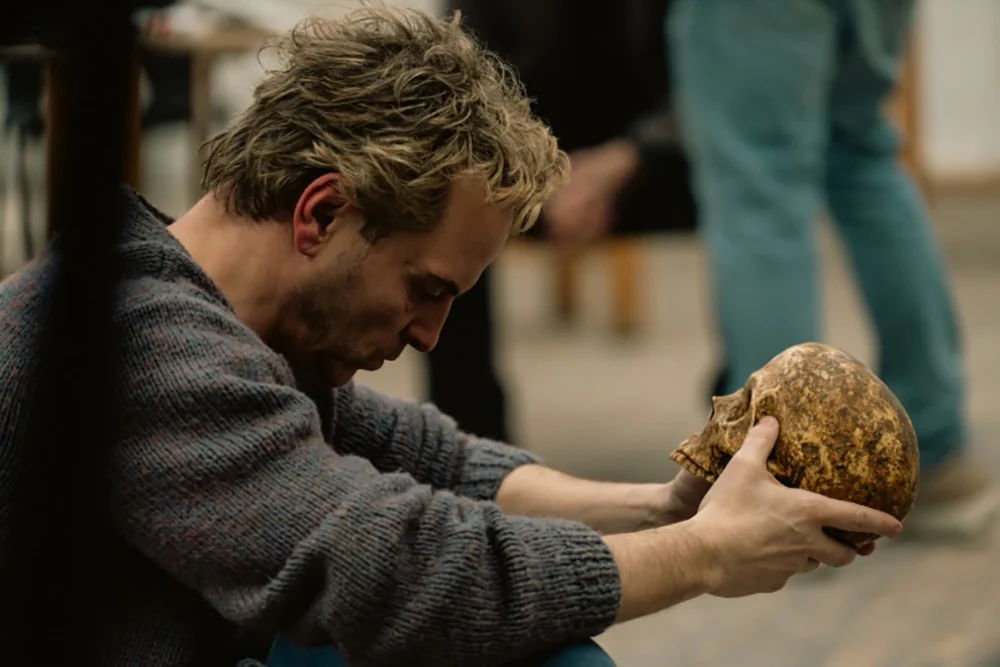
In 1989, a London production of Shakespeare’s "Hamlet," fittingly titled "Elsinore" after the Danish castle, commenced at the prestigious National Theatre. However, the drama unfolding behind the scenes, observed through the jaded, often amused eyes of the backstage technicians, proved as compelling, if not more so, than the Bard’s tragic tale. The palpable boredom of the crew was violently disrupted when the actor portraying the Ghost of Hamlet’s father, a doddering figure, repeatedly faltered, forgetting his lines. This onstage chaos escalated dramatically when the actor embodying the tormented Prince of Denmark, a fiery young talent named Daniel Day-Lewis, reached his breaking point. In a moment that would become one of his earliest widely recognized "extreme" acts, he stalked off the stage mid-performance, never to return to the production. This incident initially suggested "Elsinore" might be a peculiar theatrical biopic focusing on a young Daniel Day-Lewis. While he is indeed a presence, the film’s true subject is far more nuanced and poignant.
The narrative pivots to Ian Charleson, portrayed with remarkable depth by Andrew Scott. In 1989, Charleson was a distinguished and well-regarded British actor, having achieved significant acclaim eight years prior as Eric Liddell, the devout Scottish Christian runner in the Oscar-winning best picture, "Chariots of Fire." Liddell’s story, a testament to faith and athletic prowess, propelled Charleson, with his blond, somewhat severe handsomeness, into the spotlight. As "Elsinore" opens, the film establishes that Charleson has been endeavoring to capitalize on this early success.
However, the somber reality Charleson faced at the age of 39 was that his star had begun to fade. His foray into Hollywood had not yielded the anticipated breakthroughs, and wherever he went, the specter of "Chariots of Fire" loomed large, a role that, in the context of the film, had become a somewhat ironic burden and a recurring joke. The film’s enduring appeal, and Charleson’s most indelible association with it, was largely attributed to Vangelis’s iconic, soaring synthesizer score. This is humorously underscored when a taxi driver spontaneously bursts into song from the soundtrack, much to Charleson’s chagrin. While "Chariots of Fire" was a decent film, its critical reception and its status as a best picture winner are subtly questioned within the narrative, suggesting that stripped of its evocative music, it was a rather earnest, stiff-upper-lip period sports drama.
Charleson, once a fleeting heartthrob, now sported a distinctive two-tone frosted hairstyle, reminiscent of George Michael or perhaps Daniel Day-Lewis’s look in "My Beautiful Laundrette." His demeanor, characterized by a delicate, almost abashed quality, hinted at the internal struggles of a gay actor attempting to navigate a predominantly heterosexual entertainment industry. While Charleson lived a vibrant gay life in London’s pubs and discos, he consciously kept this aspect of his identity private, aware of the potential professional repercussions. He was still striving to maintain a "straight" public image in an industry that, at the time, offered limited acceptance for openly gay performers. His early career included a role in Derek Jarman’s transgressive 1978 film "Jubilee." Jarman, portrayed with "whiplash ferocity" by David Dawson, is depicted as deeply resentful of Charleson’s apparent erasure of this collaboration from his resume, highlighting the complex relationship between artistic integrity and professional expediency.
The compelling reason for "Elsinore" to focus on Ian Charleson’s life story lies in a pivotal event that occurred in 1989. The film reveals that Charleson had received a diagnosis of HIV. At this juncture, the virus had not yet progressed to full-blown AIDS for him, and he had opted against taking AZT, which he viewed as an ineffective chemotherapy drug. His daily routine included meticulous self-examinations with a hand mirror, searching for any signs of Kaposi’s sarcoma lesions, a visible marker of the disease’s progression. One fateful morning, while preparing for a film shoot and sitting in the makeup chair, he discovered a small, tell-tale purple blotch on his right temple. This discovery, he believed, was a harbinger of his imminent death, a death sentence. However, fate, or "karma" as the text suggests, had a different trajectory in mind.
With Daniel Day-Lewis’s abrupt departure from the "Hamlet" production, the director, Richard Eyre (played by Johnny Flynn), sought a replacement for the titular role. His gaze fell upon Ian Charleson. Charleson had previously essayed the Prince of Denmark in 1974, at the young age of 25, a period he himself acknowledged as being too early for such a demanding part. Now, however, he felt ready to confront the role of a lifetime. The central question posed by the film is whether he could undertake this monumental task while grappling with a terminal illness.
The film’s stark portrayal of AIDS in 1989 as a death sentence is particularly resonant. "Elsinore" is presented as one of the first films in recent memory to transport viewers back to that deeply tragic and haunted era. Yet, acknowledging the significant advancements in treatment and the shift in societal understanding, the film avoids becoming an overtly raw, confrontational AIDS drama in the vein of "Longtime Companion." Instead, written by Stephen Beresford and directed by Simon Stone, "Elsinore" possesses a profound emotional and intellectual depth that speaks volumes about the era and its devastating impact.
At its core, "Elsinore" delves into the shock and trauma inflicted by the AIDS epidemic. It examines the subculture of gay actors who felt compelled to conceal their identities, not out of personal shame, but as a matter of professional survival. The film further explores the immense passion and "extraordinary heavy lifting" required to perform one of Shakespeare’s most profound and daunting plays. Ultimately, these elements converge in the quietly heroic figure of Ian Charleson. At a time when he should have been prioritizing his health and avoiding any potential weakening of his body, especially by undertaking the physically and mentally demanding role of Hamlet – a role encompassing 4,167 lines of dialogue, to be delivered nightly to an audience of 1,100 on the hallowed Olivier stage of the National Theatre – he made the audacious decision to accept the challenge. He did so not only because it represented the chance of a lifetime but, more profoundly, as an act of living. He embraced the incandescent "life" of the theater as a potent means of warding off death. Paradoxically, his pursuit of "Hamlet" might also be interpreted as an embrace of death itself, given the play’s pervasive themes of mortality.
Andrew Scott’s performance as Ian Charleson is described as "astonishingly layered and moving," an accurate reflection given his remarkable physical resemblance to the actor he portrays. Scott embodies a man deeply in love with life – the life of a British celebrity, an adventurous spirit, and an artist driven by ambition. Yet, the ever-present specter of AIDS hangs over him, a metaphorical Sword of Damocles. As the visible signs of the disease begin to manifest, the film effectively conveys how this awareness colors his mood, with his innate ebullience struggling against an encroaching despair. This internal battle is vividly depicted within the clinical setting of Dr. Margaret Johnson (played by Olivia Colman), a physician specializing in AIDS treatment who believes she can extend his life. Dr. Johnson, however, is a proponent of strict medical adherence, and the notion of Ian undertaking the role of Hamlet is, in her professional judgment, the antithesis of what he should be doing.
This is not a conflict characterized by quaint disagreement. Dr. Johnson is unequivocally focused on preserving Ian’s life, while he adamantly declares, "Fuck that. I don’t care." The tender power of "Elsinore" lies in Scott’s ability to transport the audience directly into Charleson’s state of mind. His conviction is that the remaining time in his life must possess profound meaning, and he believes playing Hamlet will imbue it with that significance. Colman, sporting a rather unkempt auburn wig, delivers a "crisply delectable" performance as an antagonist who, at her core, is undeniably on Ian’s side. However, it is the eventual melting of this antagonism into a hard-won communion between Ian and Derek Jarman that proves most moving. Their relationship transcends their shared struggle with AIDS and speaks to the impossible predicament these men face: how to remain true to their artistic callings and their authentic selves amidst overwhelming prejudice and the shadow of a devastating illness. By the film’s conclusion, Ian has achieved this very goal. He has utilized the role of Hamlet to confront death head-on and to lay bare his innermost soul on the stage. "Elsinore," structured as an art-house crowd-pleaser, faces a steeper challenge in today’s cinematic landscape than it might have a few decades ago. Nevertheless, Andrew Scott’s performance transforms it into an indelible and profoundly affecting journey.
