
 By admin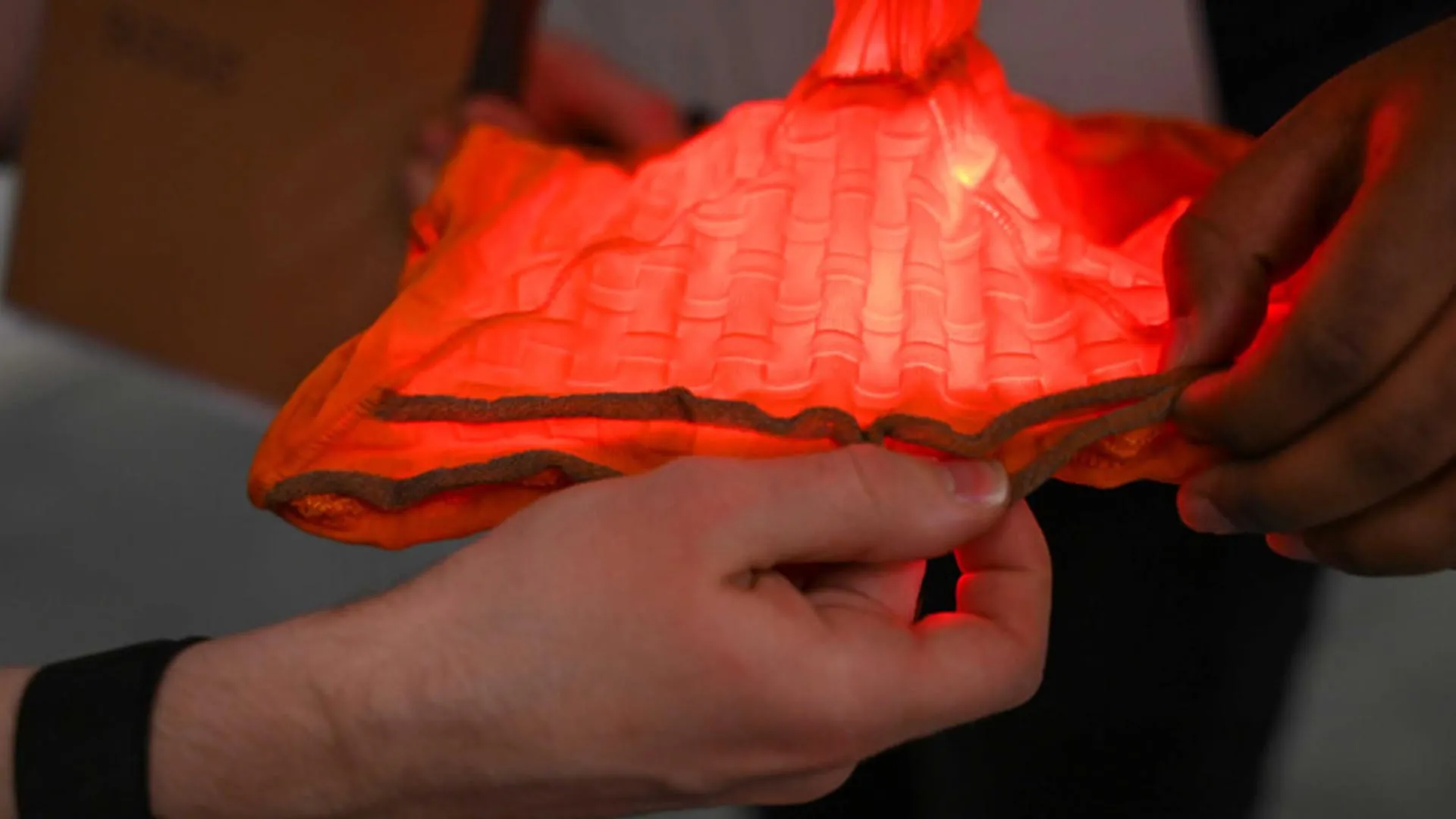
The team at Harvard SEAS has achieved a remarkable feat: they developed specialized, machine-knitted fabrics engineered to "snap" from one stable shape to another. This inherent ability to maintain multiple distinct configurations is a concept physicists refer to as "multistability." Imagine a material that, like a light switch, can reside in an "on" state or an "off" state, or perhaps several intermediate positions, each held firmly until an external force prompts a transition. Applying this principle to soft, flexible textiles opens up unprecedented possibilities for adaptive garments, responsive environments, and novel human-computer interfaces.
Leading this pioneering research was Kausalya Mahadevan, a recent Ph.D. graduate who is now a postdoctoral associate in the esteemed lab of Katia Bertoldi, the William and Ami Kuan Danoff Professor of Applied Mechanics. Their seminal findings, which blend the ancient art of textile creation with cutting-edge physics and engineering, were published in the prestigious journal Advanced Functional Materials, signaling a significant advancement in the field of smart materials. The work not only pushes the boundaries of textile engineering but also bridges the gap between traditional craftsmanship and the sophisticated world of mechanical metamaterials.
Bringing Physics Into Knitted Textiles: A Fusion of Art and Science
The genesis of this innovation lies in a unique convergence of inspiration and rigorous scientific inquiry. Mahadevan, whose journey in Bertoldi’s lab began during her undergraduate studies, articulated her long-standing fascination with fabrics and textiles. "I’ve always been excited about fabrics and textiles, and what we can engineer and build with them," she noted. Her vision for embedding advanced functionalities into these ubiquitous materials was deeply informed by an appreciation for the artistic side of textile creation. "Our ideas around multistability in textiles arose from being inspired by textile artists and how they approach structures, combined with how [Bertoldi’s] lab has traditionally thought about nonlinear mechanics in solids. We tried to approach thinking about textiles in that context."
This interdisciplinary approach is crucial. Textile artists, through generations of experimentation, have intuitively understood how to manipulate yarn and stitch patterns to create structures with specific drape, texture, and inherent form. The Bertoldi lab, on the other hand, specializes in the intricate world of nonlinear mechanics, particularly in the design of materials that exhibit complex mechanical behaviors, such as buckling, snapping, and shape-shifting under specific loads. By consciously merging the intuitive knowledge of textile artistry with the precise, predictive power of nonlinear mechanics, the researchers unlocked a new paradigm for textile design.
Traditionally, materials engineered to curve and maintain a specific form often rely on methods like molding polymers, where residual stresses are carefully controlled within the material’s structure. This process typically yields rigid or semi-rigid components. However, Mahadevan and her colleagues demonstrated that weft knitting—the very same industrial method commonly employed to mass-produce everyday items like hats, gloves, and socks—can be used to create intricate, curved structures using nothing more than yarn. This distinction is vital; it means the resulting smart textiles retain the inherent flexibility, breathability, and conformability characteristic of knitted fabrics, a significant advantage over rigid or stiff smart material counterparts.
The meticulous methodology involved selecting highly elastic yarns, which provide the necessary resilience and spring-back properties. Crucially, they employed a knitting technique called plating. Plating involves feeding two different yarns simultaneously, positioning them on opposite faces of the textile. This creates a fabric with distinct properties on each side, often leading to an inherent curvature or bias. In this case, the combination of elastic yarns and the plating method produced dense, thick fabrics that naturally curl into specific three-dimensional forms. The underlying physics of this phenomenon is surprisingly familiar; it relies on the same basic behavior that causes the bottom edge of a cut T-shirt, especially after washing, to spontaneously curl upward. This seemingly simple everyday observation, when understood and engineered, becomes a powerful tool.
Mahadevan emphasized the precision required in this stage: "The yarn selection and machine parameter choices allowed us to basically select a fabric that is going to be as snappy as we can possibly get." This statement highlights the scientific rigor involved – it wasn’t just about making any fabric curl, but about optimizing the material properties and knitting parameters to achieve the desired degree of "snappiness" and robust multistability. The choice of industrial knitting machines, rather than bespoke lab-scale setups, further underscores the practicality and potential for scalability of their approach from the outset.
Fabrics That Snap Between Stable Shapes: Engineering Multistability
The true innovation emerged when the researchers began to systematically arrange horizontal and vertical stripes of these specially designed yarns. By precisely controlling the patterns and densities of these curling elements within the fabric, they were able to create textiles that could reliably snap between different configurations and, critically, remain stable in each one. This behavior is precisely what defines multistability and evokes the simple, yet profound, analogy of a light switch: it either stays "on" or "off" until deliberately actuated, holding its state without continuous energy input.
Understanding and predicting this snap-through behavior was paramount. The team meticulously studied how the fabric’s geometry (e.g., stripe width, pattern repetition) and material properties (e.g., yarn elasticity, plating ratio) influenced the transitions. Through this detailed analysis, they were able to determine the precise physical conditions that allow knitted textiles to become multistable. This foundational understanding is critical for future design and engineering of such materials. Moreover, a significant computational achievement was their ability to successfully simulate this complex behavior. Rather than attempting the computationally intensive task of modeling every individual strand of yarn—a common challenge in textile simulation—they treated each textile as a continuous material. This simplified, yet accurate, modeling approach significantly reduces computational load and provides a robust framework for predicting the behavior of future designs, accelerating the development cycle for programmable textiles.
Integrating Intelligence: Conductive Yarns and Soft Switches
The research moved beyond purely mechanical functionality by demonstrating how these multistable textiles could be transformed into practical, intelligent devices. The researchers achieved this by ingeniously adding thin conductive yarns into the knitted structures. These specialized fibers, often incorporating metallic threads or carbon nanotubes, imparted electrical conductivity to the otherwise insulating fabric. The result was the creation of soft, stretchable electric switches that fundamentally change their electrical state when the fabric snaps from one mechanical configuration to another.
This integration of electrical functionality with mechanical multistability is a game-changer for smart textiles. Unlike traditional electronic components which are rigid, bulky, and often uncomfortable when integrated into clothing, these knitted switches are inherently flexible, conformable, and maintain the aesthetic and tactile qualities of fabric. This opens doors for truly wearable electronics that don’t feel alien to the body but rather become an intuitive extension of the garment itself. The mechanism is simple yet powerful: a change in the fabric’s physical shape directly translates into a change in its electrical properties, effectively creating a direct, tangible interface between the physical world and electronic control.
Real-World Demonstrations: Beyond the Lab
To vividly illustrate the practical potential of their innovation, the Harvard team developed several compelling prototypes:
-
The Interactive LED Shell: In one demonstration, they created a multistable knitted shell that could switch an LED light on and off. As the textile was manipulated to snap between its stable states, the integrated conductive yarns completed or broke a circuit, thereby controlling the light. This simple yet effective demonstration highlights the potential for interactive clothing or dynamic architectural elements that respond to user touch or environmental changes.
-
The Wearable Step Counter: Recognizing the growing demand for wearable health technologies, the team produced a wearable textile switch designed to be placed over a joint like a knee or an elbow. The snapping movement generated as the joint bends (e.g., during walking or running) was reliably detected by an Arduino microcontroller. This data could then be used to accurately count steps or monitor repetitive motions, offering a comfortable and unobtrusive alternative to rigid sensors for fitness tracking, rehabilitation, or sports performance analysis. The soft, breathable nature of the textile ensures user comfort, a crucial factor for long-term wearability.
-
The Reconfigurable Lampshade: Perhaps one of the most visually striking prototypes was a reconfigurable lamp shade. This innovative design incorporated three separate multistable switches, each controlling a different color of light. By stretching and snapping different portions of the fabric between configurations, users could dynamically change the lamp’s illumination color. This prototype, along with other examples from the project, was prominently featured in a recent Art Lab installation, underscoring the artistic and interactive possibilities inherent in these programmable textiles. It showcases how everyday objects can become dynamic, responsive, and aesthetically adaptable.
Paving the Way for Scalable Smart Textiles: A Vision for the Future
A cornerstone of this research’s immediate relevance and long-term impact lies in its manufacturing compatibility. Crucially, the machines employed by Mahadevan and her colleagues are not specialized, bespoke laboratory devices but are strikingly similar to the industrial knitting equipment already ubiquitous in garment factories worldwide. This direct compatibility with existing manufacturing infrastructure is a significant advantage. It suggests that devices and products based on this groundbreaking technique could potentially be scaled up for mass production relatively quickly and cost-effectively, bypassing the typical hurdles associated with novel material fabrication methods. This is a critical factor for bridging the gap between scientific discovery and widespread commercial adoption in the competitive smart textiles market.
From a purely scientific perspective, this work also brings textiles much closer to the rapidly evolving field of nonlinear mechanical metamaterials. Mechanical metamaterials are engineered structures designed at a micro or macro level to exhibit extraordinary mechanical properties not found in nature. These materials are specifically designed to bend, buckle, and snap in controlled, predictable ways to provide useful functions, such as impact absorption, cloaking from vibrations, or shape morphing. By demonstrating how knitted fabrics can be designed to exhibit controlled multistability, the Harvard research effectively positions textiles as a viable and highly promising platform for creating soft, conformable mechanical metamaterials. This opens new avenues for exploring complex mechanical functionalities in materials that are inherently flexible and scalable.
Mahadevan envisions a future where these multistable textiles become an integral part of our daily lives, offering a unique combination of softness, seamless construction, and advanced functionality. She sees additional opportunities for using multistability to create fabrics that could, for instance, quietly track body movement without the need for cumbersome external sensors. Imagine clothing that discreetly monitors posture, gait, or activity levels. Further possibilities include textiles that deliver tactile feedback—perhaps guiding users through haptic sensations or providing subtle alerts. The most transformative potential lies in fabrics that could dynamically change their physical shape when needed, adapting to different environments, user preferences, or functional requirements. This could manifest in adaptive clothing that adjusts insulation based on temperature, smart interiors that reconfigure based on occupancy, or even medical textiles that provide dynamic support or stimulation.
The research was generously supported by grants from the National Science Foundation (NSF grant DMR-2011754) and the Army Research Office (ARO MURI program W911NF-22-1-0219), highlighting the strategic importance of this foundational work for both civilian and defense applications. Furthermore, essential equipment was made possible through an Office of Naval Research (ONR DURIP Award N00014-19-1-2220), underscoring the collaborative nature of scientific advancement. This confluence of artistic inspiration, rigorous physics, and practical engineering, all rooted in a familiar craft, promises to weave a new future for textiles—one where our clothes and surroundings are not just passive materials, but active, intelligent participants in our lives.
